15 Dorm Room Divider Ideas to Maximize Privacy (No Drilling)
A shared dorm room doesn’t have to feel like you’re living on top of each other. The right divider gives each roommate a defined personal zone — somewhere to sleep, study, or decompress without constantly being in each other’s eyeline. The challenge is finding something that works within typical dorm rules: no drilling, no permanent wall damage, and no eating up what little floor space you have.
The 15 ideas below range from simple curtain solutions under $30 to dual-purpose furniture that earns its footprint with storage. Some block light completely; others just create a visual boundary while keeping the room feeling open. Start with the at-a-glance table to find what fits your setup, then dive into the details on any idea that catches your attention.


Dorm Room Divider Ideas
Scan all 15 ideas below and shop the ones that fit your space and budget.
Curtain & Fabric Dividers — No Drilling Required
Fabric-based dividers are the most practical starting point for most dorms. They install without damaging walls, pack flat at move-out, and come in enough styles to match almost any room aesthetic.

#1. Tension Rod Curtain Divider — The Fastest No-Drill Solution
A heavy-duty tension rod wedges between two walls using friction pressure alone — no tools, no holes, no deposit risk. You hang any curtain panel from it to create an instant visual barrier across part of the room. It’s the most common starting point for first-time dorm dividers because the total cost is often under $40 for rod and fabric combined.
Why It Matters: Most dorms prohibit wall anchors or ceiling hooks. A tension rod respects those rules while giving you a functional curtain track you can slide open or close as needed throughout the day.
What to Look For
- Weight rating — choose one rated for at least 20–30 lbs to hold thicker panels without sagging
- Adjustable length that spans your specific wall-to-wall measurement
- Non-slip rubber tips to prevent slippage over time
- Curtain-ring or clip compatibility if you want to swap panels easily
Practical Tip
Measure the exact wall-to-wall distance before ordering. Most rods adjust across a range — for example, 66 to 120 inches — so confirm your gap falls within that range. Slightly over-compressing a rod weakens its grip over time.

#2. Ceiling-Mounted Curtain Track — Full Floor-to-Ceiling Division
An adhesive curtain track mounts directly to the ceiling and lets panels slide smoothly from one end to the other. Unlike a basic tension rod, it runs along a straight ceiling line rather than between two opposing walls, which gives you more flexibility about where exactly you position the divider in a room.
Why It Matters: When your room isn’t shaped to accommodate a wall-to-wall tension rod — or when you want a clean ceiling-drop curtain rather than a mid-room stretch — an adhesive track fills that gap. Check with your RA first, as some dorms restrict ceiling adhesives.
What to Look For
- Adhesive strength rated for your ceiling material (drywall vs. tile)
- Smooth glider mechanism so curtains slide without catching
- Total track length that covers your desired divide distance
- Damage-free removal instructions — critical for dorm compliance
Practical Tip
Allow adhesive curtain tracks to cure for the recommended time — usually 24–72 hours — before loading any curtain weight. Rushing this step is the most common reason tracks fall mid-semester.

#3. Blackout Curtain Panel Divider — Block Light and Reclaim Your Sleep
A blackout panel does the same dividing job as a regular curtain — but when your roommate leaves a desk lamp on at midnight while you’re trying to sleep, it also cuts the light entirely. Hang it from a tension rod or curtain track across the room, around your bed area, or even just along one side of a bunk to create a personal dark zone.
Why It Matters: Sleep disruption from a roommate’s light is one of the most frequently cited dorm complaints. A blackout panel addresses that specific problem without requiring your roommate to change their schedule.
What to Look For
- True blackout lining — “room darkening” and “blackout” are not the same; check product specs
- Panel width wide enough to fully cover your opening without gaps on the sides
- Machine-washable fabric for a semester’s worth of use
- Grommets or rod-pocket top that matches your hanging method
Practical Tip
Overlap two panels at the center seam if you’re spanning a wide opening. Side-by-side single panels often leave a narrow gap at the join that lets in more light than you’d expect.

#4. Macramé Hanging Divider — Airy Style That Doesn’t Close the Room Off
A macramé divider is knotted cotton cord formed into an open lattice pattern. Because the design has gaps throughout, it creates a visual boundary without blocking light or making a small room feel even tighter. Hang it from Command ceiling hooks or a slim dowel rod, and it also doubles as a display piece — air plants, photos, and small ornaments clip on easily.
Why It Matters: It’s the right call when you and your roommate want defined personal zones without turning the room into two separate dark boxes. The open weave maintains a shared atmosphere while still marking “your side.”
What to Look For
- Overall panel width — wider panels cover more space without needing multiple pieces
- Natural cotton cord for a softer look; synthetic versions can feel stiff and plasticky
- Weight of the piece relative to your hook’s load rating
- Length — floor-grazing panels make a stronger visual statement than shorter ones
Practical Tip
Use Command Ceiling Hooks rated for the panel’s weight and follow the package bonding time before loading. Steam lightly with a handheld steamer when it arrives to relax any shipping creases in the cord.

#5. Tapestry Room Divider — Decorative Coverage With One Simple Hang
A large tapestry hung from the ceiling or a tension rod covers a wide swath of the room in a single piece of fabric. Many tapestries feature mural-like prints — landscapes, mandalas, abstract patterns — that turn the divider itself into a focal point of the room. It works particularly well draped around a bed area or used to screen off a corner desk or changing space.
Why It Matters: A tapestry does double duty — privacy divider and wall art in one — which matters in a small space where every item needs to justify its footprint. It’s also one of the easiest things to remove and repack at semester’s end.
What to Look For
- Size — look for dimensions that genuinely span the area you want to divide, usually at least 60 × 80 inches
- Fabric weight — thicker microfiber or polyester holds shape better than very thin fabric
- Rod-pocket or loop top for easier hanging
- Color that complements — rather than clashes with — your roommate’s side of the room
Practical Tip
Hang the tapestry as high as your method allows. A ceiling-height hang makes the room feel taller and the divide feel intentional rather than makeshift. A tension rod threaded through the top loop keeps it flat and crease-free.
Freestanding Screens & Panels — Portable and Rearrangeable
If you don’t want anything hanging from walls or ceilings, freestanding options give you a solid physical boundary you can move, angle, or fold away entirely when you want to open the room back up.

#6. Folding Privacy Screen — Instant Privacy You Can Put Away
A folding screen is a set of hinged panels — typically three to six — that stand upright on their own and can be angled to fill a gap or wrap around an area. When you don’t need it, fold it flat and slide it behind a dresser or desk. It’s especially practical when your privacy needs change throughout the day: closed for sleep, folded away when you and your roommate are hanging out.
Why It Matters: No wall attachment, no ceiling involvement, no roommate coordination required. You can set it up and take it down in under a minute, which makes it uniquely versatile compared to any hung solution.
What to Look For
- Panel height — taller is better for genuine privacy; look for at least 5.5 to 6 feet
- Stability — wider bases and heavier frames tip less easily than slim decorative ones
- Hinge quality — two-way hinges let you angle panels in either direction
- Folded depth — check it actually fits behind your dorm furniture when stored
Practical Tip
Arrange the screen in a slight zigzag rather than a straight line — the angled configuration is far more stable and resistant to tipping, especially in high-traffic areas where it might get bumped.

#7. Lattice Panel Divider — Definition Without Darkness
Lattice panels have a cross-hatch or grid pattern that creates a visual boundary while still letting light and air pass through freely. They work well as freestanding panels or can be placed against furniture to lean in position. The semi-open structure makes them feel less “walled off” than a solid screen, which tends to work better in very small rooms where full-opacity barriers make the space feel cramped.
Why It Matters: Privacy isn’t always about complete visual blocking. Sometimes just breaking the sightline between two sleeping or study areas is enough — and lattice does that without plunging either side into shade.
What to Look For
- Material — wood lattice has a warmer look; metal is more modern and lighter
- Freestanding base or feet that keep it upright without leaning support
- Panel height relative to where the dividing line needs to be
- Openness of the grid — finer grids provide slightly more visual cover
Practical Tip
Weave a string of fairy lights or clip trailing faux-vine garland through the lattice to make it more decorative while still doing its boundary job. The added visual weight also makes the panel feel more substantial.
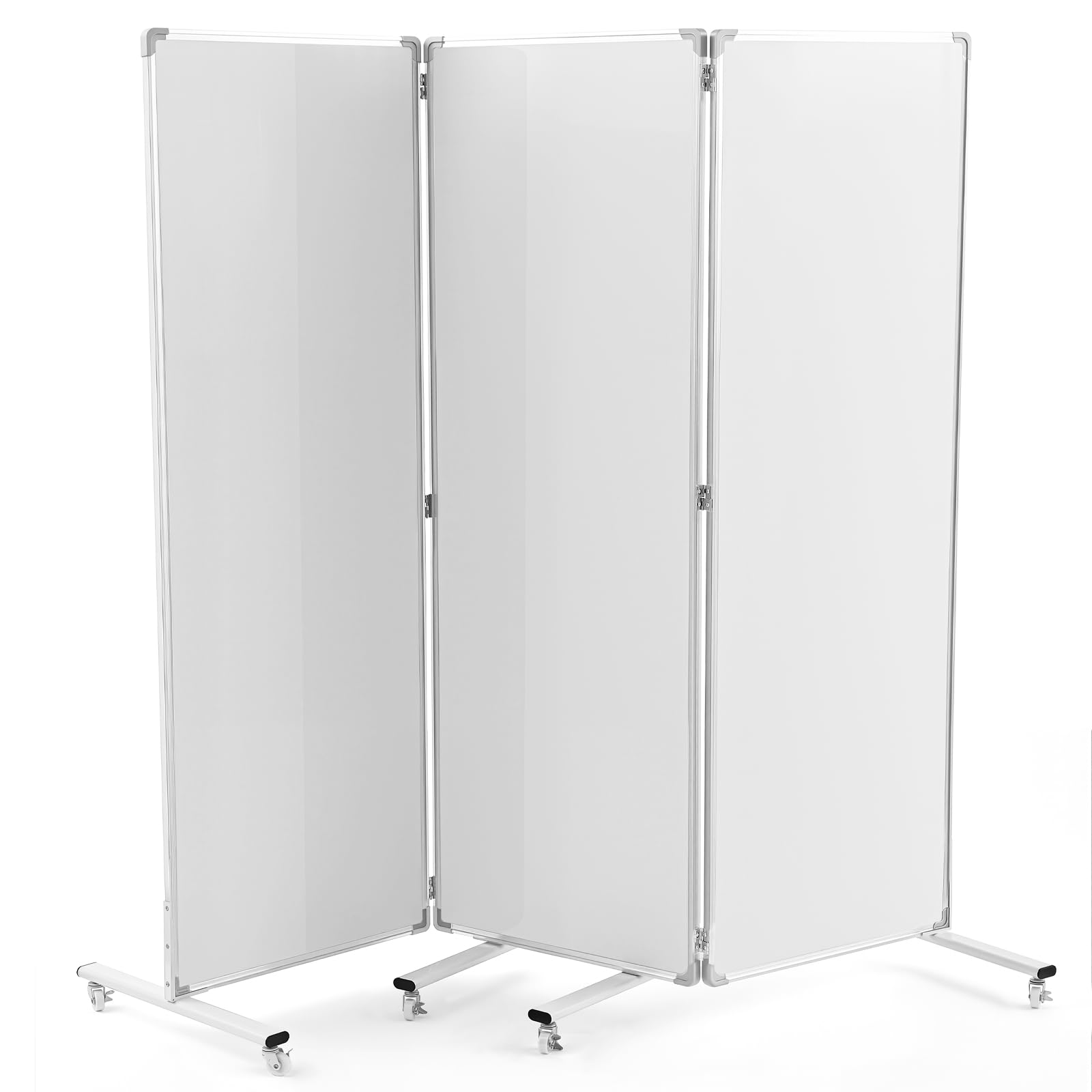
#8. Whiteboard Divider Screen — Privacy That Also Keeps You Organized
A folding screen with a whiteboard or chalkboard surface on one or both sides works as a privacy divider and a functional study tool at the same time. Write your class schedule, to-do list, or study notes on the surface that faces your desk, and your roommate sees a clean panel on their side. It’s a practical choice for the space between two desk areas.
Why It Matters: It earns its floor space by doing two jobs at once. In a dorm where every square foot matters, items that only divide and do nothing else are harder to justify — this one pulls double duty without any extra footprint.
What to Look For
- Surface type — dry-erase whiteboard is easiest to clean; chalkboard is messier but has a different look
- Panel count and total width to cover your target area
- Panel height that blocks the key sightline from your desk chair
- Whether both sides or just one side has a writable surface
Practical Tip
Use the panel’s public-facing side to post a shared weekly schedule with your roommate — it reduces scheduling conflicts and is friendlier than a digital calendar pasted to the wall.
Furniture-as-Divider — Storage and Separation in One Footprint
These ideas use pieces of furniture you’d likely bring to a dorm anyway. Positioning them strategically between two zones does the dividing work without adding a dedicated separate item to a room that’s already tight on space.

#9. Tall Bookshelf Divider — Storage You Can Stand Between You and Your Roommate
A tall, narrow bookshelf placed perpendicular to the wall — rather than against it — creates a physical barrier between the two sides of the room. Open shelving lets light pass through while still defining two distinct zones. Load it with books, plants, small bins, and framed photos, and it also absorbs some sound, which is an added benefit when one person is studying and the other is watching something.
Why It Matters: A filled bookshelf divider does more for noise separation than almost any fabric option. Books absorb and scatter sound in a way that curtains simply cannot match, making it the stronger choice if noise is as much of an issue as visual privacy.
What to Look For
- Height of at least 5 feet for meaningful visual separation when seated or lying down
- Freestanding stability — check that it won’t tip when loaded; some units require wall anchoring per the manufacturer, which may conflict with dorm rules
- Open shelving on both sides so both roommates can access it as shared storage if desired
- Narrow depth (12 to 15 inches) to preserve floor space in a tight room
Practical Tip
If you’re using a shelf unit that recommends wall anchoring for safety (many modular shelves do), confirm your dorm’s policy before purchasing. An unanchored tall unit can tip if bumped — load heavier items on lower shelves to lower the center of gravity.

#10. Cube Storage Organizer Divider — Low-Profile Zone Definition With Built-In Organization
A cube storage unit placed between two areas of the room marks out personal territories without the height of a full bookshelf. At around four cubes tall (roughly 56 inches), a vertical cube unit sits roughly at shoulder height when you’re seated — enough to break the sightline from one desk to another without fully dividing the room. Fill the cubes with fabric bins for contained storage on each side.
Why It Matters: Cube organizers are among the most versatile pieces of dorm furniture. Using one as a room divider means it’s already solving a storage problem — the division is essentially a free bonus from something you’d bring anyway.
What to Look For
- Configuration — a 2×4 or 1×4 (single column) arrangement works best as a vertical divider
- Shelf load rating per cube so it doesn’t bow with heavy items
- Freestanding stability — some require assembly bracing to stay upright
- Matching fabric bin inserts to hide what’s stored inside each cube
Practical Tip
Position the open side of each cube toward the person whose stuff goes inside it. This way the unit looks clean and finished from the opposite side while staying fully functional on yours.

#11. Clothes Rack Divider — Extra Closet Space That Doubles as a Boundary
A freestanding garment rack placed between the two sides of the room works as an overflow closet and a zone divider in one footprint. Hang clothes, add fabric bins on lower shelves, or drape a piece of fabric over the rack for more visual separation. It’s particularly useful when dorm closet space is too tight for everything you brought.
Why It Matters: This idea earns its spot because it solves two common dorm problems simultaneously — not enough closet space, and no visual separation from a roommate — without requiring any extra floor area beyond what the rack itself occupies.
What to Look For
- Rack height — taller racks cover more visual space when loaded with clothing
- Lower shelf or bottom bar for shoes or bins, which adds bulk and stability
- Wheel locks if the rack has casters — you don’t want it rolling unexpectedly
- Weight capacity relative to how many clothes you’ll hang from it
Practical Tip
Add a lightweight fabric panel or a curtain hung from the top bar with s-hooks to turn the rack into a more solid visual barrier when needed. Remove the panel quickly when you want to open the space back up.
Creative & Accent Dividers — Style-Forward Ideas That Do More Than Just Divide
These four ideas prioritize personality and ambiance alongside function. They work best for students who want the divider itself to be a design feature rather than something that just disappears into the background.

#12. Hanging Plant Wall Divider — A Living Boundary That Brightens the Room
A vertical arrangement of hanging planters, wall-mounted plant shelves, or a trellis with trailing plants creates a soft, natural boundary between two areas. The plants themselves soften the visual divide while adding color and texture. Even artificial trailing vines hung from Command hooks give the same visual effect without the upkeep of living plants — worth considering given how unpredictable dorm schedules can be.
Why It Matters: A plant divider works on multiple levels — it defines space, adds a natural focal point, and if you use real plants, some research suggests that greenery in study environments can support a calmer, more focused atmosphere.
What to Look For
- Low-maintenance plants if going real — pothos, snake plant, or ZZ plant handle inconsistent watering
- Command hook weight ratings for hanging planters — planters with soil and a pot can be heavier than they look
- Drip trays under any live pots to protect dorm floors
- Placement that won’t block a window your roommate relies on for natural light
Practical Tip
Faux trailing vines (available in long continuous strands) threaded through a tension rod or draped from Command hooks give the lush look of a plant wall without any watering, drainage, or move-out mess to deal with.

#13. Beaded Curtain Divider — A Retro Accent That Hangs in Seconds
Beaded curtains — strands of beads, shells, bamboo, or fabric knots hung vertically from a rod or hook — create a semi-transparent boundary with a distinct visual style. They part easily when you walk through and close back on their own. They’re lightweight, take only minutes to hang, and add character to a space that might otherwise feel plain and institutional.
Why It Matters: This works best as a soft psychological boundary rather than a true privacy screen. It signals “this is my side” without fully blocking anything — which is ideal if you and your roommate are generally comfortable around each other but still want individual spaces defined.
What to Look For
- String count — more strings per panel means denser coverage
- Material — bamboo and wood beads are quieter than acrylic plastic when disturbed
- Strand length to reach from your hanging point to the floor
- Top attachment style — many panels have a simple rod loop or wooden header that hangs directly from a tension rod
Practical Tip
Bamboo and wooden bead curtains make a soft clicking sound when touched — pleasant for some, distracting for others. If you’re a light sleeper or your study sessions require quiet, test whether the sound works for your situation before committing to this option.

#14. String Lights Canopy Divider — Warm Ambiance That Also Zones the Space
Draping strands of fairy lights from Command hooks across the ceiling — either in a curtain formation or as a canopy over a bed area — creates a warm, glowing boundary that does psychological zoning without any physical barrier. Combined with a light sheer curtain panel on the same hooks, it becomes a genuinely cozy cocoon around a sleeping or study zone while still looking intentional and styled.
Why It Matters: The harsh overhead fluorescent lighting in most dorms is notoriously difficult to live with. A string light canopy gives you warm, controllable ambient light around your personal zone, which makes studying and unwinding in the same room a lot more manageable.
What to Look For
- USB or plug-in power — confirm your dorm outlet situation and strip capacity
- Warm white (2700–3000K) rather than cool white for a cozier effect
- Total strand length to cover your planned canopy area without visible extension cords
- Whether the lights get warm to the touch — LED fairy lights stay cool and are the safer dorm choice
Practical Tip
Check your dorm’s electrical policy before purchasing. Many dorms restrict certain types of decorative lighting or require UL-listed products specifically. LED string lights with a UL listing are the most widely permitted type.

#15. Pegboard Panel Divider — Functional Display That Marks Your Territory
A freestanding pegboard panel — a perforated board mounted in a frame with feet — works as a room divider, a desk organizer, and a display wall in one compact footprint. Hook in shelves, bins, hooks, and trays on your side to hold desk supplies, headphones, and accessories. The solid surface provides a clean visual stop between two work areas, and you can rearrange the hooks and accessories whenever your storage needs change.
Why It Matters: This earns a spot on the list because it tackles the clutter problem and the privacy problem at the same time. A desk area tends to be where dorm tension is highest — two people studying back-to-back with nowhere to put anything. The pegboard creates a buffer zone and solves the storage problem on both sides of it.
What to Look For
- Freestanding frame rather than a wall-mount version (dorm-safe)
- Panel height that provides sightline separation at desk height
- Included hook and accessory starter kit — otherwise budget extra for these
- Panel material — metal pegboards are more durable; wood MDF is lighter but less stable under heavy hooks
Practical Tip
Start with fewer hooks than you think you need and add more as you identify what actually needs a home. Overloading a freestanding pegboard shifts its center of gravity and makes it more likely to tip when you unhook an item.
How to Choose the Right Dorm Room Divider for Your Situation
Not every idea on this list fits every dorm setup. Your room layout, your relationship with your roommate, and what you actually need from a divider all point to different answers.
- If your biggest issue is light when sleeping — Start with a blackout curtain panel divider (#3) hung on a tension rod (#1). This combination is the most direct solution and costs less than $60 for both.
- If you want something decorative that won’t overwhelm a small room — The macramé hanging divider (#4), tapestry (#5), or string lights canopy (#14) keep the space feeling open while still defining your zone.
- If noise is as much of an issue as visual privacy — A tall bookshelf (#9) filled with books is the most effective fabric-free option for absorbing sound. Heavy curtain panels are a secondary option.
- If you need flexibility — sometimes open, sometimes closed — A folding screen (#6) or tension rod curtain (#1) that slides open are your best options. Both can shift in seconds without relocating anything else.
- If floor space is extremely tight — Focus on hanging options only: the tension rod (#1), ceiling track (#2), tapestry (#5), or macramé (#4) all take zero floor space. Avoid freestanding furniture dividers if the room is very small.
- If your dorm restricts ceiling hooks and wall adhesives — Stick to freestanding options: the folding screen (#6), bookshelf (#9), cube storage (#10), clothes rack (#11), or pegboard panel (#15).
Common Mistakes to Avoid When Setting Up a Dorm Room Divider
A few straightforward missteps can turn a good divider idea into a frustrating purchase. Here are the ones worth avoiding before you spend anything.
Not measuring before buying — A tension rod ordered for a 120-inch span won’t work in a 64-inch opening. Measure the exact wall-to-wall or ceiling-drop distance before purchasing anything.
Skipping the dorm policy check — Ceiling hooks, adhesive tracks, and decorative lights all fall under rules that vary by institution and even by building. A divider that violates your dorm policy could result in a fine or required removal during an inspection.
Choosing a divider based on looks alone — A beautiful macramé panel won’t help much if your main problem is your roommate’s 2 a.m. lamp. Match the solution to the actual problem first, then consider aesthetics.
Setting up a tall freestanding unit without considering stability — Tall bookshelves and cube storage units can tip when loaded unevenly or bumped in a small, active space. Keep heavier items on lower shelves and confirm whether your unit needs anchoring before using it in a dorm context.
Not involving your roommate in the decision — A divider that blocks your roommate’s natural light, reduces their accessible storage, or encroaches on their side of the room can create more friction than the privacy is worth. A quick conversation before setup prevents most of this.
How We Selected These Dorm Room Divider Ideas
Every idea on this list was evaluated against the same practical criteria before being included.
- Dorm-rule compatibility — We prioritized ideas that can be implemented without drilling, permanent wall damage, or tools, since most dorms prohibit these. Where an idea does require wall or ceiling attachment, that’s noted clearly.
- Real problem solved — Each item addresses a specific, genuine dorm-life issue: light when sleeping, noise, lack of visual boundary, absence of defined personal space, or inadequate storage.
- Genuine distinctness — No two items on the list do the same job in the same way. A blackout curtain and a macramé panel both hang from a rod, but they solve different problems for different situations — they’re not interchangeable.
- Practical space and budget fit — Dorm rooms are small and student budgets are limited. Ideas that require significant floor footprint, major furniture investment, or complex installation were deprioritized in favor of options that are accessible and reversible.
- Coverage across different needs and aesthetics — The list spans minimalist, boho, practical, and decorative preferences so that different students with different roommate dynamics find something that works for them.
Frequently Asked Questions
Q: Can I put a room divider in a dorm without damaging walls?
A: Yes — most of the ideas on this list are designed specifically for that constraint. Tension rods use friction and require no holes. Freestanding folding screens, bookshelves, cube organizers, and clothes racks need no wall or ceiling attachment at all. For hanging options that do use the ceiling, removable adhesive hooks can work in some dorms, but confirm with your RA before installing.
Q: What is the most effective dorm room divider for blocking light at night?
A: A blackout curtain panel hung from a tension rod is the most direct solution. Look for panels specifically labeled “blackout” rather than “room darkening” — the two terms indicate different levels of light blocking. For bunk beds, hanging a blackout panel along the bed rails around your sleeping level can create a nearly full blackout enclosure without any wall attachment.
Q: How do I divide a dorm room without making it feel smaller?
A: Use dividers that allow light to pass through or that are visually lightweight. Macramé panels, sheer curtains, lattice panels, and open bookshelves all create a boundary without fully blocking light or making either side feel boxed in. Hanging dividers from ceiling height also helps — the vertical line makes the room feel taller rather than cramped.
Q: Do dorms allow tension rods for curtain dividers?
A: Tension rods are generally dorm-friendly because they don’t require drilling or wall damage — they hold in place through pressure between two walls. That said, dorm policies vary, so it’s always worth confirming with your specific residence hall. Most RAs have no issue with tension rods as long as they don’t damage walls, ceilings, or window frames.
Q: What should I do if my roommate doesn’t want a divider?
A: Start with a freestanding or hanging option that only affects your side of the room — a folding screen positioned to face your sleeping area, or curtains hung only over your bed zone. Smaller, less visually dominant dividers like a macramé panel or a lattice screen are also easier for roommates to accept than a full floor-to-ceiling curtain partition. A conversation about what privacy each person actually needs often reveals a compromise that works for both sides.
Q: What dorm room divider helps most with noise reduction?
A: A tall bookshelf filled with books provides more meaningful sound absorption than most fabric or freestanding screen options. Heavy velvet or blackout curtain panels also reduce some noise compared to sheer or lightweight fabrics. Lightweight options like macramé, beaded curtains, and lattice panels offer very little acoustic benefit. For serious noise sensitivity, pairing a bookshelf divider with white noise or earplugs is more effective than any divider alone.
Q: Can a dorm room divider help with video calls and studying?
A: Yes — a divider creates a visual background behind you during video calls so your roommate’s side of the room doesn’t appear on screen. A blackout curtain or solid folding screen works best for this since they provide a clean, opaque backdrop. Even a tapestry or macramé panel immediately improves a video call background compared to an undecorated shared room wall.
Final Thoughts
Sharing a dorm room is manageable — and even comfortable — when both roommates have a defined personal zone. You don’t need to divide the room perfectly or invest in an elaborate setup to make a real difference. A tension rod and a blackout curtain panel can solve the most immediate problems in an afternoon. From there, you can layer in more character with a macramé panel, a bookshelf, or a lattice screen as the semester goes on.
Choose based on your actual situation first: what bothers you most, what your roommate can live with, and what your dorm rules actually allow. The best divider isn’t the most impressive-looking one — it’s the one that quietly gives you back your sense of personal space.
Start with the essentials that solve your biggest day-to-day problem, then build from there. Save this list so you can come back as your needs change.

I’m a home decor enthusiast who loves discovering beautiful room ideas, creative DIY projects, and Pinterest-worthy decorating inspiration. At DecorMinty, I share simple tips, fresh trends, and practical ideas to help you create a home you’ll truly love—one room at a time.