How to Relieve a Stiff Neck at Home Safely
Quick Answer
For a typical stiff neck caused by sleeping awkwardly, prolonged screen use, posture, or mild muscle strain, try gentle neck movement, heat or cold, short activity breaks, and better head-and-shoulder positioning. Avoid forcing painful stretches. Seek prompt medical care if stiffness follows a significant injury or occurs with fever, confusion, severe headache, weakness, numbness, or difficulty walking.
Waking up unable to turn your head comfortably can make ordinary tasks surprisingly difficult. Most uncomplicated neck stiffness is temporary and improves with conservative care, especially when it comes from muscle tension, an awkward sleeping position, or spending too long with your head held in one position.
The goal at home is not to force the neck back to normal immediately. Instead, reduce irritation, keep it moving within a comfortable range, and avoid the habits that may be keeping the muscles tense.


Start With Gentle Movement, Not Complete Rest
Keep your neck moving gently unless an injury or healthcare professional gives you a reason not to. Staying completely still for long periods can make stiffness feel worse, while slow movement helps maintain a comfortable range of motion.
Begin with movements that feel easy rather than trying to stretch as far as possible.
- Slowly turn your head toward the left, then toward the right.
- Gently tilt one ear toward the same-side shoulder, then switch sides.
- Bring your chin slightly downward, then return to a neutral position.
- Roll your shoulders backward several times to release upper-back tension.
Move only through the range that feels comfortable. Mild tightness may be expected, but sharp, shooting, or rapidly increasing pain is a reason to stop.
The NHS guidance on neck pain and stiffness also recommends keeping the neck moving rather than routinely using a neck collar.
Tip
A warm shower before gentle movement may make tight muscles feel easier to move. The aim is comfortable motion—not an aggressive stretch.
Should You Use Heat or Cold?
 Save
Both can be useful, but the better choice depends partly on how the stiffness started.
Cold is often more useful immediately after a new strain or minor injury when soreness and swelling are prominent. Wrap the cold pack in a thin towel rather than putting ice directly on your skin.
Heat often feels better for muscle tightness and stiffness. A warm shower, warm compress, or heating pad on a low setting can help tense muscles relax.
Mayo Clinic recommends cold during the first 48 hours for many cases of neck pain, followed by heat, while recognizing that simple self-care is usually enough for mild to moderate symptoms. You can review its neck pain treatment guidance for additional detail.
Whichever method you use, protect your skin and avoid falling asleep with an ice pack or heating pad in place.
Fix the Position That May Be Keeping Your Neck Tight
Home remedies are less useful if the same posture keeps irritating the area throughout the day.
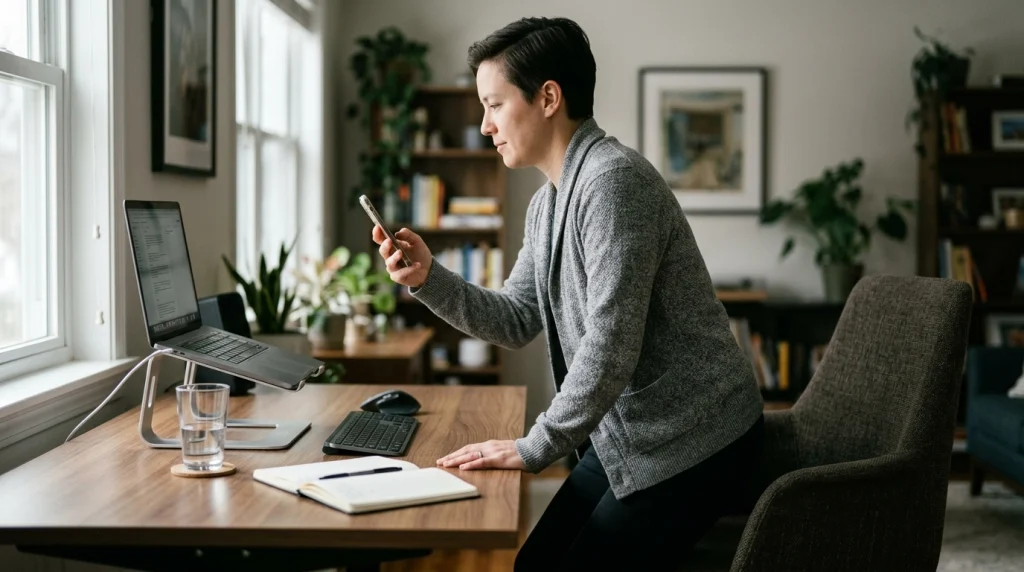
If you spend hours at a computer, try to keep your screen near eye level rather than repeatedly looking downward. Sit with your back supported and let your shoulders rest rather than pulling them upward.
Phone use deserves attention too. Holding a phone low encourages the head to tilt forward for long periods. Bringing the device closer to eye level reduces how far the neck has to bend.
Take regular movement breaks rather than trying to maintain one “perfect” posture for hours. Even a good sitting position can become uncomfortable when you stay in it too long.
What about your sleeping position?
Your head should ideally stay reasonably aligned with the rest of your body instead of being pushed sharply upward, downward, or to one side.
If you regularly wake up with stiffness, examine whether your pillow is forcing your neck into an awkward angle. A pillow does not need to be unusually thick or specialized to be helpful; what matters most is whether it supports a comfortable, neutral position for the way you sleep.
Sleeping on your stomach can require the neck to remain rotated for a long time, which may aggravate stiffness in some people.
Can Over-the-Counter Pain Relief Help?
For some adults, over-the-counter medicines such as acetaminophen or nonsteroidal anti-inflammatory drugs may temporarily reduce neck discomfort. They are not appropriate for everyone, however.
NSAIDs such as ibuprofen can interact with other medicines and may be unsuitable for people with certain stomach, kidney, heart, bleeding, pregnancy, or allergy-related concerns. Acetaminophen also has dose limits and can be harmful when too much is taken.
Follow the product label and consider asking a pharmacist or healthcare professional if you are unsure whether a medicine is safe for you. Do not combine products simply because the neck still feels stiff; different medicines can contain overlapping ingredients.
What Should You Avoid While Your Neck Is Stiff?
A few common reactions can make a minor problem more uncomfortable.
- Do not force the neck through pain. More stretching is not automatically better.
- Avoid sudden jerking or twisting. Keep movement smooth and controlled.
- Do not stay completely immobile all day. Gentle everyday movement is usually more helpful for uncomplicated stiffness.
- Avoid activities you cannot perform safely. If you cannot turn your head enough to check traffic, driving or cycling may be unsafe.
- Do not routinely wear a neck collar without medical advice. Prolonged restriction can reduce normal movement and muscle activity.
Key Insight
The useful middle ground is gentle activity without aggressive movement: do not force a painful neck, but do not automatically immobilize an uncomplicated stiff neck either.
How Long Should a Stiff Neck Take to Improve?
A simple stiff neck caused by muscle tension, posture, or sleeping position often begins improving within several days. Mild to moderate neck pain commonly responds to conservative self-care, although recovery time varies with the cause.
Pay attention to the direction of change rather than expecting an exact deadline. Gradually easier movement and decreasing discomfort are encouraging. Pain that is becoming more intense, spreading, or developing additional symptoms deserves more attention.
If stiffness does not improve after several days of sensible home care, keeps returning, or remains troublesome for weeks, a healthcare professional can evaluate whether another cause is involved and whether physical therapy or another treatment would be useful.
When a Stiff Neck Needs Medical Attention
Most everyday neck stiffness is not an emergency, but some combinations of symptoms should not be treated as an ordinary muscle problem.
Warning
Seek urgent medical evaluation for severe neck stiffness with fever, confusion, unusual sleepiness, severe headache, vomiting, marked light sensitivity, new weakness, difficulty walking, or after a significant accident, fall, or other traumatic injury.
A stiff neck accompanied by fever and neurological or systemic symptoms can occasionally occur with serious infection such as meningitis. New weakness, numbness, tingling, pain traveling into an arm or leg, or difficulty with balance can also point to nerve or spinal involvement that needs assessment.
Contact a healthcare professional if the pain is severe, keeps worsening despite self-care, repeatedly returns, or does not improve as expected.
How to Reduce the Chance of Another Stiff Neck
 Save
Once the immediate stiffness settles, prevention is mostly about reducing long periods of strain rather than finding one perfect exercise or pillow.
- Position computer screens so you do not constantly look downward.
- Take frequent movement breaks during desk work or long trips.
- Hold phones and tablets higher when practical.
- Keep your shoulders relaxed instead of repeatedly shrugging them toward your ears.
- Use a sleeping setup that keeps your head reasonably aligned with your body.
- Stay generally active so the neck and upper back are not spending most of the day in one position.
If a specific activity repeatedly triggers the same stiffness, look at how long you perform it, your head position, and whether you can change the setup rather than simply treating the symptoms afterward.
Frequently Asked Questions
1. Is heat or ice better for a stiff neck?
Cold can be useful soon after a new strain or injury, while heat often feels better for tight muscles. If there was no obvious injury and the main problem is muscle stiffness, a warm shower or low-temperature heating pad may be more comfortable.
2. Should I stretch a stiff neck?
Gentle range-of-motion exercises can help uncomplicated stiffness. Move slowly and stop before sharp or increasing pain. Do not force your neck to reach its usual range immediately.
3. Can sleeping wrong cause a stiff neck?
Yes. Sleeping with the head held at an awkward angle for several hours can strain muscles and cause temporary stiffness, especially if the pillow does not suit your sleeping position.
4. Is massage good for a stiff neck?
Gentle massage may help some people with muscular tightness. Avoid forceful pressure on a recently injured or severely painful neck, and stop if massage causes shooting pain, numbness, dizziness, or worsening symptoms.
5. Why does my neck get stiff after using a computer?
Holding your head in one position for a long time can fatigue and tighten neck and shoulder muscles. Screen height, sitting position, and lack of movement breaks can all contribute.
6. When should I worry about a stiff neck?
Seek medical attention for stiffness associated with serious injury, fever, severe headache, confusion, unusual sleepiness, weakness, difficulty walking, persistent numbness or tingling, or symptoms that continue worsening instead of improving.
Conclusion
A routine stiff neck often improves with gentle movement, heat or cold, posture adjustments, and time. Keep activity comfortable rather than forcing the neck through pain, and address the position or habit that may have triggered the stiffness. If symptoms are severe, follow an injury, keep worsening, or appear with neurological symptoms, fever, or other warning signs, get medical care instead of relying only on home treatment.

I’m a home decor enthusiast who loves discovering beautiful room ideas, creative DIY projects, and Pinterest-worthy decorating inspiration. At DecorMinty, I share simple tips, fresh trends, and practical ideas to help you create a home you’ll truly love—one room at a time.