Best Sleeping Position for Neck Pain: Sleep Better Tonight
Quick Answer
For most people with neck pain, sleeping on the back or side is better than sleeping on the stomach. The goal is to keep your head, neck, and upper spine in a neutral line, with a pillow that supports rather than bends your neck. If your pillow is part of the problem, see this guide to choosing a neck pillow for neck pain.
Best positions to try
- Back sleeping: Often makes it easiest to keep your head centered and your neck symmetrical.
- Side sleeping: Can work well when the pillow fills the gap between your shoulder and head.
- Stomach sleeping: Usually puts the most rotational stress on an already sore neck.
- Pillow height: Your head should not tip noticeably toward the ceiling, mattress, or shoulder.
- Morning check: Repeatedly waking stiffer than you went to bed suggests your sleep setup deserves attention.
One important reminder
- Persistent pain, weakness, numbness, or pain after an injury deserves medical evaluation rather than repeated pillow experiments.
Neck pain can turn something as ordinary as bedtime into a nightly positioning experiment. I focus less on finding one “perfect” pose and more on whether the neck stays comfortably aligned for several hours.
As of 2026, that neutral-alignment approach remains more useful than declaring one sleep position best for everyone. Your shoulder width, mattress, pillow height, symptoms, and preferred position all affect the result.


What is the healthiest sleeping position for your neck?
 Save
SaveThe healthiest position is usually one that keeps your head centered over your shoulders without forcing the neck to bend or twist. For many adults, that means sleeping on the back or properly supported side.
Neutral neck alignment means your cervical spine, or the neck portion of your spine, stays close to its natural resting position. Your head should not be pushed sharply forward, dropped backward, or tilted sideways.
Why back sleeping often works well
Back sleeping gives both sides of your neck a relatively symmetrical position. It also removes the large shoulder-to-mattress gap that side sleepers must compensate for with pillow height.
The Mayo Clinic’s neck-pain guidance recommends keeping the head and neck aligned with the body while sleeping. It also suggests neck support rather than letting the head sit at an awkward angle.
- Use moderate support: A pillow should support the neck without forcing your chin toward your chest.
- Keep your head centered: Avoid spending hours with your face rotated strongly to one side.
- Check your chin: If your chin points noticeably toward your chest, the pillow may be too thick.
- Support the rest of your spine: Some back sleepers feel more comfortable with a pillow beneath their knees.
Side sleeping can also be neck-friendly
Side sleeping is not automatically worse for your neck. The key is using enough pillow height to fill the space created by your shoulder.
A useful next step is comparing neck pillows for different sleeping positions. The correct shape for a side sleeper can be quite different from one that suits a back sleeper.
| Position | Neck goal | Pillow setup | Common mistake |
|---|---|---|---|
| Back | Head centered with the natural neck curve supported | Low-to-moderate loft with cervical support | Stacking thick pillows and pushing the head forward |
| Side | Nose and chest facing forward with the neck level | Enough loft to fill the shoulder-to-head gap | Letting the head sag toward the mattress |
| Stomach | Minimize forced rotation and extension | Very thin pillow if this position cannot be avoided | Using a thick pillow while the head remains turned |
What sleeping position is best for neck pain?
Start with back sleeping if it feels comfortable, then try side sleeping with carefully matched pillow height. Neither position should increase your symptoms simply because someone labels it the “best” position.
Cleveland Clinic also emphasizes neutral posture for back and neck discomfort. Its sleep-position guidance for pain focuses on keeping the head, shoulders, and hips aligned rather than forcing the body into an uncomfortable pose.
Try your back first
When I evaluate a sleep setup, I first look at whether a back sleeper’s pillow supports the neck curve without lifting the entire head too far. A huge mound of foam can defeat the purpose of choosing a supposedly orthopedic pillow.
- Too high: Your chin moves toward your chest.
- Too low: Your head may fall backward and leave the neck unsupported.
- Uneven: Your head repeatedly rolls toward one side.
- Better fit: Your face points comfortably upward while the neck feels supported rather than stretched.
For side sleeping, match loft to your shoulder
A side sleeper normally needs more pillow height because the shoulder raises the head farther from the mattress. A broad-shouldered sleeper on a firm mattress may need noticeably more loft than a smaller person on a soft mattress.
Firmness matters too. My practical rule is that the pillow needs enough resistance to maintain its useful height through the night, not simply feel firm when you first lie down.
If you’re deciding between different support levels, compare a firm versus soft neck pillow before assuming firmer automatically means healthier.
Use a photo as a quick alignment check
One simple fit check I like is having someone take a photo while you lie in your normal side-sleeping position. Look at whether the center of your forehead, nose, chin, and breastbone remain reasonably aligned.
If your head drops sharply toward the mattress, you probably need more support. If it angles toward the ceiling, the pillow may be too tall.
What is the unhealthiest sleeping position?
For someone already dealing with neck pain, stomach sleeping is usually the position I would try hardest to change. Your head generally has to remain rotated to one side so you can breathe.
That rotation can persist for long stretches while the rest of your torso faces downward. A thick pillow can add another problem by extending the neck upward.
- Prolonged rotation: The face stays turned while the torso remains prone.
- Pillow extension: A thick pillow can lift the head above the upper spine.
- Asymmetry: Sleeping with the head turned the same way every night can load each side differently.
- Difficult correction: It is harder to create a truly neutral neck position while lying face-down.
That does not mean every stomach sleeper will develop neck pain. It means stomach sleeping gives you fewer easy ways to keep a sore cervical spine neutral.
What if you cannot stop stomach sleeping?
Don’t force yourself into an unfamiliar position so aggressively that you spend the whole night awake. Instead, reduce the amount of neck bending while you gradually experiment with side or back sleeping.
- Try a thinner head pillow rather than stacking pillows.
- Use a body pillow beside you to make a partial side position feel more natural.
- Notice whether you always rotate your head toward the same shoulder.
- Reassess if morning pain increases after a change.
A pillow marketed as “cervical” does not guarantee a good fit. Research summarized in a systematic review of pillow designs and neck symptoms found that pillow characteristics can affect pain and waking symptoms, while pillow height and shape remain important factors.
Which side is not safe to sleep on?
For ordinary mechanical neck pain, there is no universal rule that the left or right side is unsafe. The more useful question is whether one side increases pain, numbness, stiffness, or shoulder pressure.
Some people naturally tolerate one side better because of a sore shoulder, previous injury, mattress indentation, or differences in pillow fit. Let your symptoms guide the choice rather than an internet rule about left versus right.
Switch sides when one side clearly aggravates your neck
If lying on the right consistently makes your neck or shoulder worse, try the left and compare your morning symptoms. You can repeat the same experiment in reverse.
Keep the pillow setup identical when possible. Changing your pillow, mattress topper, and sleeping side at once makes it difficult to identify what helped.
- Compare mornings: Note pain and stiffness immediately after waking.
- Watch shoulder pressure: A painful shoulder can change how you hold your head.
- Keep your face forward: Avoid curling your chin tightly toward your chest.
- Check pillow collapse: A pillow that flattens overnight may stop supporting the neck.
Your mattress changes the pillow height you need
A soft mattress allows your shoulder to sink farther into the bed. That often reduces the amount of pillow loft needed for side sleeping.
A firm mattress keeps your shoulder higher. That can create a larger gap between your head and mattress.
This is why I prefer choosing the whole sleep setup together rather than shopping by a label alone. The detailed neck-pillow selection guide explains how position, height, firmness, and material work together.
What position should you never sleep in?
There is no single sleeping position that every adult must “never” use. However, if you have active neck pain, I would generally avoid spending the whole night on your stomach with your head strongly turned.
Comfort matters. A position that looks perfect on paper is not useful if you constantly wake up, brace your muscles, or roll into another position within minutes.
Avoid these position-and-pillow combinations
- Back plus stacked pillows: Several thick pillows can push the chin forward.
- Side plus low pillow: The head can sag toward the mattress.
- Side plus excessive loft: The head can bend toward the opposite shoulder.
- Stomach plus thick pillow: Rotation and upward neck extension can occur together.
- Arm under head: Your support height changes as your arm moves during sleep.
Don’t chase a perfect position all night
People move during sleep, so your goal is not to remain frozen in one textbook posture. Build a setup that supports the positions you naturally return to most often.
If you are mainly a combination sleeper, an adjustable-fill pillow can make more sense than an aggressive fixed contour. You can fine-tune the height instead of hoping a predetermined profile matches your body.
It’s also worth understanding when neck pillows actually work. Supportive design helps only when the shape and height suit how you sleep.
How do you know if you sleep on your neck wrong?
 Save
SaveA repeated pattern of waking with more neck discomfort than you had at bedtime is one of the clearest clues that your sleep position or pillow may be contributing. Morning stiffness alone does not prove the pillow caused your pain, but patterns matter.
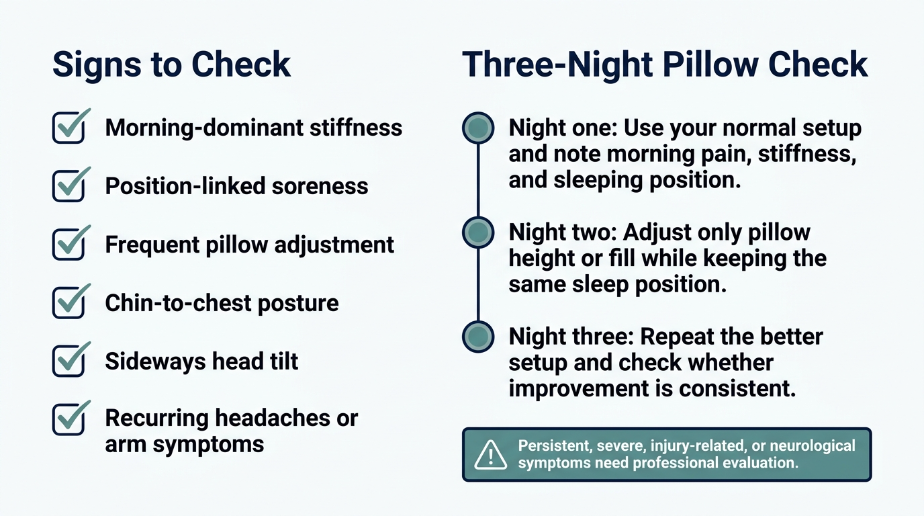
Signs your overnight setup deserves a closer look
- Morning-dominant stiffness: Your neck feels especially restricted immediately after waking.
- Position-linked soreness: One side becomes more painful after sleeping on that side.
- Frequent pillow adjustment: You repeatedly fold, stack, or push the pillow during the night.
- Chin-to-chest posture: Your head sits noticeably forward when you lie on your back.
- Sideways head tilt: Your head angles toward or away from the mattress while side sleeping.
- Recurring headaches or arm symptoms: These deserve more caution, especially when symptoms are new or persistent.
Run a simple three-night pillow check
I prefer changing one variable at a time. That produces more useful information than replacing the pillow, mattress topper, and sleep position together.
- Night one: Use your normal setup and note your morning pain, stiffness, and sleeping position.
- Night two: Adjust only pillow height or fill while keeping the same sleep position.
- Night three: Repeat the better setup and see whether the improvement is consistent.
If every position causes substantial pain, stop treating the issue as a pillow-shopping problem. Neck pain has many possible causes, and a sleep setup cannot diagnose or treat them all.
When should you get medical advice?
Seek professional evaluation when pain is persistent, severe, follows a significant injury, or comes with neurological symptoms. New weakness, persistent numbness, or pain traveling into an arm should not be dismissed as a bad pillow.
The goal of changing your sleep position is comfort and sensible support, not delaying care for a condition that needs assessment.
If you want to improve your setup rather than simply change positions, these are the two pillow styles I’d shortlist first:
🏆 BEST FIXED CONTOUR
TEMPUR-Neck™ Pillow
★★★★☆ 3.8/5
This firm contoured pillow comes in small, medium, and large profiles, with listed peak heights of about 3.5, 4, and 4.75 inches. I’d consider it for back or side sleepers who already know they prefer structured, fixed cervical support rather than a plush adjustable pillow.
🔧 BEST ADJUSTABLE
Coop Sleep Goods Original Adjustable Pillow
★★★★★ 4.7/5
Its cross-cut memory-foam and microfiber fill can be removed or added to change both loft and feel. I’d pick this style for a combination or side sleeper who needs to fine-tune pillow height rather than commit to one fixed contour.
Frequently Asked Questions
Is it better to sleep without a pillow if you have neck pain?
Not necessarily. Back and side sleepers usually need some support to keep the head and neck aligned with the torso. Removing the pillow completely may let a side sleeper’s head sag toward the mattress, while a back sleeper may lose useful support beneath the neck.
Should your shoulders be on the pillow when sleeping?
Usually, a standard bed pillow primarily supports the head and neck rather than the entire shoulder area. Side sleepers especially need the shoulder to interact naturally with the mattress while the pillow fills the space between the shoulder and head.
Can a pillow that is too high cause neck pain?
Yes, an excessively high pillow can hold the neck in a bent position for hours. Back sleepers may notice the chin pushed toward the chest, while side sleepers may see the head tilted upward away from the mattress.
How long should you try a new sleeping position?
Give a comfortable change several nights before judging it, unless it clearly worsens pain or creates new symptoms. Change one variable at a time so you can tell whether position, pillow height, firmness, or another part of your setup made the difference.
Can the wrong mattress contribute to neck pain?
It can influence your neck indirectly because mattress firmness changes how deeply your shoulders and torso sink. That changes the pillow height needed for neutral alignment, particularly for side sleepers.
My takeaway:
start with back or side sleeping, then adjust your pillow until your head stays naturally aligned with your chest and shoulders. Avoid forcing a painful position simply because it is supposed to be healthier.
If changing position and pillow height does not improve repeated morning pain, consider getting the underlying neck problem evaluated rather than continuing to buy different pillows.

I’m a home decor enthusiast who loves discovering beautiful room ideas, creative DIY projects, and Pinterest-worthy decorating inspiration. At DecorMinty, I share simple tips, fresh trends, and practical ideas to help you create a home you’ll truly love—one room at a time.