How Long Should You Use a Cervical Neck Pillow?
Quick Answer
You can use a well-fitted cervical neck pillow every night and for as long as it remains comfortable and supportive. There is no standard medical rule requiring you to stop after a certain number of days or weeks. Give a new pillow enough time to assess comfort, but do not push through sharp, worsening, or radiating pain simply because you think your neck must “adjust.”
A cervical pillow is different from a treatment that you take for a fixed number of days. Its main purpose is to support your head and neck while you sleep, so the useful question is not simply how many weeks you should use it. The better question is whether it keeps your neck in a comfortable position night after night.
That distinction matters because pillow height, shape, mattress firmness, shoulder width, and sleeping position can all change how a cervical pillow feels. A pillow that suits one sleeper for years may be uncomfortable for another person from the first night.


Can You Use a Cervical Pillow Every Night?
Yes. A cervical pillow designed for bed use can generally be used every night when it supports your neck comfortably without forcing your head forward, backward, or sideways.
There is no established rule saying that adults should use a cervical pillow for only a few weeks and then return to a conventional pillow. In clinical research, cervical and supportive pillows have been evaluated over periods of several weeks, while their everyday purpose is ongoing sleep support rather than a short treatment course.
The more useful test is how your neck responds. Your pillow should help fill the space between your head, neck, shoulders, and mattress while allowing a relatively neutral resting position. Harvard Health’s guidance on sleeping with neck pain similarly emphasizes proper neck support and warns against pillows that keep the neck excessively flexed.
If you are still deciding whether this type of pillow suits your needs, the guide to neck pillow benefits and risks explains where supportive pillows may help and where expectations should remain realistic.
How Long Should You Try a New Cervical Pillow?
A new cervical pillow deserves a reasonable trial when it feels unfamiliar but not harmful. However, there is no scientifically established adjustment period that applies to everyone.
Studies examining cervical or ergonomic pillows commonly assess outcomes after several weeks. For example, one randomized study of adults with chronic biomechanical neck pain evaluated a cervical pillow over four consecutive weeks. That tells us that meaningful pillow assessment can involve more than one or two nights, but it does not prove that everyone must tolerate discomfort for four weeks.
Key Insight
“Adjustment” should mean becoming accustomed to a different shape or support level. It should not mean enduring steadily increasing pain, numbness, tingling, or an obviously awkward neck position.
During the first several nights, pay attention to patterns rather than judging the pillow from a few minutes of lying on it. Notice how you feel after a full night and how your symptoms behave across several mornings.
- Reasonable to continue: the contour feels unusual, but your neck remains comfortable and morning stiffness is mild or improving.
- Reassess the fit: you repeatedly wake with more stiffness than before, your chin is pushed toward your chest, or your head feels tilted to one side.
- Stop and seek appropriate evaluation: you develop significant new numbness, weakness, radiating arm pain, severe headaches, or symptoms following an injury.
If you want to separate normal pillow support from a poor fit, see the guide on whether a pillow can cause neck pain or headaches.
The Right Duration Depends More on Fit Than Time
 Save
A pillow does not become suitable merely because you have used it long enough. If its height is wrong for your body and sleeping position, another week of use may simply mean another week with your neck in an uncomfortable position.
Research supports paying attention to these physical characteristics. A systematic review and meta-analysis of pillow studies found that pillow design can affect neck-related outcomes and that shape and height may influence cervical alignment. The findings do not identify one universally ideal cervical pillow for every sleeper.
You can review the underlying systematic review indexed by PubMed for the research on pillow design, neck pain, waking symptoms, disability, sleep quality, and alignment.
Back sleepers
A back sleeper usually needs enough support beneath the neck to maintain its natural curve without placing so much material behind the head that the chin is forced downward toward the chest.
If you wake feeling as though your head has been pushed forward all night, the cervical ridge or overall pillow height may be excessive.
Side sleepers
A side sleeper generally needs the pillow to fill the distance between the side of the head and the mattress created by the shoulder. Too little height can let the head drop toward the mattress, while too much can tilt it in the opposite direction.
Because body proportions matter, two side sleepers may need noticeably different pillow heights even if they use the same mattress.
Stomach sleepers
Stomach sleeping already requires substantial neck rotation. A thick contoured cervical pillow may add unwanted extension or bending, so the type of pillow designed for a back or side sleeper may not translate well to this position.
For a broader position-by-position explanation, see choosing a neck pillow by sleeping position.
How Do You Know Whether to Keep Using It?
Judge the pillow by repeatable morning and nighttime patterns rather than by the word “cervical” on the label.
A pillow is more likely to be working for you when you can settle into your usual position without feeling that the contour is forcing your neck somewhere unnatural. You should also be able to change position when necessary instead of feeling trapped in a deep cradle.
Over several nights, check:
- whether you wake with less, the same, or more neck discomfort than before;
- whether stiffness settles quickly or continues through the day;
- whether you frequently move off the contour because it feels uncomfortable;
- whether your head feels level rather than noticeably tilted;
- whether the pillow remains supportive after your head compresses the material;
- whether headaches or shoulder discomfort appeared after changing pillows.
If your mornings are consistently better and the pillow remains comfortable, there is usually no reason to stop using it merely because a certain number of weeks have passed.
Tip
Evaluate a cervical pillow in the bed where you actually sleep. Mattress firmness changes how deeply your shoulders and body sink, which can change the pillow height your neck needs.
When Should You Stop Using a Cervical Pillow?
Stop or reassess the pillow when it repeatedly makes you feel worse rather than assuming discomfort proves that the pillow is correcting your posture.
Some morning unfamiliarity can occur after changing pillow shape, but persistent or progressively worsening symptoms deserve attention. In particular, do not rely on a pillow as the sole explanation or treatment for neurological symptoms.
- New or increasing numbness or tingling: especially when it extends into an arm or hand.
- Weakness: new weakness in an arm or hand should not be managed by simply trying another pillow height.
- Radiating pain: pain traveling from the neck into the shoulder or arm may require medical assessment.
- Severe or worsening pain: a pillow should not require you to endure escalating pain night after night.
- Pain after an injury: neck symptoms after a fall, collision, or other significant injury should not be treated as a pillow-fitting problem.
Harvard Health also recommends medical evaluation when neck pain occurs with symptoms such as radiating pain, weakness, or numbness.
Do You Eventually Need to Switch Back to a Regular Pillow?
No. You do not have to return to a conventional pillow simply because your neck feels better.
If the cervical pillow remains comfortable and supports your preferred sleeping position, it can continue functioning as your normal pillow. Likewise, there is no special benefit in remaining loyal to a cervical design if a different pillow gives you better support.
The label matters less than what happens to your position after your head settles into the pillow. A standard pillow with appropriate height may suit one person better than a strongly contoured pillow, while another person may find the contour much easier to sleep on.
If you are unsure what distinguishes the designs in the first place, this neck pillow guide explains cervical, travel, roll, and other common styles.
What If the Pillow Worked at First but Stops Feeling Supportive?
 Save
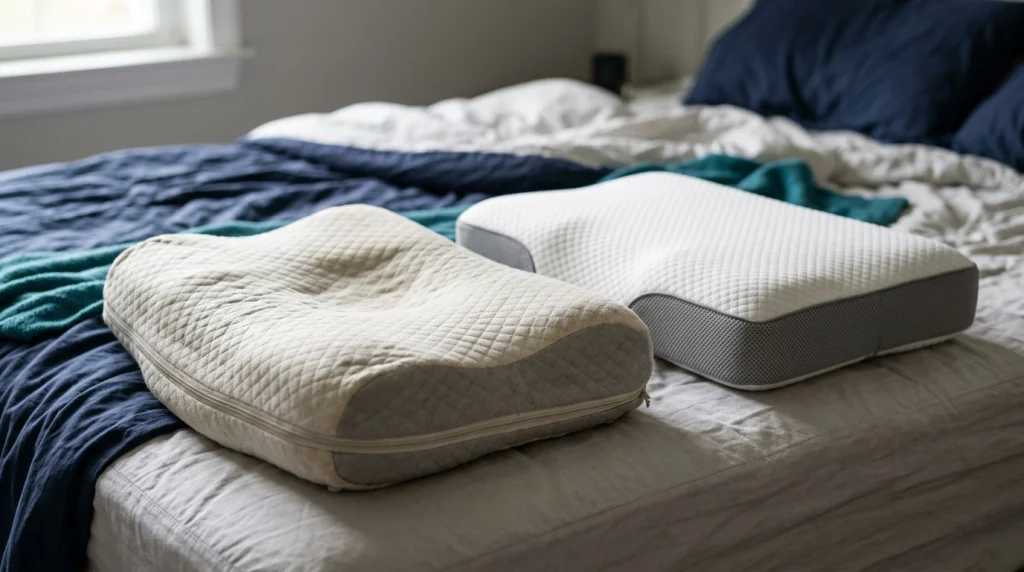
That can be a material problem rather than a sign that your neck no longer needs support.
Foam, fiber, latex, and other fills age differently. Once a cervical pillow permanently loses height or its neck contour collapses, the position that originally felt comfortable can change. At that point, continuing to use the same pillow indefinitely is not automatically better than replacing it.
Look for permanent flattening, uneven support, a contour that no longer rebounds, or a clear return of morning discomfort that coincides with deterioration of the pillow. The guide to how long neck pillows last covers replacement signs in more detail.
Frequently Asked Questions
Can I sleep on a cervical pillow all night?
Yes. A cervical pillow made for bed use is intended to support your head and neck while you sleep and can be used throughout the night when the height and contour suit you.
Should I use my cervical pillow only when my neck hurts?
Not necessarily. If the pillow is comfortable and provides suitable support, you can use it routinely rather than waiting for neck discomfort to appear.
Can a cervical pillow make neck pain worse?
Yes. A pillow that is too high, too low, too firm, or poorly matched to your sleeping position can hold the neck in an uncomfortable position and may worsen morning symptoms.
Is mild discomfort normal when changing pillows?
A different contour can feel unfamiliar initially. Mild, temporary stiffness is different from sharp, escalating, radiating, or neurological symptoms. Do not assume significant worsening is a necessary adjustment phase.
Can I alternate between a cervical pillow and a regular pillow?
Yes. There is no requirement that you use only one type. What matters is whether each setup supports your neck comfortably without leaving you repeatedly worse the next morning.
When should neck pain be evaluated instead of changing pillows?
Seek appropriate medical evaluation for persistent or severe pain, symptoms after significant injury, pain radiating into an arm, or new numbness, tingling, or weakness. A pillow can improve positioning, but it cannot determine or treat every cause of neck pain.
Conclusion
You do not need to stop using a cervical neck pillow after a fixed number of days or weeks. If it supports your neck comfortably, works with your sleeping position, and does not produce worsening symptoms, it can become your regular nightly pillow.
Use your morning comfort and neck position as the main guide. Give an unfamiliar but comfortable design a reasonable trial, but do not treat significant pain as something you must endure until your body adapts. If the pillow repeatedly worsens symptoms, reassess its height, shape, and firmness—or investigate whether the problem extends beyond the pillow itself.

I’m a home decor enthusiast who loves discovering beautiful room ideas, creative DIY projects, and Pinterest-worthy decorating inspiration. At DecorMinty, I share simple tips, fresh trends, and practical ideas to help you create a home you’ll truly love—one room at a time.