Can a Neck Pillow Help With Posture? What It Can and Can’t Do
Quick Answer
Yes, a neck pillow can help support better posture while you sleep, rest, or sit by keeping your head and neck closer to a neutral position. However, it does not permanently correct poor daytime posture. The pillow must also have the right height, shape, and support for your sleeping or sitting position; an unsuitable pillow can push your neck farther out of alignment.
A neck pillow can be useful when poor support lets your head tilt forward, backward, or sideways for long periods. Its main benefit is positional: it fills unsupported space so your neck does not have to remain bent or twisted while you rest.
That is different from changing the habits behind poor posture. If you spend hours leaning toward a laptop or looking down at a phone, a pillow used at night cannot erase those daytime positions. Think of it as a support tool rather than a posture treatment.


How Can a Neck Pillow Affect Your Posture?
A neck pillow can affect posture by changing the position of your head relative to your shoulders and upper spine. Ideally, the pillow supports the natural space around your neck without forcing your head noticeably forward, backward, or to one side.
This matters because your neck remains in roughly the same position for long periods while you sleep. A pillow that is too high may push your head forward or sideways. One that is too low may allow your head to drop toward the mattress.
The practical goal is not to create a perfectly straight or rigid neck. It is to keep your head, neck, and upper body comfortably aligned.
The Mayo Clinic’s neck-pain guidance recommends keeping the head and neck aligned with the body during sleep. That is essentially the job a well-fitted pillow should help accomplish.
Support is different from posture correction
A supportive pillow may improve your position while you are actually using it. It does not automatically retrain how you sit, stand, walk, work at a desk, or hold your phone.
Long-term posture is influenced by many factors, including workstation setup, movement habits, muscle strength and endurance, mobility, pain, sleep position, and how much time you spend in one posture.
Key Insight
A neck pillow can support a better position for several hours, but it cannot compensate for consistently poor posture during the rest of the day.
Can a Cervical Pillow Improve Forward Head Posture?
Possibly in some situations, but the evidence is not strong enough to treat a cervical pillow as a proven correction for forward head posture.
Forward head posture describes a position in which the head sits farther in front of the shoulders than expected. A cervical or contoured pillow may help prevent you from spending the entire night with your neck excessively flexed, especially if your old pillow is unusually thick.
There is some clinical evidence that pillow design can influence measured head and neck position. For example, research involving people with cervical spondylosis has reported changes in craniovertebral angle and neck muscle endurance after use of an ergonomic latex pillow. The researchers also cautioned that additional evidence was needed before broad recommendations could be made.
So the useful conclusion is modest: pillow design can affect neck positioning, but a pillow alone should not be expected to correct an established postural pattern.
What Kind of Neck Pillow Supports Better Alignment?
 Save
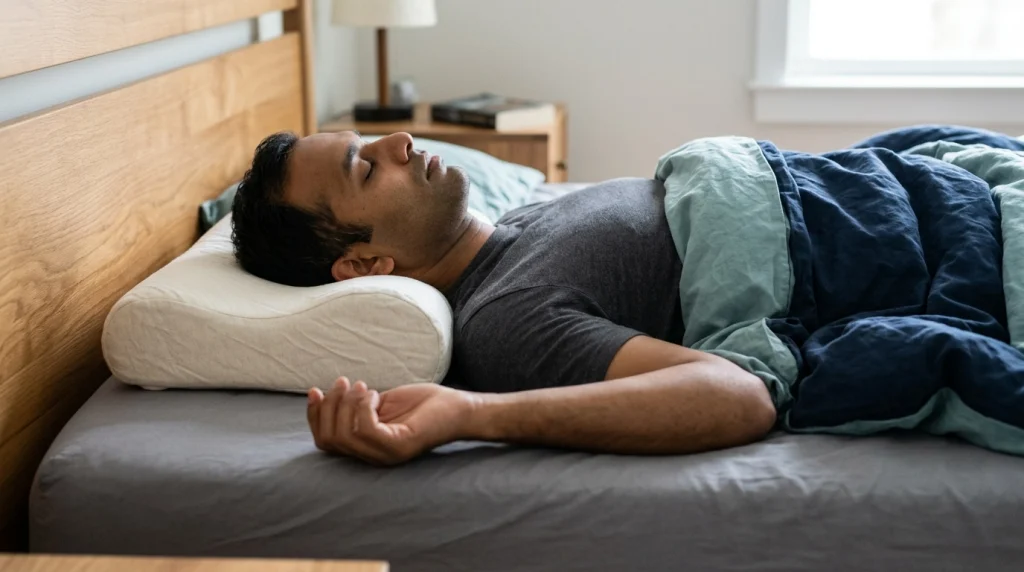
The best pillow is one that fills the gap between your head, neck, shoulder, and sleeping surface without creating a new bend. Shape matters, but pillow height is often just as important.
If you are unfamiliar with the different designs, this guide to what a neck pillow is explains the difference between travel pillows, cervical pillows, neck rolls, and contoured designs.
- Back sleepers: Usually need enough support beneath the neck without pushing the head sharply forward.
- Side sleepers: Usually need enough pillow height to fill the space created by the shoulder.
- Stomach sleepers: Often need a much thinner pillow because turning the head while lying face-down already rotates the neck.
- Upright travelers: Need support in the direction their head tends to fall once they relax.
Your mattress also affects the required pillow height. If your shoulder sinks deeply into a soft mattress, the space between your head and the mattress becomes smaller. On a firmer surface, that gap may be larger.
A simple alignment check
Lie in your normal sleeping position and let your muscles relax. Your head should not feel as though it is being pushed toward your chest, tipped toward the ceiling, or dropped noticeably toward one shoulder.
For side sleeping, imagine a line running through the center of your face, neck, and chest. A pillow that causes your head to lean markedly toward or away from the mattress is probably the wrong height.
For more practical positioning guidance, see how to use and wear a neck pillow correctly.
When Can a Neck Pillow Make Posture Worse?
A neck pillow can work against you when its shape or height forces your head into a position you would not naturally maintain.
- Too high: Can push the chin toward the chest when sleeping on your back.
- Too low: Can leave the neck unsupported or allow the head to drop.
- Too firm: May prevent the pillow from compressing enough for your body shape.
- Too soft: May collapse after you settle into it and provide little useful support.
- Wrong travel position: Thick padding behind the neck can push the head forward if the seat already has a prominent headrest.
Cleveland Clinic also advises choosing pillow support that keeps the neck from being bent significantly upward, downward, or sideways while sleeping.
Warning
Do not keep using a pillow that consistently causes increasing neck pain, numbness, tingling, weakness, dizziness, or pain that travels into an arm. Those symptoms may need medical evaluation rather than a different pillow adjustment.
Neck Pillow vs. Better Daytime Posture Habits
If your main goal is to improve everyday posture, daytime habits usually deserve more attention than the pillow itself.
A pillow can influence your position for the hours you spend sleeping or resting. Your workstation, phone position, chair, movement frequency, and muscle activity affect you throughout the day.
For example, Cleveland Clinic recommends keeping electronic devices positioned so you do not need to continually slouch or strain your neck. It also recommends regular movement for people who sit for long periods.
That creates a more useful strategy than relying on one product:
- Choose a pillow that keeps your neck comfortable and approximately neutral during sleep.
- Raise screens so you do not constantly look down.
- Avoid remaining in one sitting posture for hours at a time.
- Take regular movement breaks.
- Keep your shoulders relaxed rather than continuously rounded forward.
- Address persistent pain or neurological symptoms instead of trying to solve them with extra pillow support.
The pillow supports the nighttime part of the equation. Your daily habits handle the rest.
How to Tell Whether Your Neck Pillow Is Helping
You do not need a complicated measurement system. Pay attention to your resting position and what happens after repeated nights of use.
A pillow is more likely to be suitable when:
- your head feels supported rather than held up by muscle tension;
- your chin is not forced noticeably toward your chest;
- your head does not tilt strongly toward one shoulder;
- you can relax without continually repositioning the pillow;
- you are not regularly waking because the pillow feels uncomfortable;
- you do not develop new or worsening neck symptoms after switching pillows.
Do not judge only by how soft or comfortable the pillow feels during the first few minutes. A very plush pillow can feel pleasant initially but compress too far once you have been lying on it for an hour.
Try adjusting before replacing it
If the problem is small, changing the position or height may be enough. A removable insert, adjustable-fill pillow, or even a carefully positioned towel can change support without requiring another purchase.
If you want to experiment first, these neck pillow alternatives include simple options such as rolled towels and small pillows that can help you test how much support feels appropriate.
Should You Use a Neck Pillow Specifically to Fix Posture?
 Save
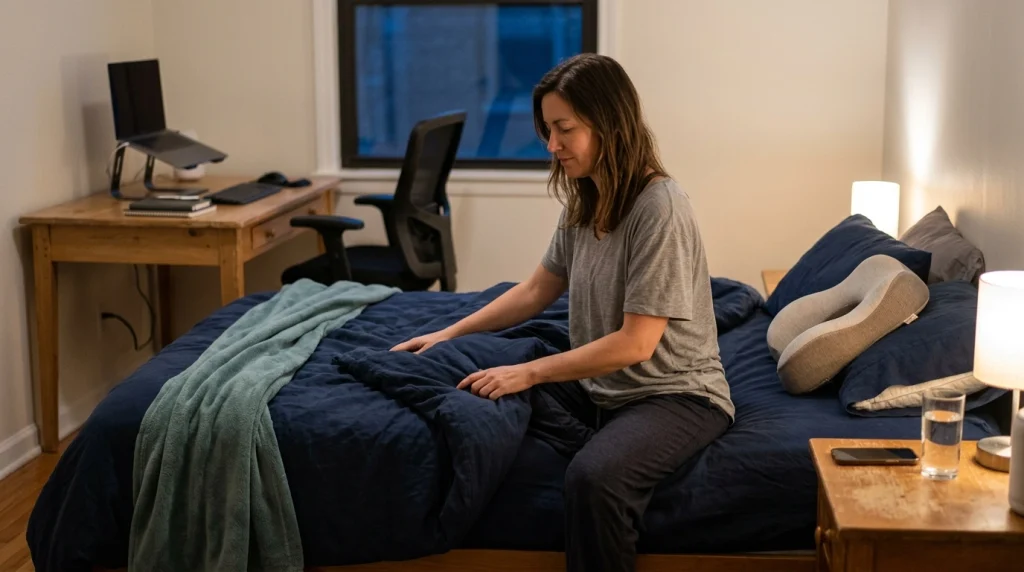
Use one to support comfortable alignment, not as your only posture-correction strategy.
A properly fitted neck pillow makes the most sense when your existing pillow leaves your head obviously tilted, pushes it too far forward, or fails to support your neck while you sleep. It can also help during travel if your head repeatedly drops to one side or toward your chest.
But if your concern is mostly rounded shoulders, prolonged desk slouching, or forward head position while using a computer or phone, changing your daytime setup and movement habits is likely to be more important.
The strongest approach is to combine suitable sleep support with better positioning and regular movement during the day.
Frequently Asked Questions
1. Can sleeping without a pillow improve posture?
Not necessarily. Sleeping without a pillow may work for some stomach sleepers, but back and side sleepers commonly need some support to keep the head and neck aligned. The correct pillow height depends on sleeping position, body shape, and mattress firmness.
2. Is a cervical pillow better than a regular pillow for posture?
A cervical pillow can provide more targeted neck support, but it is not automatically better. A regular pillow that has the right height and firmness can also maintain comfortable alignment. Fit matters more than the label.
3. Can a neck pillow fix forward head posture?
A neck pillow may reduce unnecessary neck bending while you sleep, but it should not be expected to permanently correct forward head posture. Daytime habits, movement, strength, workstation setup, and other factors also contribute.
4. How high should a pillow be for good neck alignment?
There is no single ideal height for everyone. The pillow should fill the space between your head and sleeping surface while keeping your head reasonably aligned with your neck and upper body. Side sleepers generally require more height than back sleepers.
5. Can a travel neck pillow help sitting posture?
It can help support your head while resting in a seat, particularly if your head tends to fall sideways or forward. It will not prevent slouching through your lower back or shoulders, so seat position and overall sitting posture still matter.
6. How long does it take to know whether a neck pillow is right for you?
You can often identify obvious fit problems immediately, such as excessive head tilt or pressure. Comfort over several nights gives a better picture. Stop or adjust the pillow if it repeatedly creates new pain, numbness, tingling, or worsening symptoms.
Conclusion
A neck pillow can help with posture by supporting a more comfortable head and neck position while you sleep, rest, or travel. The benefit depends mainly on fit: the pillow should support your neck without forcing your head into an exaggerated angle.
It should not be treated as a permanent fix for poor posture. Combine appropriate nighttime support with better screen positioning, regular movement, and comfortable daytime alignment for a more complete approach.

I’m a home decor enthusiast who loves discovering beautiful room ideas, creative DIY projects, and Pinterest-worthy decorating inspiration. At DecorMinty, I share simple tips, fresh trends, and practical ideas to help you create a home you’ll truly love—one room at a time.