How to Use and Wear a Neck Pillow Correctly
Quick Answer
To use a neck pillow correctly, place its support where your head naturally drops when you relax. A traditional U-shaped travel pillow usually sits around the neck, but rotating it can support your chin better if your head falls forward. Before buying another style, learn how to choose the right neck pillow for your sleeping or travel position.
Quick steps for wearing a travel neck pillow
- Relax first: Sit naturally and notice whether your head falls forward, sideways, or backward.
- Position the support: Put the thickest or firmest area where your head needs the most help.
- Check the gap: The pillow should contact your neck without forcing your chin sharply upward.
- Adjust the opening: Keep it forward for traditional side support, or rotate it if you need more chin support.
- Secure gently: Fasten any clasp, strap, or wrap firmly enough to stop shifting without squeezing your neck.
- Test your posture: Close your eyes and relax for a minute. Your head should remain comfortably supported instead of dropping.
I used to think a travel pillow had one obvious right way up. Then I noticed that the position that looked correct often stopped working the moment I actually relaxed in the seat.
The important part isn’t copying the picture on the packaging. It’s matching the pillow to the direction your head moves when your muscles relax.


What is the correct way to use a neck pillow?
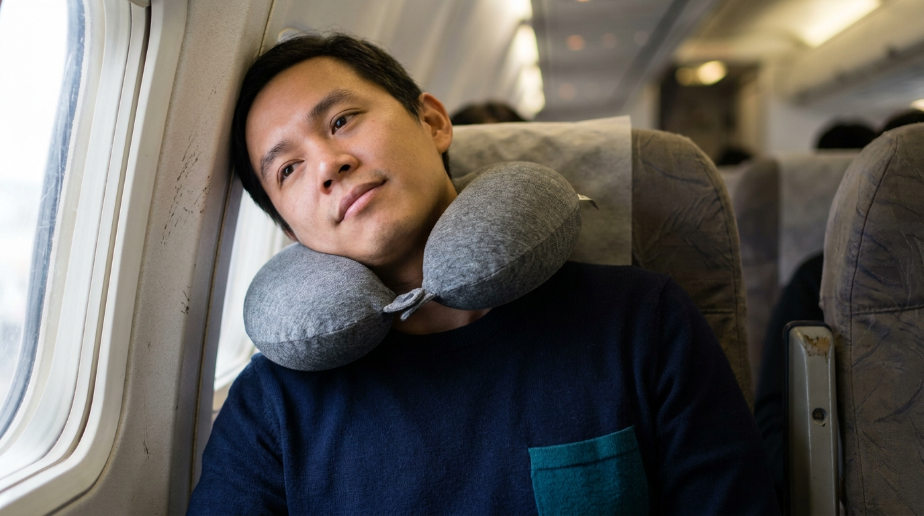 Save
SaveThe correct way to use a neck pillow is to let it support your head without pushing your neck out of a neutral, comfortable position. For travel, that usually means preventing sideways tilt or forward chin-drop.
A neck pillow is a support cushion designed to reduce unsupported movement of your head and neck while resting. Travel versions and bed-based cervical pillows solve that problem in different ways.
Use this five-point fit check
- Head position: Your head shouldn’t be pushed noticeably forward.
- Chin position: Your chin shouldn’t be forced hard toward your chest or ceiling.
- Side support: You should be able to relax without your ear dropping heavily toward your shoulder.
- Shoulder comfort: The pillow shouldn’t dig sharply into the tops of your shoulders.
- Breathing and swallowing: Nothing should feel restrictive around the front of your neck.
Neutral alignment matters because pillow height and shape can affect how the cervical spine sits during rest. A systematic review indexed by PubMed found that pillow design and height can influence neck-related outcomes, although no single design is ideal for everyone.
If you’re wondering whether the idea works at all, my guide on whether neck pillows really work explains why fit matters more than the label on the package.
My quick test: I sit back, close my eyes, loosen my shoulders, and stop deliberately holding my head upright. Wherever my head starts to drift is where I want the pillow to provide support.
What is the correct way to wear a neck pillow?
Wear a travel neck pillow snugly around your neck with the supportive section positioned against the direction your head tends to fall. Don’t assume the opening must always face the same direction.
For a traditional U-shaped pillow
The familiar position has the curved section behind your neck and the two arms running forward along both sides. This works well when your main problem is sideways movement.
If your chin repeatedly drops toward your chest, however, rotating the pillow can work better. The padded curve then sits under or near the chin while the opening moves toward the back.
- Opening forward: Better when you need rear and side support.
- Opening backward: Worth trying when forward head-drop is your main problem.
- One side thicker: Rotate the pillow toward the side you naturally lean.
- Front clasp: Tighten enough to stabilize the pillow, not compress your throat.
This rotated technique has also been discussed by travel publications such as The Points Guy. The practical goal is simple: support your relaxed head, not maintain a fashionable orientation.
How are you supposed to wear a neck pillow?
You’re supposed to wear a neck pillow according to its design rather than treating every pillow like the same U-shaped cushion. Wrap-style, high-sided, contoured, and seat-strap models use different support points.
As of 2026, travel pillows range from simple foam horseshoes to structured wraps that support one side of the jaw. Always check the manufacturer’s instructions when the design includes internal braces, straps, or asymmetrical padding.
How common travel designs differ
| Design | How you wear it | Main support | Specific example |
|---|---|---|---|
| Classic U-shape | Around the neck; rotate as needed | Sides, rear, or chin | Orientation depends on head-drop direction |
| Trtl Travel Pillow | Internal support against the neck, then wrapped like a scarf | Jaw and one side of the head | 8.7 × 9.5 × 3.6 in; 4.7 oz |
| Cabeau Evolution S3 | Around the neck with front clasp and optional seat straps | 360-degree travel support | Flat rear profile and raised side supports |
| Cervical bed pillow | Under the head and neck in bed | Natural neck curve | Not normally worn around the neck |
The Trtl is a useful example because its manufacturer specifically instructs users to position the internal support against the neck and wrap the fabric around like a scarf. That’s completely different from putting a foam horseshoe behind your neck.
Which way does a neck pillow go?
A neck pillow goes whichever way keeps your relaxed head closest to a neutral position. On a symmetrical U-pillow, the opening can face forward or backward depending on whether you need lateral support or chin support.
Let your head-drop direction decide
- Head falls forward: Try placing more padding beneath the chin.
- Head falls left: Position stronger support between the left side of your head and shoulder.
- Head falls right: Reverse that setup for the right side.
- Head rolls backward: Keep enough support behind the neck without pushing your entire head forward.
One mistake I avoid is stuffing a thick foam section behind my neck when the airplane headrest already pushes my head forward. More padding isn’t automatically more support.
If you regularly wake with soreness rather than simple travel stiffness, compare fit, firmness, and height using my guide to the best neck pillow for neck pain.
Which way round should you wear a neck pillow?
Start with the manufacturer’s intended orientation, then adjust a flexible U-shaped pillow if that position fails to support you. A travel pillow is correctly positioned when you can relax instead of actively holding your head upright.
Run a 60-second seated test
- Place the pillow in its normal position.
- Sit against the actual seat or a similar chair.
- Relax your jaw and shoulders.
- Close your eyes for about 30 seconds.
- Notice the first direction your head starts moving.
- Rotate or reposition the pillow to block that movement.
- Repeat the test without consciously holding your head still.
Your neck shouldn’t feel wedged into one rigid angle. Support should feel stable while still letting you breathe, swallow, and make small natural movements.
Comfort warning: Loosen or remove the pillow if you notice increasing pain, numbness, tingling, dizziness, difficulty swallowing, or unusual headaches. Persistent symptoms deserve medical advice rather than a tighter pillow.
Which side of a neck pillow should you sleep on?
For a travel pillow, rest against the side that best supports the direction your head naturally leans. For a cervical bed pillow, use the contour intended for your normal sleeping position and keep your head aligned with your spine.
Travel sleeping versus bed sleeping
A U-shaped airplane pillow is designed mainly for upright rest. It shouldn’t automatically replace a regular bed pillow for an entire night’s sleep.
For bed sleep, UCLA’s sleeping-posture guidance recommends matching pillow thickness to sleeping position. Side sleepers generally need enough height to fill the space between the ear and mattress, while back sleepers need support beneath the neck without excessive height.
- Side sleeper: Keep your nose and breastbone pointing roughly in the same direction instead of letting your head drop toward the mattress.
- Back sleeper: Support the neck curve while avoiding a pillow that pushes the chin toward the chest.
- Stomach sleeper: Thick neck support often creates excessive rotation or extension, so a thinner setup usually makes more sense.
You can compare these differences in more detail in my guide to the best neck pillow for each sleeping position.
For more background, WebMD’s overview of neck pillows also explains why sleep position, pillow shape, and individual comfort all matter.
Where should you put a neck pillow?
Place a travel neck pillow around the lower part of your neck so it fills unsupported space without sitting directly against your throat. The exact position should let the jaw, sides of the head, or neck rest against the pillow when your muscles relax.
Where the pillow should make contact
- Under the jaw: Useful when your chin drops forward.
- Beside the jaw and ear: Helpful when your head falls to one side.
- Along the lower neck: Useful for filling the space between your neck and seat.
- Against the seat: Some models use straps to stop the pillow and head from sliding forward.
Avoid positioning a rigid edge directly across the front of your throat. You should never need excessive pressure to make a travel pillow stay in place.
If you’re unsure whether frequent neck-pillow use suits you, my guide on whether neck pillows are good for you covers the benefits, limitations, and signs that the fit needs changing.
Do you wear a neck pillow backwards?
 Save
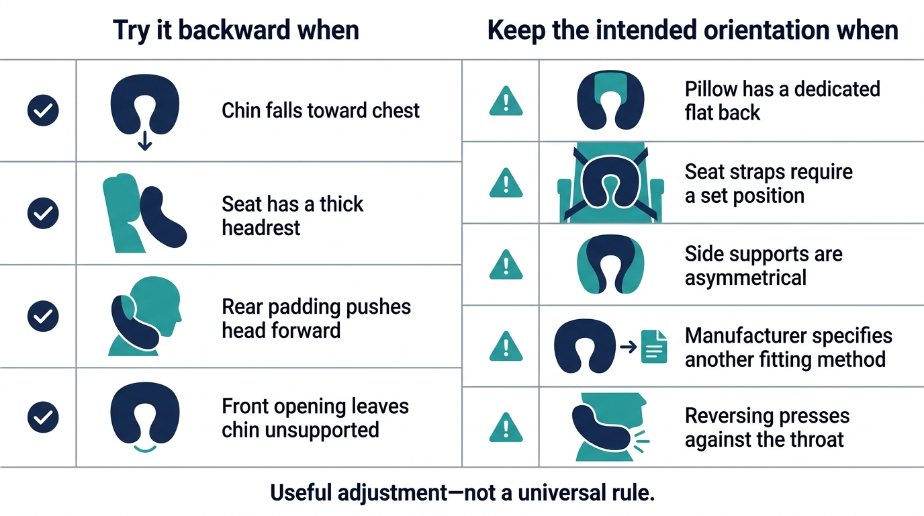
SaveYes, you can wear some U-shaped neck pillows “backwards” if rotating the pillow places useful padding beneath your chin and reduces forward head-drop. It isn’t a universal rule, and structured models should be used according to their instructions.
When backwards can work better
- Your chin repeatedly falls toward your chest.
- The seat already has a thick headrest behind you.
- The rear section of the pillow pushes your head forward.
- The pillow’s front opening leaves your chin completely unsupported.
When you shouldn’t automatically reverse it
- The pillow has a dedicated flat back.
- It uses seat straps that require a specific orientation.
- It has asymmetrical side supports.
- Its manufacturer gives a different fitting method.
- Reversing it presses uncomfortably against your throat.
The phrase “wear it backwards” is therefore a useful trick, not a law. What matters is whether the rotated position supports your relaxed head more effectively.
If you’re ready to pick one, these are the two travel designs I’d consider for different kinds of support:
🏆 Best Traditional Travel Support
Cabeau Evolution S3 Travel Neck Pillow
★★★★☆ 4.3/5
This memory-foam design uses raised side supports, a flat rear profile, an adjustable front clasp, and seat straps. I like this style when I want support around both sides without stacking a bulky foam section between my head and the airplane seat.
✈️ Best Compact Wrap Style
Trtl Travel Pillow
★★★★★ 4.7/5
The original Trtl measures about 8.7 × 9.5 × 3.6 inches and weighs about 4.7 ounces. Its structured support sits beside the neck and wraps like a scarf, which I prefer when a full foam horseshoe feels too bulky in a packed seat.
Frequently Asked Questions
Can a neck pillow be too tight?
Yes. A travel neck pillow can be too tight if it presses noticeably against your throat, makes swallowing uncomfortable, restricts normal movement, or creates pressure beneath the jaw. Tighten clasps and wraps only enough to stabilize the support, then loosen them if you feel pressure instead of comfort.
Should a travel neck pillow touch your shoulders?
Light contact with your shoulders is normal, especially with large U-shaped pillows. However, the pillow shouldn’t sit so heavily on them that it pushes your neck upward or forces your head into an unnatural angle. Your shoulders should remain relaxed while the pillow supports your head.
Can you use a travel neck pillow in bed?
You can use one briefly if it feels comfortable, but travel pillows are primarily designed for upright resting. For regular overnight sleep, a bed pillow matched to your back, side, or stomach position usually provides more appropriate support across the head, neck, and mattress.
Is it safe to sleep all night with a neck pillow?
A cervical pillow intended for bed can be used overnight when it fits comfortably. A bulky U-shaped travel pillow is different and may hold your neck in an awkward position while lying down, so don’t assume an airplane pillow is suitable for full-night bed use.
How do you know if your neck pillow is positioned correctly?
You should be able to relax your shoulders and stop consciously holding your head upright. If the pillow catches your normal head-drop without pushing your chin sharply up, down, or sideways, the position is probably close. Increasing pain or numbness means you should reposition or remove it.
The takeaway
don’t worry about whether your neck pillow looks “backwards.” Position it so your head stays comfortably supported when you fully relax.
Test the fit before your next flight instead of experimenting after takeoff. A one-minute seated check can tell you more than the picture printed on the pillow’s packaging.

I’m a home decor enthusiast who loves discovering beautiful room ideas, creative DIY projects, and Pinterest-worthy decorating inspiration. At DecorMinty, I share simple tips, fresh trends, and practical ideas to help you create a home you’ll truly love—one room at a time.