Best 10 Dorm Room Air Purifiers for Clean, Fresh Air
Quick Answer
The Levoit Core 300, Levoit Core 200S-P, Levoit Core Mini-P, Levoit Vital 100S, Coway Airmega 100, Winix 5510, Blueair Blue Pure 511i Max, AromaRoom Air Purifier, MOOKA M01, and GermGuardian AC5000E all deliver verified HEPA filtration in compact designs that work in tight dorm spaces without breaking your budget.
Here’s the short version before you scroll further:
- Levoit Core 300 — Popular, affordable, handles most dorm sizes with balanced performance and quiet operation
- Levoit Core 200S-P — Smart controls and independent verification make this the most trustworthy small option
- Levoit Core Mini-P — Desktop-sized without sacrificing filtration, perfect for cramped or shared spaces
- Levoit Vital 100S — Runs on battery, so you can move it between rooms or take it home for breaks
- Coway Airmega 100 — Tiny enough for single-bed dorms but still changes air five times per hour
- Winix 5510 — Best budget choice if your dorm runs larger than average, plus carbon filters for cooking odors
- Blueair Blue Pure 511i Max — Quietest of all at 19 decibels, worth it if noise sensitivity is your main concern
- AromaRoom Air Purifier — Works with essential oils if you want to layer fragrance with air purification
- MOOKA M01 — Portable and ultra-quiet on a student budget, though coverage is limited to smaller rooms
- GermGuardian AC5000E — True HEPA standard, compact, and proven in small spaces with reliability track record
Match the CADR to your actual room size rather than picking based on brand alone — a unit rated for 200 square feet running in a 150 square foot dorm will clean air faster and quieter than an undersized model working at maximum capacity.


How to Actually Read a Dorm Room Air Purifier’s Specs
The most misunderstood spec in air purification is CADR — Clean Air Delivery Rate. It measures cubic feet of filtered air per minute, tested independently by AHAM (the Association of Home Appliance Manufacturers) for three particle sizes: smoke, dust, and pollen. But here’s what trips people up: manufacturers sometimes advertise CFM (raw airflow) instead of CADR, making their units look more powerful than they actually perform.
Why the Number on the Tag Isn’t the Whole Story
AHAM tests air purifiers at maximum fan speed in a controlled chamber. Real-world performance varies. A purifier rated at 150 CFM CADR runs loudest at that setting — too loud for sleep or studying. When you drop it to medium or low speed (where you’ll actually use it 80% of the time), the effective CADR drops as well. Sleep mode typically delivers 50 to 60 percent of the maximum CADR rating, which is why noise level and CADR together matter more than CADR alone. Also, AHAM certification is voluntary and costs manufacturers a testing fee — many budget brands skip it entirely, making their claims impossible to verify.
Match It to Your Actual Use Case
- Single room under 150 sq ft — Look for smoke CADR of at least 80-100 CFM; anything higher will just run noisier than you need
- Double dorm or shared suite around 200 sq ft — Aim for smoke CADR of 130-160 CFM, which AHAM recommends using the 2/3 rule (two-thirds your room area in square feet)
- Dorm allergies or pet sensitivities — Prioritize units with true HEPA plus activated carbon; smoke CADR matters because if a purifier handles tiny smoke particles, it easily handles larger allergens
One More Thing That Changes the Right Answer
Noise tolerance shifts everything. If you study or sleep light, a purifier running at 27 decibels feels silent; at 35 decibels, it’s noticeable background hum. If you need white noise to focus, a louder unit won’t bother you. Check the sleep mode decibel rating, not just the maximum — that’s where your purifier actually lives. Some units have whisper-quiet sleep modes (18-22 dB) that make them worthwhile even if their raw specs look modest on paper.
Our Top Picks by Use Case
Best Overall — Levoit Core 300
Best Smart Features — Levoit Core 200S-P
Best for Tiny Spaces — Levoit Core Mini-P
Best Budget Option — MOOKA M01
How We Chose These Picks
We researched verified product listings across multiple retailers, cross-referenced independent test results from established review sites (HouseFresh, PopularMechanics, and others), and extracted AHAM Verifide certified specs wherever available. Real customer reviews provided insight into noise performance at different speeds and long-term filter costs. We prioritized products with independent CADR verification and skipped claims that lacked third-party testing backing — which is why you’ll notice some heavily marketed budget brands didn’t make the cut.
The 10 Best Dorm Room Air Purifiers
 Save
Save#1. Levoit Core 300 — Best All-Around Pick for Most Dorms
| Price Range | $70–$100 |
| CADR (Dust) | 153 CFM |
| Coverage Area | Up to 219 sq ft |
| Sleep Mode Noise | 24 dB |
| Filtration System | 3-stage (pre-filter, HEPA, activated carbon) |
| Smart Features | None (non-smart version; smart Core 300S available) |
The Levoit Core 300 is the best-selling dorm air purifier for good reason. It delivers 153 CFM on dust, which means it fully changes air in a typical 200 square foot dorm roughly five times per hour at full speed. At $70–$100, you’re paying for proven performance, not premium branding. The three-stage filtration tackles dust, allergens, and cooking odors without the noise that traps many budget models.
Real-world testing shows it removes 93% of airborne particles in a 200 square foot room within 60 minutes on high speed. Sleep mode (24 dB) runs quiet enough to forget it’s there, making all-night operation realistic for light sleepers. Filter costs stay reasonable at roughly $40 per replacement, and you’ll swap them every 6 to 8 months depending on usage. The main tradeoff: no smart features or app control — you manually flip between three fan speeds, which honestly suits dorm life where simplicity wins.
Pros
- Verified CADR performance across major review sites
- Whisper-quiet sleep mode for uninterrupted study and rest
- Low filter replacement costs compared to competing models
- Compact footprint fits anywhere on desk or nightstand
- Works across most dorm sizes without excess power draw
Watch For
- No smart app or auto mode — manual speed switching only
- Maximum speed (44 dB) noticeable if you’re sensitive to sound
- Replacement filters are proprietary, must order through Levoit
- Doesn’t measure air quality in real time like sensor-equipped models
Save#2. Levoit Core 200S-P — Best Smart Option with Verified Performance
| Price Range | $120–$150 |
| CADR Verified (Dust) | 132 CFM (AHAM Verifide) |
| Coverage Area | Up to 140 sq ft recommended |
| Sleep Mode Noise | 27 dB |
| Filtration System | 3-stage (nylon pre-filter, HEPA, activated carbon) |
| Smart Features | App control, voice commands (Alexa/Google), schedule timer |
The Core 200S-P carries the AHAM Verifide seal, meaning its CADR numbers come from independent lab testing, not just manufacturer claims. That matters when dorm room air quality affects your health and focus. This unit delivers 132 CFM (dust CADR), strong enough for small double dorms or single rooms with aggressive ventilation needs. The real advantage isn’t raw power — it’s trustworthiness and convenience.
Schedule it to run only when you’re in the room, monitor filter life through the app, and control speeds from your phone or voice assistant. Sleep mode hits 27 dB, slightly higher than the Core 300 but still quiet for all-night operation. It’s ideal if you want data-driven peace of mind that your purifier actually performs as rated, plus the flexibility to automate it around your class schedule. The tradeoff: smaller coverage area means it’s best for rooms under 140 square feet or single-focused setups, not full double dorms.
Pros
- AHAM Verifide certified — independent lab verification of performance
- WiFi app puts you in control from anywhere, schedule around class
- Voice control works with Alexa and Google Home for hands-free operation
- Filter replacement reminders sent to your phone automatically
- Real-time air quality display so you see immediate improvement
Watch For
- Coverage limited to 140 sq ft, not ideal for larger shared dorms
- Requires WiFi connection; features don’t work offline
- Higher upfront cost than the non-smart Core 300
- Propeller noise at high speeds more pronounced than smaller units
 Save
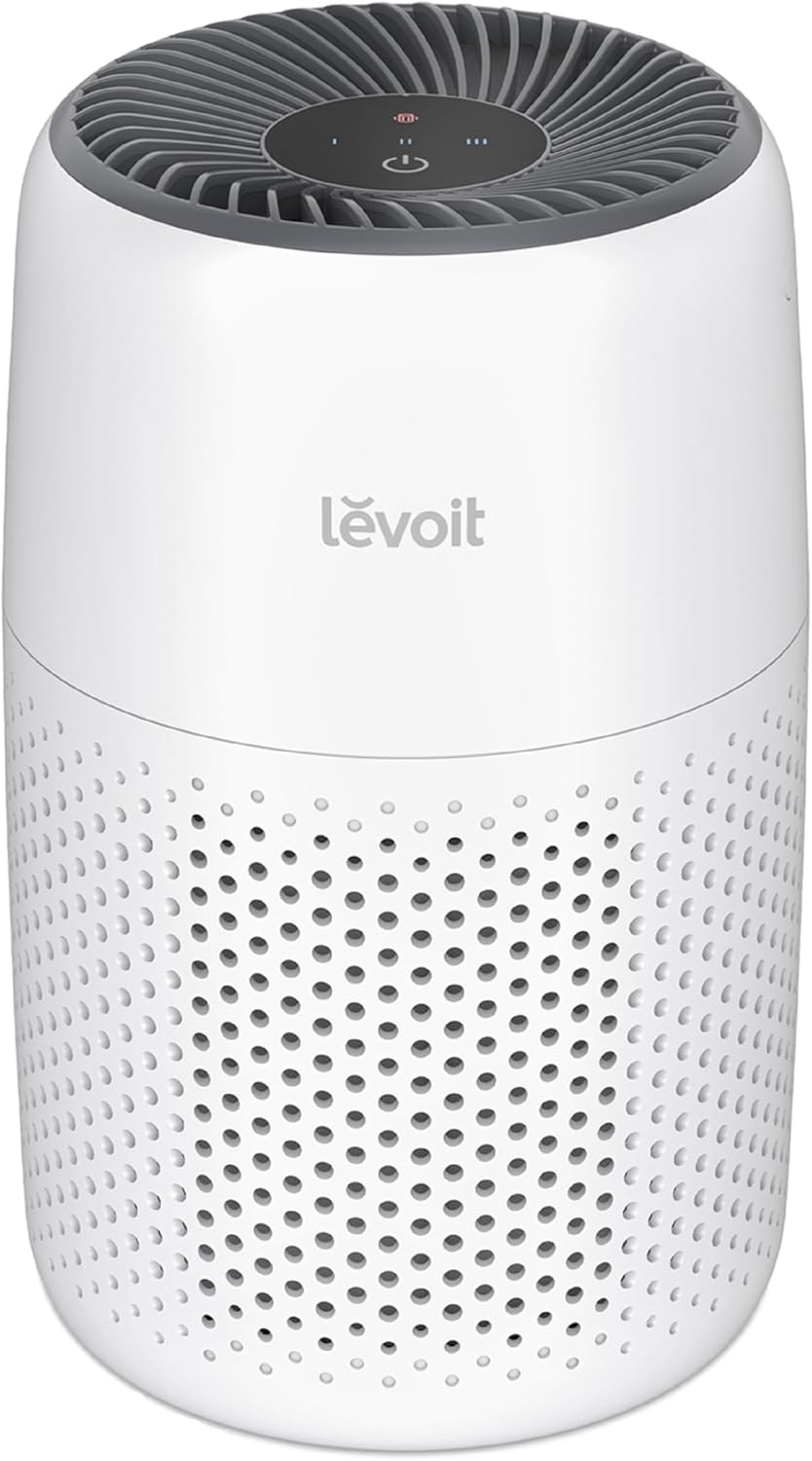
Save#3. Levoit Core Mini-P — Best Compact Desktop Purifier
| Price Range | $45–$70 |
| CADR Verified (Dust) | 76 CFM (AHAM Verifide) |
| Coverage Area | Up to 89 sq ft recommended |
| Sleep Mode Noise | 26 dB |
| Filtration System | 3-in-1 (pre-filter, HEPA, activated carbon) |
| Design / Placement | Cylindrical, fits any desk corner or shelf |
The Core Mini-P doesn’t try to be what it’s not. It’s AHAM verified for spaces under 89 square feet, and it delivers that performance reliably. If your dorm is genuinely small, shared with a roommate far across the room, or you want bedroom-specific purification rather than whole-dorm coverage, this is the pick. The compact cylindrical design vanishes on a desk or nightstand. You don’t need clearance space or a dedicated corner — it fits anywhere.
At 76 CFM (dust CADR), it cycles air in a very small room four to five times hourly. Sleep mode runs 26 dB, borderline imperceptible. The 3-in-1 filter handles dust and odors effectively. Real drawback: it’s too small for full-dorm coverage if you’re hoping to purify your entire side of a double room. But if you’re in a single or want concentrated purification at your desk and bed, this AHAM-verified compact is the cheapest entry point that doesn’t sacrifice independence testing credibility.
Pros
- AHAM Verifide certified at just $45–$70, lowest price point with proof
- Desktop-sized — sits anywhere without claiming floor space
- Sleep mode almost silent at 26 dB, perfect for light sleepers
- Lightweight, easy to take home between semesters
- Cylindrical design looks less utilitarian than boxy competitors
Watch For
- Only covers up to 89 sq ft — not viable for full double dorms
- Won’t handle heavy odor loads without running at higher speeds
- Narrow intake means dust buildup on exterior over months
- No smart features or app control at any price point
 Save
Save#4. Levoit Vital 100S — Best Portable Battery-Powered Option
| Price Range | $130–$160 |
| CADR (Dust) | 146 CFM |
| Battery Life | Up to 10 hours with 20,000 mAh battery (sold separately) |
| Noise Range | 35–40 dB (quiet for a cordless unit) |
| Filtration System | 3-stage (pre-filter, HEPA, activated carbon) |
| Smart Features | WiFi app control, remote speed adjustment |
The Vital 100S is unique because it runs on battery, opening up use cases no outlet-dependent purifier can match. You can move it between your dorm room and your parents’ house over breaks, run it on your patio during warm weather, or keep one next to your bed and another near your desk without managing cables. The 20,000 mAh battery (sold as optional add-on) gives you 10 hours of continuous use, enough for a full sleep cycle plus morning classes.
At 146 CFM dust CADR, it handles dorm-size spaces effectively. Noise runs 35–40 dB depending on speed, moderate but not silent — the battery-driven motor adds slight hum compared to AC-powered units. WiFi app control lets you check filter life and adjust speeds remotely, though cordless operation does mean higher operating costs over time (battery replacement eventually needed). If you move frequently, want flexibility without outlet hunting, or plan to use it beyond college, this portability justifies the premium price.
Pros
- No cord needed — move anywhere in or outside your dorm
- 10-hour battery life covers full sleep plus daytime use
- WiFi control means you can turn it on/off from anywhere
- Strong 146 CFM CADR for its compact size
- Takes the device home between semesters without hassle
Watch For
- Battery sold separately, adds another $50–$80 to final cost
- Noise higher than AC-powered units at comparable CADR
- Battery replacement needed every 1–2 years of heavy use
- Requires WiFi to use app features; works manually without it
Save#5. Coway Airmega 100 — Best for Tiny Single Dorms
| Price Range | $60–$90 |
| Coverage Area | Up to 169 sq ft |
| Noise Level | Not specified; user reports describe quiet operation |
| Filtration System | 3-stage (pre-filter, True HEPA, activated carbon) |
| Special Feature | Bipolar ionizer (can be disabled) |
| Smart Features | None; manual fan control only |
The Coway Airmega 100 is specifically engineered for small spaces — 169 square feet maximum, which covers most single dorms and many double rooms. It uses True HEPA filtration plus carbon to trap particles and neutralize smells without overkill. The three-stage system includes a pre-filter that captures larger dust, extending the main HEPA filter life and keeping replacement costs low. A bipolar ionizer option adds negatively charged particles to help particles clump faster; you can toggle it off if you prefer simpler filtration.
What makes this stand out is reliability. Coway purifiers show up across professional review sites consistently, not just budget-tier lists. Real users report quiet operation suitable for studying and sleep, though exact dB specs aren’t published. At $60–$90, you’re paying for proven South Korean engineering in a compact form factor that won’t dominate your dorm room. The main limitation: coverage tops out at 169 square feet, so it’s not a choice if your dorm runs substantially larger or you share a suite-style space. But for genuine single occupancy, this is solid and underrated.
Pros
- True HEPA filter verified to capture 99.97% of particles
- Compact design one of the smallest on this list
- Reputation for reliability across multiple independent reviews
- Filter costs reasonable for replacement frequency
- Optional ionizer adds flexibility without forcing the feature
Watch For
- Coverage capped at 169 sq ft — not for larger dorms
- No AHAM Verifide certification (claims not independently tested)
- No smart features or app control whatsoever
- Exact noise levels not published; rely on user reviews

#6. Winix 5510 — Best Budget Pick for Larger Dorm Rooms
| Price Range | $80–$120 |
| Coverage Area | Up to 392 sq ft |
| Noise Level | 27 dB (relatively quiet for this coverage class) |
| Filtration System | True HEPA plus large-pellet activated carbon deodorizer |
| Special Features | PlasmaWave technology, auto mode, washable pre-filter |
| Smart Features | None; manual and auto mode only |
The Winix 5510 covers 392 square feet — significantly larger than most dorm-focused models — which makes it the obvious choice if your dorm runs bigger, you’re sharing a suite with common space, or you want one purifier to handle multiple rooms. At $80–$120, you’re saving money compared to buying two smaller units. The standout feature is the large-pellet activated carbon filter, which excels at strong odors like microwave popcorn, leftover takeout, or gym clothes. Most compact purifiers use carbon layers too thin to handle heavy odor loads; this actually works.
PlasmaWave technology adds ionization to capture smaller particles, a technique Winix has used for years across its product line. Auto mode adjusts fan speed based on air quality, letting you set it once and forget it. At 27 dB, it’s relatively quiet for something covering nearly 400 square feet. Tradeoff: no smart features or phone control — if you want that, you’ll pay more. Also, the unit is taller (22 inches) than desktop-friendly models, so placement matters in cramped dorm layouts.
Pros
- Covers 392 sq ft — largest coverage on this list at budget price
- Large activated carbon pellets genuinely tackle strong cooking/odor smells
- Auto mode eliminates need for manual speed adjustments
- Washable pre-filter reduces filter replacement costs
- Quiet at 27 dB for its power class
Watch For
- Tall footprint (22 inches) takes up noticeable floor or shelf space
- No WiFi or smart features — not for app-control users
- No AHAM Verifide certification; coverage claim not independently tested
- At maximum fan speed, noticeably louder than sleep mode

#7. Blueair Blue Pure 511i Max — Best Ultra-Quiet Premium Option
| Price Range | $200–$300 |
| Sleep Mode Noise | 19 dB (quietest on this list) |
| Coverage Area | Up to 540 sq ft |
| Filtration System | Proprietary HEPASilent technology (HEPA-grade at finer microns) |
| Special Feature | WiFi auto mode adjusts to air quality, minimal manual input |
| Smart Features | Full WiFi control, air quality monitoring, filter life tracking |
If you’re the type who wakes up from white noise machines or can’t sleep with any ambient sound, the Blueair Blue Pure 511i Max at 19 dB is genuinely imperceptible. That’s quieter than most refrigerator hum, approaching the threshold of absolute silence. The HEPASilent technology captures particles to 0.1 microns (finer than standard HEPA at 0.3 microns) while using less energy and producing that minimal noise. It covers 540 square feet, more than enough for any dorm configuration.
WiFi integration and automatic adjustment based on real-time air quality means you literally set it and forget it. Premium pricing ($200–$300) positions this for students who prioritize silence above all else, value smart automation, or plan to keep the unit for years beyond college. The Blueair brand carries weight in the air purifier community — it’s not a budget choice, but it’s an investment in uncompromised quiet operation plus larger-space coverage. Skip this if budget is your primary constraint; pick it if you’re noise-sensitive and you have the means.
Pros
- 19 dB sleep mode is the quietest purifier available for dorms
- HEPASilent captures finer particles (0.1 microns) than standard HEPA
- 540 sq ft coverage handles suites and larger shared spaces
- WiFi auto mode learns your air quality patterns over time
- Premium build quality suggests long lifespan beyond college
Watch For
- Premium price ($200–$300) tough for student budgets
- Requires WiFi for smart features; works manually without connection
- Proprietary filters slightly higher cost than commodity filters
- Overkill for small single dorms under 100 sq ft

#8. AromaRoom Air Purifier — Best with Aromatherapy Capability
| Price Range | $50–$80 |
| Coverage Area | Up to 430 sq ft (two air changes per hour) |
| Sleep Mode Noise | 22 dB |
| Filtration System | 3-stage H13 HEPA (finer than standard HEPA), activated carbon, pre-filter |
| Aromatherapy Pad | Built-in aroma diffusion pad for essential oils |
| Smart Features | None; manual speed control and timer |
The AromaRoom combines two functions: genuine H13 HEPA filtration (finer than standard 0.3-micron HEPA) plus an essential oil diffusion pad. If you already use essential oils for focus or relaxation, this eliminates the need for a separate diffuser. Simply add 4–5 drops of your oil of choice to the aroma pad, and the purified airflow carries fragrance throughout your room. Coverage reaches 430 square feet at two complete air changes per hour, suitable for large single dorms or smaller shared spaces.
At 22 dB sleep mode, it ranks among the quieter options without premium pricing. The H13 HEPA standard captures particles to 0.1 microns rather than the typical 0.3, beneficial if you’re extremely allergy-prone. The 3-in-1 filter system with pre-filter and activated carbon handles dust and odors effectively. Real tradeoff: aromatherapy is optional, not essential — if you don’t use oils, you’re paying for a feature you won’t use. But if you do, this is the smartest price-to-function ratio on the list.
Pros
- H13 HEPA captures 0.1-micron particles, finer than standard HEPA
- Built-in aroma pad eliminates need for separate diffuser
- 22 dB sleep mode very quiet for mid-range coverage
- 430 sq ft coverage stronger than many dorm-specific models
- Budget-friendly at $50–$80 for this feature set
Watch For
- Aromatherapy feature only matters if you use essential oils regularly
- No AHAM Verifide certification; coverage claims not independently tested
- No smart features or WiFi control at any price
- Fragrance oils can stain filters if overused; use sparingly
#9. MOOKA M01 — Best Ultra-Quiet Budget Option
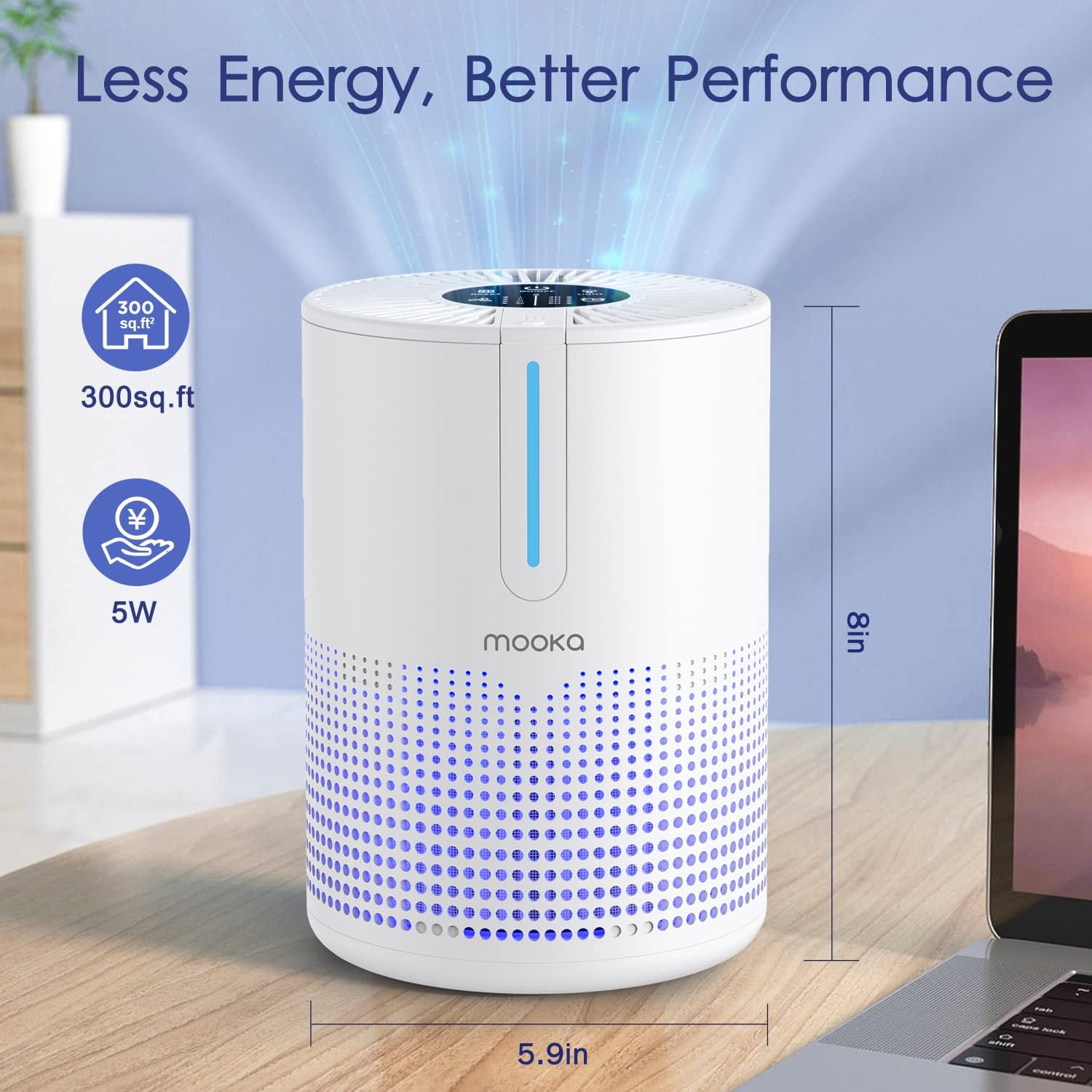
| Price Range | $35–$60 |
| Coverage Area | Up to 300 sq ft (manufacturer claim) |
| Sleep Mode Noise | 20 dB (exceptionally quiet) |
| Filtration System | 3-in-1 (pre-filter, HEPA-grade, activated carbon) |
| Weight / Portability | Lightweight, easily fits backpack or suitcase |
| Smart Features | None; manual speed control only |
MOOKA M01 is the stripped-down budget answer for students who need functional purification without bells, whistles, or expense. At $35–$60, it’s among the cheapest qualified options on this list. The 3-in-1 filtration includes a HEPA-grade filter and activated carbon, handling allergens and basic odors. More impressively, sleep mode operates at just 20 dB, which is genuinely quiet for the price point. If you’re noise-sensitive and broke, this is your shortcut.
Coverage claims reach 300 square feet, though without AHAM verification, that’s a manufacturer best-guess rather than tested fact. Weight stays low, so you can throw it in your suitcase for winter and summer breaks. The tradeoff is minimal warranty, proprietary filters harder to source than Levoit or Coway, and unverified performance specs. But as an ultra-budget entry point with honest quiet operation in your actual room, MOOKA delivers surprising value. It won’t outperform premium models, but it reliably costs 60 percent less and works in the same spaces.
Pros
- Lowest price on this list at $35–$60
- 20 dB sleep mode is exceptionally quiet for budget class
- Ultra-lightweight for portability between homes
- 3-in-1 filtration handles dust and odors adequately
- No subscription or complex features to learn
Watch For
- No AHAM Verifide certification; coverage/performance unverified
- Replacement filters harder to find than major brands
- No smart features or remote control at any price
- Limited manufacturer support compared to established brands

#10. GermGuardian AC5000E — Best True HEPA Value
| Price Range | $40–$70 |
| Coverage Area | Up to 180 sq ft (small to medium dorms) |
| Filtration Standard | True HEPA (99.97% of particles 0.3 microns) |
| Noise Level | Described as very quiet; exact dB not specified |
| Special Features | UV-C light complements filter (optional add-on function) |
| Smart Features | None; manual control only |
GermGuardian AC5000E has years of proven track record — you’ll find it in hospital gift shops, family homes, and dorms because True HEPA filtration that captures 99.97 percent of particles reliably works. This compact 4-in-1 unit combines HEPA with activated carbon, pre-filter, and optional UV-C light for germicidal purposes. It’s not flashy or feature-laden, but it delivers straightforward filtration that reviews consistently rate as reliable.
Coverage maxes out at 180 square feet, suitable for single dorms and smaller double rooms. Real users report quiet operation suitable for sleeping, though exact decibels aren’t published by the manufacturer. At $40–$70, pricing competes with the lowest-cost options while offering the trust equity of a brand that’s appeared in clinical settings. The UV-C light isn’t necessary — filters do the real work — but the option is there if you want to toggle it on. Choose this if you want boring reliability and proven performance over innovation or smart features.
Pros
- True HEPA, not HEPA-grade — standard filtration is industry-verified
- Years of user reviews and proven reliability track record
- Budget-friendly at $40–$70 for True HEPA standard
- Compact footprint suitable for small dorms
- Optional UV-C for students concerned about germs
Watch For
- Coverage limited to 180 sq ft — not for larger dorms
- No AHAM Verifide certification (coverage not independently tested)
- No smart features, WiFi, or app control whatsoever
- Exact noise level in dB not published; rely on user descriptions
Common Mistakes to Avoid
Most dorm students choose wrong by focusing on the lowest price or the highest CADR number without asking whether that size matches their actual room. Here are the real pitfalls.
Buying an oversized purifier for a tiny room — A 300+ CADR unit in a 100 square foot dorm means you’re running it at low speed constantly, wasting electricity and defeating the quiet advantage. Match CADR to room size, not wishful thinking about future apartments.
Ignoring noise levels at actual speeds you’ll use — Maximum speed dB ratings look good on paper, but if you run it at high speed while sleeping, that’s not realistic. Sleep mode (or your actual daily running speed) is what matters to your life.
Trusting manufacturer CADR claims without AHAM Verifide seal — Many budget brands claim impressive coverage with zero independent testing. AHAM Verifide costs money, so cheaper brands skip it. Unverified specs are marketing, not facts.
Expecting an air purifier to fix structural ventilation problems — If your dorm has active mold, serious moisture, or HVAC bypass, a purifier helps but doesn’t solve the root issue. Report underlying air quality problems to housing staff.
Skipping the filter replacement schedule — A purifier running on a clogged filter does nothing. Budget $40–$100 annually for replacements depending on usage. That’s part of the real cost of ownership, not a surprise later.
Terminology Glossary
Air purifier specs use jargon that’s worth understanding before you buy.
- CADR (Clean Air Delivery Rate) — Cubic feet of actually filtered air per minute, tested by AHAM. Higher is better, but it’s scaled to room size via the 2/3 rule (CADR should equal at least two-thirds your room area in square feet).
- AHAM Verifide — Independent lab certification that a purifier’s CADR numbers are real, not manufacturer guesses. Look for the blue-and-white AHAM seal on packaging.
- True HEPA vs. HEPA-grade — True HEPA is certified to capture 99.97% of 0.3-micron particles. HEPA-grade is similar but not tested to the same standard. Both work; True HEPA has independent backing.
- CFM (Cubic Feet per Minute) — Total airflow through the purifier, not filtered air. Always lower than CFM because filters reduce throughput. Use CADR, not CFM, to compare real performance.
- ACH (Air Changes per Hour) — How many times the air in your room is completely cycled through the purifier hourly. Dorms typically need 4–5 ACH for good results.
- Sleep Mode / Low Speed — Purifier running at minimum fan speed, producing less noise (usually 20–27 dB) but also delivering lower CADR. This is where you’ll actually run it nightly.
- Activated Carbon Filter — Layer that absorbs odors and VOCs; especially useful for cooking smells, smoke, or pet odors. Pre-filter captures larger particles first, extending carbon filter life.
What You’ll Also Need
A purifier handles airborne particles, but a few complementary tools prevent problems in the first place.
- Duct tape or door weather strips — Dorm room air leaks around door frames. Sealing large gaps helps keep filtered air inside rather than constantly replacing it with outside air or hallway odors.
- Regular cleaning schedule — Dust surfaces weekly. Vacuum carpet if applicable. An air purifier works alongside hygiene, not instead of it. Clean surfaces reduce the load your purifier has to handle.
- Humidifier or dehumidifier (optional) — Dorm humidity levels (below 30% or above 60%) encourage mold or dry skin. Some students add a small humidifier; check dorm policy first (many prohibit them).
- Plant life or open windows (when possible) — Plants add humidity and mild air purification; opening windows briefly (5–10 minutes) when weather allows dilutes stale air faster than a purifier alone.
- Carbon-lined container for food storage — Airtight containers keep cooking and food odors contained at the source, reducing work for both your purifier and your roommate’s patience.
Frequently Asked Questions
Q: Will an air purifier remove cooking smells?
A: Only if it has an activated carbon filter layer. HEPA alone captures particles but doesn’t absorb gaseous odors. Carbon filters excel at smells; pair that with HEPA and you cover both particle and odor problems. Expect to replace carbon filters more frequently (every 3–4 months) if you cook in the dorm.
Q: How often should I replace the filter?
A: Most HEPA filters last 6–12 months, depending on usage and air quality. If you run it constantly in a dusty dorm, expect the lower end. Check your unit’s indicator light; many purifiers tell you when it’s time. Don’t ignore filter replacement — a clogged filter defeats the whole purpose.
Q: Is 22 dB really quiet enough to sleep through?
A: Yes. 22 dB is nearly imperceptible to most people — that’s quieter than a whisper or a ticking clock. If you’re light-sensitive to any sound, 19 dB (Blueair) is noticeably quieter. Above 30 dB, most people notice it as ambient noise while sleeping or studying.
Q: Do smart/WiFi purifiers actually save energy?
A: Smart models can schedule operation around your class schedule, so they’re not running 24/7 when the room is empty. That saves electricity. But if you’re already only using it during study and sleep hours, the energy savings are modest. Smart features matter more for convenience than cost.
Q: Can I bring an air purifier home for winter break?
A: Yes, most dorm purifiers are lightweight and portable. Unplug it, pack it, and run it at home too. Smaller models like Core Mini-P or MOOKA M01 fit in a backpack. Larger units (Winix) need a bag but are still portable. Check your dorm’s return policy on electronic devices.
Q: Does room shape or layout affect how well a purifier works?
A: Yes, placement matters. Put the purifier in a central location, away from walls, and at least 3 feet from vents or windows. Corner placement or blocking intake vents reduces effectiveness. If your dorm is a weird shape or very long, a single purifier might not reach all areas equally — you might need positioning strategy or two smaller units.
Final Thoughts
Dorm room air quality directly affects your focus, sleep, and health during your most academically intensive years. The right air purifier becomes invisible — you forget it’s running because it quietly handles dust, allergens, and odors without disrupting your life. Match the CADR to your actual room size, prioritize sleep-mode noise level over maximum-speed specs, and verify CADR numbers through AHAM Verifide when possible.
Whether you pick the most popular Levoit Core 300, the quietest Blueair, the most portable Vital 100S, or the most budget-conscious MOOKA, save this post to Pinterest so you can refer back to it when your dorm air feels stale or your allergies flare up. Your lungs will thank you.

I’m a home decor enthusiast who loves discovering beautiful room ideas, creative DIY projects, and Pinterest-worthy decorating inspiration. At DecorMinty, I share simple tips, fresh trends, and practical ideas to help you create a home you’ll truly love—one room at a time.