Are Neck Pillows Good for You? Benefits, Risks, and Who Should Use One
Quick Answer
Neck pillows can be good for you when they keep your head and neck comfortably aligned while you sleep or travel. Research suggests certain pillow designs may reduce waking neck pain, but no single material or shape works best for everyone, according to a 2025 systematic review of pillows for chronic neck pain.
What matters most
- Neutral alignment: Your head should not tilt sharply up, down, or sideways.
- Sleep position: Side sleepers usually need more height than back sleepers.
- Comfort matters: A technically supportive pillow still fails if you cannot relax on it.
- Not a cure: A pillow can support your neck, but it does not treat every cause of persistent neck pain.
- Fit beats labels: “Cervical,” “orthopedic,” and “ergonomic” do not guarantee the pillow suits your body.
Simple test
- If you consistently wake with more stiffness, headaches, numbness, or shoulder discomfort after changing pillows, reassess the height and firmness.
I think neck pillows get oversold in two opposite directions. Some products promise dramatic pain relief, while other people dismiss shaped pillows as unnecessary.
The more useful answer sits in the middle. A well-fitted pillow can support comfortable sleep, but your sleeping position and individual anatomy matter more than the label on the package.
Definition: A neck pillow is a pillow designed to support the cervical spine, which is the neck portion of your spine. It may be a contoured bed pillow, adjustable pillow, cervical roll, or U-shaped travel pillow.


Are neck pillows good for you?
 Save
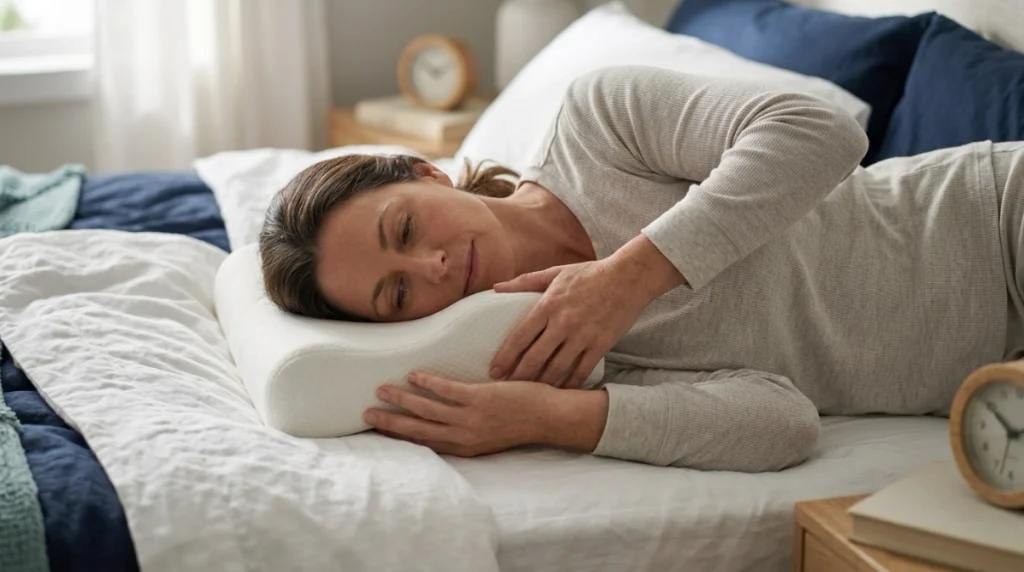
SaveYes, neck pillows can be good for you if they support your neck without forcing your head into an awkward position. The goal is comfortable alignment rather than maximum firmness.
A 2021 systematic review and meta-analysis examined 35 articles on pillow design. Nine high-quality studies included 555 participants, and some spring and rubber pillows were associated with improvements in neck pain and waking symptoms.
- Back sleepers: Look for enough neck support without pushing the chin toward the chest.
- Side sleepers: Fill the space between the shoulder and head so the neck does not droop sideways.
- Stomach sleepers: Usually need a thinner pillow because thick loft can increase neck rotation and extension.
- Combination sleepers: Often benefit from adjustable fill or a shape that accommodates more than one position.
The Cleveland Clinic’s neck-pain guidance also emphasizes keeping the head and neck aligned with the rest of the body during sleep.
Are neck pillows healthy?
A neck pillow is generally a healthy sleep accessory when it supports a comfortable posture and does not create new symptoms. It should be viewed as bedding, not medical treatment.
One practical rule I use when evaluating pillows is simple: ignore the dramatic product language and look first at height, firmness, sleep position, and adjustability.
| Sleep position | Typical support goal | Common problem |
|---|---|---|
| Back | Support the natural neck curve while keeping the head fairly level | Pillow too high pushes the head forward |
| Side | Fill the shoulder-to-head gap | Pillow too low lets the head tilt toward the mattress |
| Stomach | Minimize extra neck extension | Thick pillows increase an already rotated position |
| Combination | Provide usable support across changing positions | Fixed contours may feel restrictive |
If you’re updating your whole sleep setup rather than only the pillow, comparing it with your overall bedding setup can help you think about comfort as a complete system.
Are neck pillows safe?
Neck pillows are usually safe for healthy adults when they are used as intended. Stop using one if it repeatedly causes pain, tingling, numbness, dizziness, headaches, or worsening stiffness.
A pillow should support you rather than hold your neck rigidly. You should still be able to settle naturally into your preferred sleeping position.
- Check the height: Your head should not be noticeably tipped toward your chest or ceiling.
- Check side alignment: Your nose should roughly face forward rather than angle toward the mattress.
- Give adjustment time: A different shape may feel unfamiliar for several nights, but worsening pain is not something to ignore.
- Keep travel use separate: U-shaped travel pillows solve a different problem from cervical bed pillows.
Persistent or severe neck pain deserves more than a pillow change. Mayo Clinic’s neck-pain guidance recommends medical assessment when symptoms are severe, persistent, or accompanied by concerning neurological signs.
Are neck pillows bad for you?
A neck pillow can be bad for your comfort if the height, firmness, or contour does not suit your body. The problem usually comes from poor fit rather than from neck pillows as a category.
A very high contour can push a back sleeper’s head forward. A thin pillow can let a side sleeper’s head drop toward the bed for hours.
Signs your neck pillow may not fit
- You wake with stiffness that improves after getting out of bed.
- Your chin feels pushed toward your chest.
- Your head feels tilted when you sleep on your side.
- You keep sliding off the contour during the night.
- Your shoulders feel compressed against the pillow.
- You slept more comfortably before switching pillows.
Stomach sleeping deserves extra attention because the neck is already rotated for long periods. A large cervical contour may increase that awkward position instead of helping it.
Are neck pillows good or bad?
Neck pillows are neither automatically good nor automatically bad. Their value depends on whether they help your head, neck, shoulders, mattress, and sleeping position work together comfortably.
The research reflects that nuance. A newer systematic review found limited evidence supporting specialized pillows as an additional option for chronic neck pain, but it did not establish one clearly superior pillow material.
- Probably good: You wake comfortable and your neck feels naturally supported.
- Probably wrong for you: Pain or stiffness consistently increases after using it.
- Worth adjusting: The pillow has removable fill and feels close to right.
- Worth replacing: The contour forces your neck into one uncomfortable position.
That is why I favor adjustability when someone has no idea what pillow height suits them. It lets you change the support instead of immediately buying another pillow.
What are the benefits of neck pillows?
The main potential benefit is better support for the cervical spine during rest. Some people also report less morning stiffness and better comfort when the pillow matches their sleeping position.
- Neck support: Helps fill empty space beneath the neck rather than leaving it unsupported.
- Head positioning: May reduce excessive side bending or forward flexion.
- Morning comfort: Some clinical studies report reductions in waking neck symptoms.
- Travel support: U-shaped models can limit large head movements when sleeping upright.
- Customizable loft: Adjustable-fill designs let you experiment with height.
Harvard Health also recommends considering pillow shape and sleep position when managing nighttime neck discomfort. Its guidance on sleeping with neck pain notes that back and side positions can be easier on the neck when properly supported.
Comfort elsewhere in the bed matters too. For small bedrooms or college spaces, these grey dorm bedding options show how pillow and bedding choices can be coordinated without overcomplicating the setup.
What are neck pillows used for?
Neck pillows are used for sleeping, resting, travel, and positioning support. The phrase covers several products that should not be treated as interchangeable.
- Cervical contour pillow: Used on a bed to support the neck curve.
- Adjustable bed pillow: Lets sleepers change the amount of fill and loft.
- Cervical roll: Provides targeted support beneath the neck.
- U-shaped travel pillow: Supports the head while sitting upright.
- Specialty positioning pillow: May be recommended in certain rehabilitation or post-procedure situations.
The most important distinction is between travel and bed use. A U-shaped airline pillow is designed around upright sitting, while a cervical bed pillow has to work with your mattress and shoulder position.
Why do people use neck pillows?
People usually try neck pillows because they wake with stiffness, want better support, travel frequently, or feel their ordinary pillow collapses too much. Others simply find a contoured shape more comfortable.
There is also a strong trial-and-error element. Two people who sleep in the same position may prefer different heights because their shoulder width, body size, mattress firmness, and neck shape differ.
What should you consider before buying one?
 Save
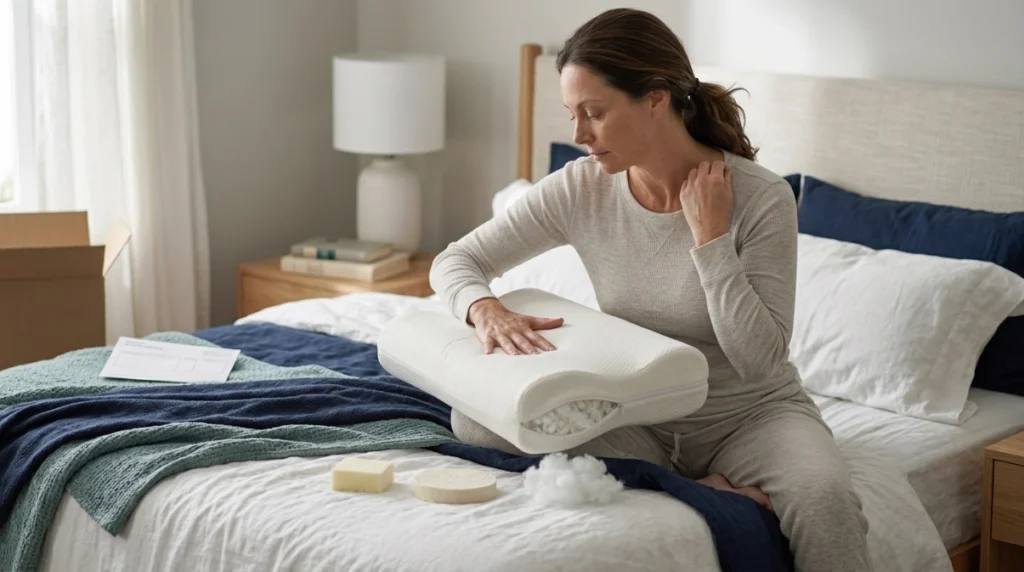
Save- Your main sleeping position — side, back, stomach, or combination.
- Your mattress firmness — softer mattresses let the shoulder sink farther.
- Your shoulder width — especially important for side sleepers.
- Adjustability — useful if you are unsure about the correct loft.
- Return policy — pillow comfort is highly individual.
- Material preference — foam, latex, fiber, and other fills feel different.
If you’re putting together a bed from scratch, this guide to green dorm room bedding sets is another useful example of choosing bedding around comfort, size, and personal preference instead of appearance alone.
Are neck pillows worth it?
A neck pillow is worth trying when your current pillow clearly does not support you well. It is less compelling if you already sleep comfortably and wake without neck symptoms.
As of 2026, I would put fit and adjustability ahead of expensive materials. A $100 contour pillow that is the wrong height can be less useful than a simpler pillow adjusted correctly.
A simple buying decision
- Worth trying: You regularly wake with neck stiffness and suspect pillow height or support.
- Worth paying more for: Adjustable fill, durable construction, or several profile sizes genuinely help you find the right fit.
- Not worth chasing: Claims that a pillow can cure chronic pain or correct every neck problem.
- See a professional first: You have persistent pain, weakness, numbness, an injury, or symptoms spreading into an arm.
If you’re ready to test a more supportive pillow, these are two practical options I would compare first:
🏆 Best for adjustability
Coop Home Goods Original Adjustable Pillow
★★★★☆ 4.5/5
The shredded memory-foam and microfiber fill can be added or removed, which makes the loft easier to tune for different sleeping positions. I prefer this approach for someone who knows their existing pillow is wrong but does not yet know exactly how much height they need.
🛏️ Best fixed contour
TEMPUR-Neck Pillow
★★★☆☆ 3.6/5
This extra-firm contoured memory-foam pillow is offered in different profile heights and is aimed mainly at back and side sleepers. I would choose it only after measuring your preferred pillow height because the fixed contour is less forgiving than adjustable fill.
Frequently Asked Questions
Can a neck pillow fix neck pain?
A neck pillow may reduce sleep-related discomfort when poor support contributes to your symptoms, but it cannot fix every cause of neck pain. Persistent pain, weakness, numbness, injury-related symptoms, or pain spreading into an arm should be assessed by a qualified healthcare professional.
How long does it take to get used to a cervical pillow?
A different contour can feel unfamiliar for several nights because your usual sleeping position is changing slightly. Mild adjustment is different from worsening symptoms, so do not force yourself to continue using a pillow that repeatedly causes more pain.
Is memory foam best for neck pain?
No material is clearly best for everyone. Research has examined foam, rubber or latex, spring, water-based, and conventional pillows, but newer evidence does not establish one universally superior material for chronic neck pain.
Should side sleepers use a neck pillow?
Side sleepers can benefit from a supportive pillow if it fills the gap between the shoulder and head. The correct height depends on shoulder width, mattress firmness, body size, and how deeply the shoulder sinks into the mattress.
Can I sleep on a neck pillow every night?
Yes, if the pillow remains comfortable and supports a neutral sleeping posture. There is no need to limit nightly use simply because a pillow is described as cervical or ergonomic, but worsening symptoms are a reason to reconsider the fit.
The takeaway: neck pillows can be good for you, but only when the fit is right. Choose support based on your sleeping position and body rather than assuming a deeper contour or firmer material is automatically healthier.
Start with the simplest test: notice how your neck feels when you wake. If a pillow lets you sleep comfortably and wake without new stiffness, it is probably doing its job.

I’m a home decor enthusiast who loves discovering beautiful room ideas, creative DIY projects, and Pinterest-worthy decorating inspiration. At DecorMinty, I share simple tips, fresh trends, and practical ideas to help you create a home you’ll truly love—one room at a time.