What Size Neck Pillow Should You Get? A Practical Fit Guide
Quick Answer
Most adults should choose a neck pillow size based on shoulder width, sleep position, and pillow height, not just bed size. Side sleepers usually need a taller profile, back sleepers usually need a lower-to-medium profile, and stomach sleepers often do better with a very thin pillow or no contour pillow. For a full buying method, start with this guide on how to choose the right neck pillow.
Fast sizing rules
- Side sleepers: Pick a pillow tall enough to fill the shoulder-to-neck gap without tilting your head upward.
- Back sleepers: Choose a lower contour that supports the neck curve without pushing the chin down.
- Small frames: Start with small or low-profile sizes, especially on a firm mattress.
- Broad shoulders: Try medium or large sizes because your neck sits farther from the mattress.
- Between sizes: Choose the smaller size first if the brand gives that instruction.
Simple fit check
- Lie down for five minutes and check whether your nose, chin, and chest feel naturally stacked.
I like to size a neck pillow the same way I size a pair of shoes: the label helps, but the fit test matters more.
A neck pillow should support the natural curve of your cervical spine, which is the neck section of your spine. It should not force your head forward, drop it sideways, or make your jaw feel tucked.
A neck pillow is a pillow shaped or sized to support the space under your neck while keeping your head close to neutral alignment.


What size neck pillow do I need?
 Save
SaveYou need the neck pillow size that keeps your head level with your upper spine in your normal sleep position.
That sounds simple, but it depends on three things: your shoulder width, mattress firmness, and how much your pillow compresses under your head.
Start with your sleep position
Side sleepers usually need the tallest neck pillow profile. Your shoulder creates a larger gap between your head and the mattress.
Back sleepers usually need a lower profile. The pillow should support the neck curve without pushing the head forward.
- Side sleeping: Choose enough height to fill the shoulder gap.
- Back sleeping: Choose moderate neck support with a lower head cradle.
- Stomach sleeping: Avoid tall contour pillows because they twist the neck.
If you wake with one ear closer to your shoulder, the pillow may be too low or too soft. If your chin feels pressed toward your chest, the pillow may be too tall.
Measure the shoulder-to-neck gap
For contour pillows, measure from the base of your neck to the outer edge of your shoulder. This gives you a starting point for pillow height.
I also check the mattress. A soft mattress lets the shoulder sink more, so you may need less pillow height than the tape measure suggests.
| Sleeper type | Common fit need | Best starting size | Warning sign |
|---|---|---|---|
| Side sleeper, narrow shoulders | Moderate neck height | Small to medium | Head tilts upward |
| Side sleeper, broad shoulders | More height under the neck | Medium to large | Head drops toward mattress |
| Back sleeper | Low neck roll with gentle head support | Small to medium | Chin tucks downward |
| Stomach sleeper | Very low height | Thin pillow, not tall contour | Neck rotates sharply |
The best size is the one that feels boring after a few minutes. You should not notice pressure under your jaw, ear, shoulder, or skull base.
If neck pain is part of the reason you are shopping, read this deeper guide on the best neck pillow for neck pain before choosing a firm contour.
Do neck pillows come in different sizes?
Yes, neck pillows come in different sizes, but brands do not use one universal sizing system.
Some brands size by height, some by travel shape, and some by bed-pillow width. That is why “medium” can mean different things from one product to another.
The main types of neck pillow sizing
The most common neck pillow sizes are small, medium, large, travel, standard, queen, and king.
Contour cervical pillows usually use height-based sizing. Travel pillows usually use shape and neck circumference more than bed width.
- Small: Lower profile for smaller frames, back sleepers, or narrow shoulders.
- Medium: Middle profile for average builds and mixed back-side sleepers.
- Large: Taller profile for broader shoulders or side sleepers.
- Travel: Compact support for sitting upright in a plane, car, or train.
- Queen or king: Wider bed-pillow sizing, not always better neck support.
This is where shoppers get confused. A king-size pillow can still be too flat for your neck.
Size is not the same as firmness
Size describes the shape, height, or width. Firmness describes how much the pillow resists pressure.
A tall soft pillow can collapse too much. A low firm pillow can still feel intense under the neck.
If you are comparing feel, this guide on firm vs. soft neck pillows explains why support and hardness are not the same thing.
Check the fit, not just the package
A good neck pillow should help your head and body stay aligned while you sleep. Mayo Clinic gives similar guidance for keeping the head and neck aligned during sleep on its neck pain resource page.
MedlinePlus also recommends a pillow that supports the neck when managing neck pain. That is the practical standard I use when judging size.
Here is my quick at-home test:
- Lie in your normal sleep position.
- Relax your jaw and shoulders.
- Ask whether your head feels centered, lifted, or dropped.
- Stay there for five minutes, not five seconds.
- Check for pressure under the ear, neck roll, or shoulder.
If the pillow only feels good for the first minute, keep testing. Neck pillow mistakes often show up after your body settles.
For a broader comfort check, this article on whether neck pillows really work explains what support can and cannot fix.
How big is a neck pillow?
A bed-style neck pillow is often close to standard pillow width, but the important number is usually the height of the neck roll.
Travel neck pillows are much smaller. They are made for upright support, not full-night mattress alignment.
Typical neck pillow dimensions
Many contour neck pillows are roughly 20 to 24 inches wide and 12 to 16 inches deep. Their support height often ranges from about 3 to 5 inches.
Those numbers are only a starting point. Foam density, mattress sink, and body shape can change the fit.
| Pillow style | Common size range | Best use |
|---|---|---|
| Contour cervical pillow | About 20–24 in wide, 3–5 in high | Back and side sleeping |
| Travel neck pillow | About 10–13 in across | Upright sitting support |
| Standard bed pillow | About 20 x 26 in | General sleeping comfort |
| Queen bed pillow | About 20 x 30 in | Wider mattress coverage |
The biggest mistake is buying for bed width alone. A queen pillow is wider, but it may not place the neck at the right height.
Height matters more than width
For neck support, height controls alignment more than length. A pillow can be wide enough and still be the wrong size.
Cleveland Clinic’s neck pain guidance also points toward keeping the head and neck aligned with the rest of the body while sleeping. That is a useful way to judge pillow height.
- Too high: Your chin moves toward your chest.
- Too low: Your head drops backward or sideways.
- Too narrow: You roll off the support zone at night.
- Too firm: You feel pressure instead of support.
As of 2026, most good neck pillow sizing guides still come back to the same idea. Match the pillow to your body, not just the mattress size.
If you are still deciding whether a neck pillow is even right for you, read this guide on whether neck pillows are good for you.
What size TEMPUR neck pillow do I need?
For the TEMPUR-Neck pillow, most shoppers should start by measuring from the base of the neck to the outside edge of the shoulder.
Tempur-Pedic says the small, medium, and large versions share the same length and width. The size mainly changes the tallest pillow height.
Official TEMPUR-Neck pillow dimensions
The TEMPUR-Neck pillow is designed for side and back sleepers. It uses a firm contoured shape rather than a loose fill.
Here are the approximate dimensions listed by Tempur-Pedic:
| TEMPUR-Neck size | Approximate dimensions | Best starting fit |
|---|---|---|
| Small | 20 x 12.5 x 3.5 in | Small frames, back sleepers, narrow shoulders |
| Medium | 20 x 12.5 x 4 in | Average builds, mixed side and back sleepers |
| Large | 20 x 12.5 x 4.75 in | Broader shoulders, side sleepers needing more height |
| Travel | 10 x 12 x 4 in | Portable upright or compact support |
The official sizing note I pay attention to is simple. If your measurement falls between two sizes, choose the smaller size.
How I would choose between small, medium, and large
I would start with small if you sleep mostly on your back or have narrow shoulders. That lower height is less likely to over-flex the neck.
I would start with medium if you switch between your back and side. It is the safer middle option for many average builds.
I would only choose large if you have a clear shoulder gap to fill. It can feel great for side sleepers, but too high for some back sleepers.
- Choose small: You are petite, narrow-shouldered, or mostly a back sleeper.
- Choose medium: You are average-framed or sleep on both your back and side.
- Choose large: You are broad-shouldered and mainly sleep on your side.
The TEMPUR-Neck pillow is firm, so do not size up just because you like plush pillows. A firm tall contour feels larger than its number suggests.
What size TEMPUR-Pedic neck pillow should I get?
 Save
SaveYou should get the TEMPUR-Pedic neck pillow size that matches your measured shoulder-to-neck distance and keeps your neck neutral in your main sleep position.
For most unsure shoppers, small or medium is safer than large. Large works best when you know you need extra height.
Best TEMPUR-Pedic size by sleeper type
If you are a side sleeper with broad shoulders, the large TEMPUR-Neck pillow may fit your gap better. If you are a back sleeper, small or medium usually makes more sense.
If you rotate all night, choose the size that works for the position you wake up in most often. Your morning position tells you a lot.
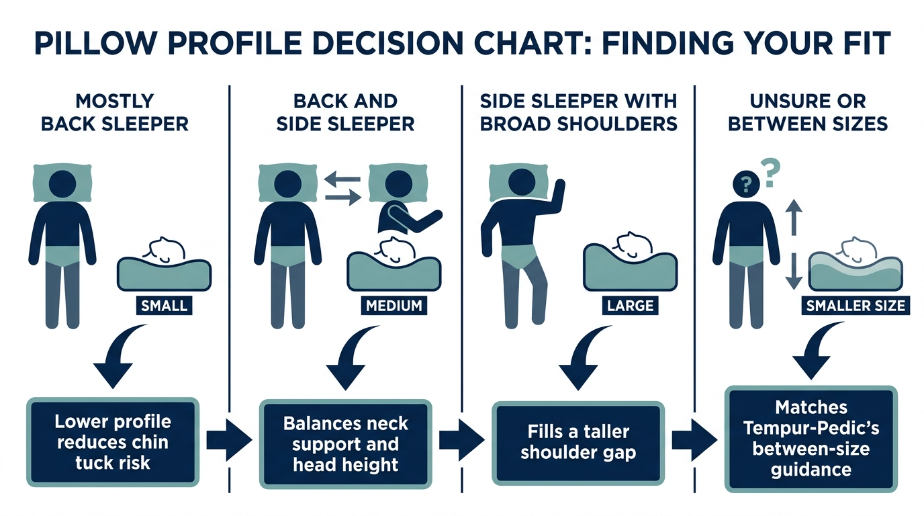
| Your situation | Best TEMPUR-Pedic starting size | Why |
|---|---|---|
| Mostly back sleeper | Small | Lower profile reduces chin tuck risk |
| Back and side sleeper | Medium | Balances neck support and head height |
| Side sleeper with broad shoulders | Large | Fills a taller shoulder gap |
| Unsure or between sizes | Smaller size | Matches Tempur-Pedic’s between-size guidance |
When you should not size up
Do not size up because you want a “more supportive” pillow. Support comes from fit, not just height.
A pillow that is too tall can create the same problem you were trying to fix. It can bend your neck instead of supporting it.
- Do not size up if your chin already tucks on your current pillow.
- Do not size up if you sleep mostly on your back.
- Do not size up if your mattress is soft and your shoulders sink deeply.
- Do not size up if firm foam usually feels intense to you.
My practical sizing takeaway
If I were buying one without testing it in store, I would choose medium for an average side-back sleeper and small for a back sleeper.
I would choose large only for a dedicated side sleeper with broad shoulders. That is the clearest use case.
For pain, numbness, tingling, weakness, or symptoms that keep returning, a pillow should not be your only plan. Mayo Clinic, MedlinePlus, and Cleveland Clinic all point readers toward medical evaluation when symptoms are severe, persistent, or linked with concerning signs.
If you are ready to pick one, here are the two options I would compare first:
🏆 Best contoured fit
TEMPUR-Neck Pillow
★★★★☆
This firm contour pillow comes in small, medium, and large height profiles, with the standard sizes measuring 20 x 12.5 inches. I like it for shoppers who want a precise neck roll and are willing to measure before buying.
💰 Best budget test
Core Products Tri-Core Cervical Pillow
★★★★☆
This cervical pillow uses shaped neck support with a more traditional bed-pillow layout. I like it as a lower-cost way to test whether a cervical shape suits your sleep before spending more on premium foam.
FAQ
What is the best neck pillow size for side sleepers?
Side sleepers usually need a medium or tall neck pillow because the shoulder creates space between the head and mattress. The right size keeps your nose lined up with the center of your chest instead of letting your head drop toward the bed.
What is the best neck pillow size for back sleepers?
Back sleepers usually do best with a small or medium neck pillow. The pillow should support the neck curve, but the head section should stay low enough that your chin does not press toward your chest.
Should a neck pillow be firm or soft?
A neck pillow should feel supportive before it feels hard. Soft pillows can work if they hold shape, while firm pillows can work if the height is correct. The wrong height causes more trouble than the firmness label.
How do I know if my neck pillow is too high?
Your neck pillow is probably too high if your chin tucks down, your throat feels crowded, or you wake with pressure at the base of your skull. Side sleepers may also feel the top shoulder pushed forward.
What if I am between TEMPUR-Neck pillow sizes?
If you are between TEMPUR-Neck pillow sizes, choose the smaller size first because Tempur-Pedic gives that guidance. This is especially important if you sleep partly on your back or use a soft mattress.
Final takeaway
The best neck pillow size is the one that keeps your neck neutral in your real sleeping position. Do not buy by height alone.
Measure your shoulder-to-neck gap, check your mattress sink, and test your alignment for at least five minutes. When in doubt, choose the lower size before you size up.

I’m a home decor enthusiast who loves discovering beautiful room ideas, creative DIY projects, and Pinterest-worthy decorating inspiration. At DecorMinty, I share simple tips, fresh trends, and practical ideas to help you create a home you’ll truly love—one room at a time.