How Long Do Neck Pillows Last? Replacement Guide
Quick Answer
Most neck pillows last about 1 to 3 years with regular use, although the actual lifespan depends heavily on the filling and construction. Polyester may flatten within a year, memory foam often lasts around 2 to 3 years, while quality latex can remain supportive for 2 to 4 years or longer. Understanding what neck pillows are made of makes it much easier to judge how long yours should last.
Typical neck pillow lifespan
- Polyester fill: Usually about 6 months to 2 years before noticeable flattening.
- Memory foam: Commonly around 2 to 3 years before permanent impressions appear.
- Latex: Often about 2 to 4 years and sometimes longer with careful use.
- Microbead travel pillows: Often around 1 to 2 years before beads compress and support declines.
- Buckwheat pillows: Hulls can often be refreshed or replaced instead of replacing the entire pillow.
The rule I use
- Replace the pillow when it stops returning to its normal shape or no longer supports your neck comfortably, even if it has not reached the expected age.
I don’t treat a neck pillow like a product with a fixed expiration date. Two pillows bought on the same day can wear out at completely different speeds.
The filling, nightly use, moisture, cleaning habits, body weight, and pillow quality all matter. In this guide, I’ll show you the lifespan ranges I use and the warning signs that matter more than the calendar.


How long do neck pillows last?
 Save
SaveMost regularly used neck pillows should be expected to last roughly 1 to 3 years. Some inexpensive fiber models wear out sooner, while durable latex and replaceable-fill designs can last considerably longer.
The key is whether the pillow still maintains the height and shape your neck needs. Age alone cannot tell you that.
Definition: A neck pillow is a support pillow designed to stabilize or cushion the head and cervical spine during sleep, rest, or upright travel. It may use memory foam, latex, polyester fiber, microbeads, buckwheat hulls, or an inflatable chamber.
How long does each neck pillow material last?
Material is the best starting point for estimating longevity. Sleep Foundation notes that experts commonly recommend replacing pillows every one to two years, while certain materials can remain usable longer.
You can review its pillow replacement guidance for a broader explanation of how different fills age.
| Neck pillow material | Typical useful lifespan | Common failure sign |
|---|---|---|
| Polyester fiberfill | About 6 months–2 years | Flattening, clumping, reduced loft |
| Down alternative | About 1–2 years | Needs constant fluffing |
| Memory foam | About 2–3 years | Permanent indentation or slow rebound |
| Latex | About 2–4 years | Loss of bounce, cracking, uneven support |
| Microbeads | About 1–2 years | Crushed beads and reduced neck support |
| Buckwheat hulls | Refresh hulls around every 3 years | Flattened or crushed hulls |
| Inflatable travel pillow | No reliable universal schedule | Air leaks, damaged seams, failing valve |
These ranges are useful benchmarks, not guarantees. A high-density foam pillow used nightly may outlast a cheap foam pillow by a wide margin.
Does frequent use shorten a neck pillow’s life?
Yes. A pillow used eight hours every night experiences much more compression than a travel pillow used six times per year.
- Nightly bed pillow: Expect continuous compression, moisture, body oils, and repeated movement.
- Travel pillow: Less frequent use can extend its life, but packing and crushing may damage it.
- Desk or reading pillow: Wear depends on how heavily you lean against it.
- Guest-room pillow: Light use may extend practical lifespan substantially.
I pay special attention to the center of a cervical pillow because that area often carries pressure night after night. If the center remains noticeably compressed after the bed has been empty for hours, I consider that a meaningful wear signal.
Can cleaning make a neck pillow last longer?
Proper cleaning can protect the cover, reduce buildup, and help the pillow stay usable longer. Incorrect cleaning can do the opposite.
Memory foam and latex should not automatically go into a washing machine. My guide to washing and cleaning a neck pillow safely explains how care changes by filling.
- Use a washable cover: It keeps sweat and oils away from the core.
- Follow the care label: Manufacturer instructions outrank general cleaning advice.
- Dry completely: Never store a damp pillow inside a case or travel bag.
- Avoid unnecessary heat: Strong heat can damage some foam and latex materials.
- Fluff compatible fills: Fiber and shredded-fill pillows may regain useful loft with routine fluffing.
How long do cervical neck pillows last?
 Save
SaveA cervical neck pillow typically lasts about 1 to 3 years, but the material determines the realistic range. A molded memory-foam cervical pillow may give around 2 to 3 years of useful support, while latex can often last longer.
“Cervical” describes the pillow’s support purpose rather than a special long-lasting material. A polyester cervical pillow and a latex cervical pillow will age differently.
What makes a cervical pillow different?
A cervical pillow is shaped to support the cervical spine, which is the neck portion of your spine. Many designs use a center cradle, raised sides, neck rolls, or contoured foam.
That structure makes shape retention especially important. A cervical pillow that loses its contour may no longer perform the job you bought it to do.
A 2025 systematic review indexed by PubMed found that pillow characteristics may influence pain, function, and sleep-related outcomes in people with chronic neck pain, although the evidence does not establish one universally best pillow.
Does a memory foam cervical pillow last longer?
Solid memory foam commonly lasts around two to three years. Higher-quality foam may retain its shape longer, while lower-density foam can soften or develop impressions earlier.
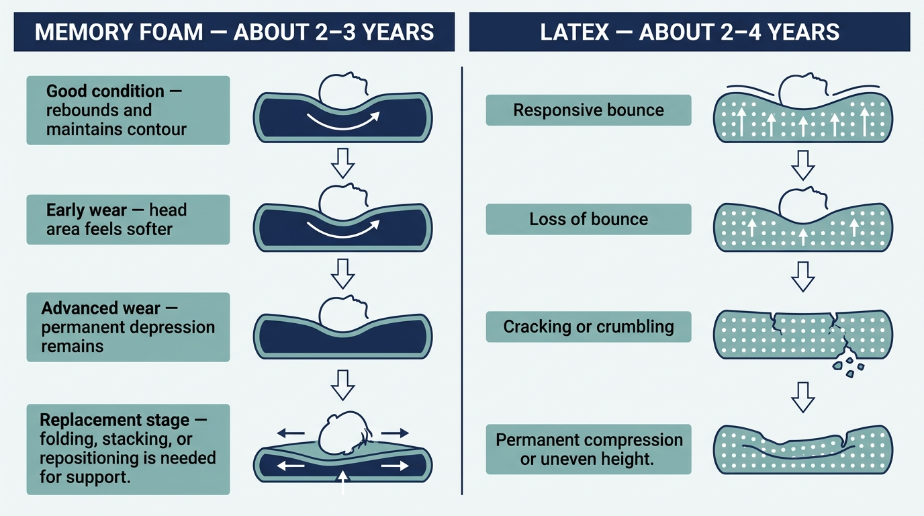
- Good condition: Foam rebounds after pressure and maintains the original contour.
- Early wear: The head area feels softer than the surrounding foam.
- Advanced wear: A permanent depression remains when nobody is using the pillow.
- Replacement stage: You need to fold, stack, or reposition the pillow to get the old support back.
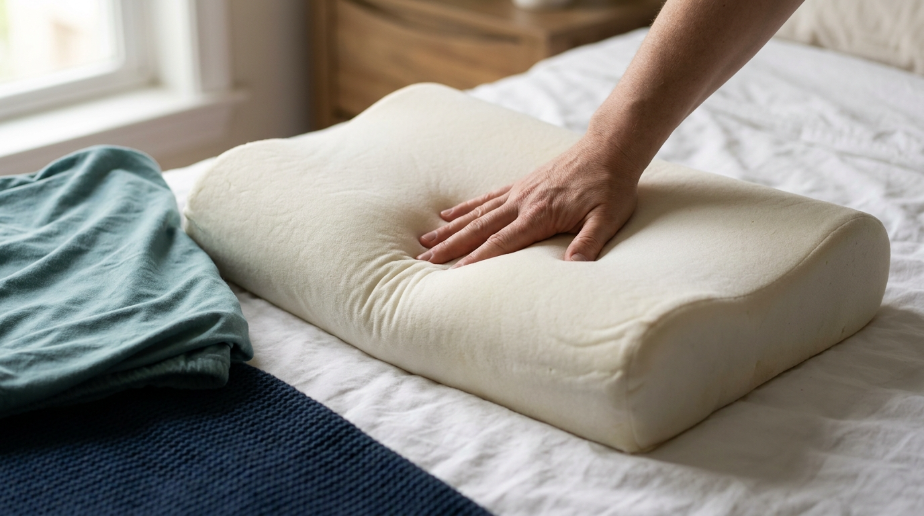
My practical test is simple. I press firmly into the main support area, release it, and compare the rebound with a less-used edge.
A major difference tells me more than the purchase date alone. Foam should still feel supportive, not permanently crushed.
How long does a latex cervical pillow last?
Latex is usually one of the more durable pillow materials. A quality latex pillow may remain useful for roughly two to four years, with some premium designs lasting longer under favorable conditions.
Latex has a naturally responsive feel, so loss of bounce is easy to notice. Cracking, crumbling, permanent compression, or uneven height are stronger replacement signals than simple discoloration.
Does the correct pillow size affect longevity?
Indirectly, yes. A pillow that is too low or too high may force you to bunch, fold, compress, or constantly reposition it.
Before assuming a newer pillow is defective, check whether you chose the right neck pillow size for your body and sleep position.
- Side sleepers: Usually need enough height to fill the shoulder-to-neck gap.
- Back sleepers: Usually need lower support that does not force the chin downward.
- Stomach sleepers: Often need a thin profile to avoid excessive neck rotation and extension.
If the pillow never fitted correctly, replacing it with the same height will not solve the underlying problem. My neck pillow selection guide explains how I compare loft, firmness, material, and sleeping position together.
When should you replace a neck pillow?
Replace a neck pillow when it permanently loses shape, no longer supports your normal position, develops damage or persistent odor, or consistently leaves you less comfortable. You do not need to wait until a recommended number of years has passed.
This matters with cervical pillows because support can decline gradually. You may adapt to the change without realizing how flat the pillow has become.
What are the clearest signs your neck pillow is worn out?
- Permanent flattening: The pillow no longer returns to its original height.
- Uneven support: One side feels softer, lower, or more compressed.
- Lumps or clumps: Loose filling has formed uncomfortable hard and soft areas.
- Damaged foam: The core is cracking, crumbling, or tearing.
- Compressed beads: A travel pillow feels thinner despite being correctly positioned.
- Recurring odor: Cleaning and airing no longer remove the smell.
- Visible damage: Seams, zippers, valves, or internal supports are failing.
- Constant adjustment: You repeatedly fold or reposition the pillow to find support.
Should you replace a pillow if your neck starts hurting?
A worn or poorly fitted pillow can contribute to uncomfortable sleep positioning, but new neck pain does not prove the pillow caused it. Neck pain has many possible causes.
Mayo Clinic recommends keeping the head and neck aligned with the body during sleep in its neck pain guidance.
If you recently noticed morning stiffness, compare your pillow’s current height with how it felt when new. Also consider whether your mattress, sleep position, or daily posture has changed.
If the pillow clearly makes symptoms worse, stop using it. Persistent pain, numbness, weakness, severe headaches, or symptoms following an injury deserve professional medical evaluation.
Can an old neck pillow still look fine?
Absolutely. A removable cover can look almost new while the support material underneath has softened significantly.
That is why I remove the pillowcase and inspect the actual pillow. I look for compressed areas, weak seams, foam changes, displaced filling, and differences in height.
Try this five-minute replacement check
- Remove the cover. Inspect the entire pillow instead of judging the pillowcase.
- Check the profile. Look across the surface for dips, collapsed edges, or uneven contours.
- Press and release. See whether foam or latex returns to shape normally.
- Lie down naturally. Do not deliberately correct your posture to make the pillow work.
- Check morning comfort. Notice whether you wake needing to stretch or reposition your neck immediately.
I find this more useful than replacing every pillow automatically on its second birthday. A supportive pillow that has aged well does not become useless overnight.
The opposite is also true. A six-month-old pillow that has permanently collapsed should not be kept simply because it is “too new” to replace.
Can you keep using a neck pillow beyond three years?
Yes, when the material is durable and the pillow remains clean, structurally sound, and supportive. Latex and replenishable-fill pillows are the most obvious examples.
The better question is whether it still performs its original job. This is also the standard I use when deciding whether a neck pillow is still working properly.
- Keep it: Shape, height, firmness, hygiene, and comfort remain consistent.
- Monitor it: Small changes are appearing, but support still feels even.
- Replace it: Structural or comfort problems persist after normal care and adjustment.
If your current pillow is losing support and you want a replacement built around durability or adjustability, these are the two designs I’d compare first:
🏆 Best for long-term bounce
Purple Harmony Pillow
★★★★☆ 4.4/5
The Harmony uses a responsive Talalay latex core surrounded by Purple’s GelFlex Grid and comes in three height choices. I like the latex construction here because maintaining bounce and height is especially useful when durability is a priority.
🛏️ Best adjustable support
Coop Original Adjustable Pillow
★★★★☆ 4.5/5
This pillow uses an adjustable blend of cross-cut memory foam and microfiber, so you can add or remove fill as support needs change. I prefer an adjustable design when gradual compression is the concern because restoring loft can extend its useful life.
Frequently Asked Questions
Can a neck pillow last five years?
A neck pillow can last five years in some cases, especially if it uses durable latex or replaceable fill and receives light use. Five years should not be assumed, though. Check whether the pillow still maintains its original shape, height, cleanliness, and support rather than relying only on age.
How often should you replace a travel neck pillow?
A frequently used foam or microbead travel pillow may need replacement after roughly one to three years, while an occasional-use pillow can last longer. Replace it sooner if the beads compress, foam loses shape, seams tear, the clasp fails, or an inflatable model develops persistent leaks.
Does washing a pillow extend its lifespan?
Correct cleaning can protect a pillow by reducing sweat, oils, dirt, and odor buildup. However, improper washing can shorten its life. Solid memory foam and many latex cores should not be machine washed, so always follow the manufacturer’s care label before cleaning.
Do memory foam neck pillows expire?
Memory foam does not suddenly expire on a specific date, but its structure gradually breaks down. Around two to three years is a useful general range. Permanent impressions, slower rebound, crumbling foam, and noticeably reduced support are stronger reasons to replace it than the calendar alone.
Should I replace my pillow if I wake up with neck pain?
Reassess the pillow if new morning stiffness or pain repeatedly appears, especially when its height or firmness has changed. However, neck pain can have many causes. Persistent pain, numbness, weakness, severe headaches, or symptoms after an injury should be evaluated by a healthcare professional.
Final takeaway: Most neck pillows last around one to three years, but material and condition matter more than a fixed replacement date. Check yours regularly for lost height, permanent compression, damaged filling, uneven support, and changes in morning comfort.
If the support has clearly changed, replacing the pillow sooner is usually more sensible than trying to stretch another year from it. Choose the replacement around your sleeping position, required height, and a material that can maintain that support over time.
“`
—
SEO METADATA (for WordPress SEO plugin — do not paste into content):
Meta Title:
Meta Description: Learn how long neck pillows last by material, how long cervical pillows last, and the clear signs it’s time to replace yours.
URL Slug: how-long-do-neck-pillows-last
Focus Keyword: How Long Do Neck Pillows Last?
Heading source used: OPTION A – user-supplied
Internal links placed from sitemap:
* https://decorminty.com/what-are-neck-pillows-made-of/ → placed in the Quick Answer Box with anchor text “what neck pillows are made of”
* https://decorminty.com/how-to-wash-clean-neck-pillow/ → placed in section “How long do neck pillows last?” with anchor text “washing and cleaning a neck pillow safely”
* https://decorminty.com/what-size-neck-pillow-should-you-get-a-practical-fit-guide/ → placed in section “How long do cervical neck pillows last?” with anchor text “right neck pillow size for your body and sleep position”
* https://decorminty.com/how-to-choose-right-neck-pillow/ → placed in section “How long do cervical neck pillows last?” with anchor text “neck pillow selection guide”
* https://decorminty.com/do-neck-pillows-really-work/ → placed in section “When should you replace a neck pillow?” with anchor text “a neck pillow is still working properly”
Links to manually verify before publishing:
* None identified from the authoritative and internal URLs used during research.
—

I’m a home decor enthusiast who loves discovering beautiful room ideas, creative DIY projects, and Pinterest-worthy decorating inspiration. At DecorMinty, I share simple tips, fresh trends, and practical ideas to help you create a home you’ll truly love—one room at a time.