How to Sleep With a Neck Pillow: The Right Way in Bed
Quick Answer
To sleep with a neck pillow, position it so your head stays centered over your shoulders instead of bending forward or sideways. Match the pillow height to your sleep position, and use this guide to choosing the right neck pillow if the contour feels too high or too low.
How to position it
- Lie down naturally: Settle into your normal back or side sleeping position before adjusting anything.
- Support your neck: Place the raised or supportive section beneath the natural curve of your neck.
- Center your head: Let the lower or recessed area cradle your head if the pillow has a contour.
- Check your chin: Your chin should not be pushed sharply toward your chest or tilted upward.
- Relax completely: The pillow should hold your position without making you tense your neck muscles.
- Recheck in the morning: New stiffness or soreness can mean the height, firmness, or shape needs adjusting.
A neck pillow can feel strange at first because it supports areas an ordinary flat pillow may leave unsupported. The goal is not to force your neck into a perfect-looking curve.
The goal is comfortable alignment while your muscles relax. I’ll show you how to position the pillow for back and side sleeping, which direction it should face, and how to spot a poor fit.
Definition: A neck pillow is a pillow designed to support the cervical spine, which is the neck section of your spine. Bed versions may use raised contours, a recessed head area, adjustable fill, or a small cervical roll to support the space beneath your neck.


How to Use a Neck Pillow in Bed
 Save
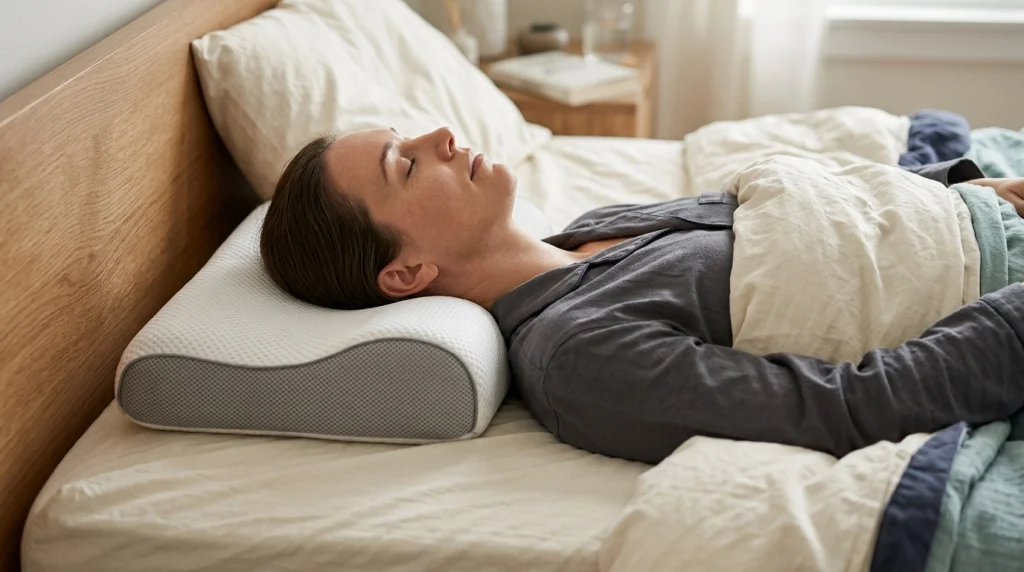
Use a bed-style neck pillow by supporting the curve of your neck while letting your head rest naturally. Your head, neck, chest, and upper back should feel like one continuous line rather than separate angles.
That distinction matters because a U-shaped travel pillow and a cervical bed pillow solve different problems. If those names are confusing, this guide explains what a neck pillow is and how the main styles differ.
Start in your normal sleeping position
Do not position the pillow while sitting upright and assume it will feel the same after you lie down. Your shoulder position, mattress compression, and head weight all change once you are in bed.
I use a simple relaxed-head check: lie down, unclench your jaw, drop your shoulders, and stop consciously holding your head straight. The pillow should support that relaxed position without making you correct it with muscle tension.
- Back sleeper: Put the supportive contour beneath your neck and let the head rest in the lower center area.
- Side sleeper: Use enough height to fill the space between your ear, neck, shoulder, and mattress.
- Combination sleeper: Look for a design that gives you a lower center for back sleeping and supportive side zones.
- Stomach sleeper: Avoid a thick neck contour because extra height can increase neck rotation and extension.
Keep the neck aligned instead of elevated
Mayo Clinic recommends supporting the neck so it remains aligned with the chest and back during sleep. Its sleep-position guidance also suggests a pillow beneath the knees for back sleepers who want additional lower-back support.
Do not confuse support with maximum height. A higher pillow is not automatically more supportive.
If your chin is pushed toward your chest, the pillow may be too tall behind your head. If your head drops backward or your neck feels unsupported, it may be too low.
Check where your shoulders are
With most bed pillows, your shoulders should remain mainly on the mattress rather than climbing onto the pillow. The lower edge of the pillow should meet the shoulder area without bunching beneath it.
This becomes especially important with contoured cervical pillows. Sliding too far upward can change the intended position of the neck roll.
- Too high on the bed: The contour may sit beneath your shoulders instead of your neck.
- Too low: The neck roll may press against the base of your skull rather than filling the neck curve.
- Correct placement: Your neck feels supported while your shoulders remain relaxed on the mattress.
How Are You Supposed to Sleep on a Neck Pillow?
You are supposed to sleep on a neck pillow with the supportive section filling the natural gap beneath your neck. Your head should rest rather than being propped aggressively upward.
As of 2026, there is no single pillow height or contour that fits every sleeper. Shoulder width, mattress firmness, body size, and sleep position all change the amount of support you need.
For back sleeping
Back sleepers generally need less height than side sleepers because the shoulder does not create the same large gap between the head and mattress. A contoured pillow often places the neck on a raised roll while the back of the head rests in a shallower center.
Cleveland Clinic advises choosing a pillow that keeps the neck parallel to the mattress rather than bending it noticeably up or down. Its neck-friendly pillow guidance also warns against support that bends the neck forward or sharply to one side.
For side sleeping
Side sleepers usually need more pillow height because the shoulder holds the head farther away from the mattress. The pillow has to fill that space without lifting the head beyond the centerline of the spine.
Look straight ahead rather than tucking your chin downward. Your nose and sternum should generally face the same direction instead of your face rotating toward the mattress or ceiling.
What should the pillow feel like?
A well-positioned neck pillow should feel supportive but not aggressive. You should not feel as though the pillow is stretching your neck while you sleep.
- Good sign: Your head feels supported without conscious effort.
- Good sign: You can relax your jaw and shoulders.
- Possible problem: Your chin is pressed toward your chest.
- Possible problem: Your ear is tilted noticeably toward one shoulder.
- Possible problem: You wake with new headaches, stiffness, tingling, or shoulder pressure.
Do not keep using a new pillow just because an adjustment period is mentioned on the packaging. Mild unfamiliarity is different from worsening pain or neurological symptoms.
Which Way Do You Sleep on a Neck Pillow?
The correct direction depends on the design, but a contoured bed pillow usually places a raised edge beneath your neck and a lower area beneath your head. If the pillow has two different neck-roll heights, start with the smaller one unless the manufacturer recommends otherwise.
For a broader explanation of how pillow shapes change by position, see this guide to the best neck pillow for each sleeping position.
Use the shape as a guide
Many cervical pillows are deliberately asymmetrical. One long edge may be higher than the other so you can rotate the pillow and change the amount of neck support.
Do not assume the tallest side belongs under your neck. Use the side that keeps your head closest to neutral.
| Sleep position | Typical pillow setup | What good alignment looks like | Common warning sign |
|---|---|---|---|
| Back | Neck on the supportive roll; head in the center cradle | Chin remains neutral instead of dropping toward the chest | Head feels pushed forward |
| Side | Head and neck supported on the taller side zone | Nose stays roughly centered with the chest | Head drops toward or away from the mattress |
| Combination | Lower center plus supportive side areas | Both positions feel supported without major readjustment | One position feels good while the other bends the neck |
| Stomach | Very low support, if a pillow is used | Minimal extra neck extension | Thick contour increases twisting |
What about a U-shaped travel neck pillow?
A horseshoe-shaped travel pillow is mainly designed to control head movement while you are sitting upright. It is not automatically a substitute for a full-size bed pillow.
Harvard Health notes that horseshoe pillows can support the neck during upright travel, but excessive thickness behind the neck may push the head forward. That same concern matters if you try to use one while lying flat, so check the position carefully using Harvard’s neck-pain sleep guidance.
Can You Sleep With a Neck Pillow?
 Save
Yes, adults can sleep with a properly fitted neck pillow through the night when it supports a comfortable position. The label “cervical,” “orthopedic,” or “ergonomic” does not guarantee that the pillow fits your body.
The more useful question is whether the pillow keeps your head supported without creating a new bend. Morning comfort gives you important feedback.
Signs the pillow is working
- Your neck feels relaxed: You are not fighting the pillow to find a comfortable position.
- Your head stays centered: It does not consistently fall forward, backward, or sideways.
- You change positions easily: Rolling over does not leave your neck trapped on a high ridge.
- You wake comfortably: You do not develop new stiffness or pressure that disappears after removing the pillow.
Signs you should adjust or stop
A pillow that feels unusual for the first few minutes is not necessarily a bad fit. Persistent or increasing discomfort is different.
- New morning headaches
- Increasing neck or shoulder pain
- Numbness or tingling in an arm or hand
- Weakness or radiating pain
- Dizziness that appears with the new position
- A strong feeling that your chin is being pushed downward
If symptoms are persistent, severe, follow an injury, or include weakness or numbness, get medical advice rather than relying on a different pillow as treatment. Pillows can change support, but they cannot diagnose the source of neck pain.
Can You Sleep on Your Side With a Neck Pillow?
Yes, you can sleep on your side with a neck pillow, and many cervical pillows are designed specifically for side and back sleepers. Side sleeping usually requires enough height to fill the larger space created by your shoulder.
Sleep Foundation recommends keeping the head and neck aligned with the rest of the body during side sleeping. Its neck-pain sleeping-position guidance notes that a pillow should prevent the head from sinking too far toward the mattress or being raised excessively.
Do a side-view alignment check
If possible, ask someone to look at you from behind or take a side-on photo while you lie naturally on the pillow. The center of your head should not visibly slope toward the mattress or ceiling.
This check can be more useful than judging pillow thickness by hand. Your shoulder width and how deeply your mattress compresses both affect the final height.
Adjust for shoulder width and mattress firmness
A broad-shouldered sleeper on a firm mattress often creates a larger head-to-mattress gap than a smaller sleeper on a softer mattress. That is why fixed pillow-height rules are only starting points.
If you are comparing profiles, this Decorminty neck pillow sizing guide explains how shoulder width, sleep position, and mattress feel change the fit.
Try a pillow between your knees
Side sleeping affects more than the neck. When the upper leg drops forward, it can rotate the hips and lower torso.
A small pillow between the knees can help keep the pelvis and spine more comfortable. The neck pillow can then focus on supporting the upper part of your sleeping posture.
- Keep your face forward: Avoid sleeping with your chin tucked hard toward your chest.
- Fill the shoulder gap: Do not let the head collapse toward the mattress.
- Avoid excessive height: More loft can be just as uncomfortable as too little.
- Keep the lower shoulder off the pillow: Let it rest naturally on the mattress.
- Recheck after settling: Foam and fiber can compress after several minutes.
If you are ready to try a different pillow, these are two options I would compare first based on different priorities:
🏆 Best Contoured Support
TEMPUR-Neck Pillow
★★★★☆ 3.8/5 on Tempur-Pedic
This extra-firm contoured pillow comes in small, medium, and large profiles and is designed for back and side sleeping. I would choose it for someone who prefers a defined neck contour and wants several profile sizes rather than adjustable loose fill.
💤 Best Adjustable Loft
Coop Sleep Goods Original Adjustable Pillow
★★★★★ 4.7/5 on Coop Sleep Goods
The Original uses an adjustable blend of cross-cut memory foam and microfiber, so you can add or remove fill to change height and firmness. I would favor this option for combination sleepers who want to fine-tune loft instead of committing to one molded contour.
Frequently Asked Questions
Is a neck pillow supposed to go under your neck or your head?
A cervical neck pillow usually supports both areas differently. The raised section sits beneath the neck curve, while the head rests in a lower or recessed area so the pillow supports the neck without pushing the entire head upward.
Can I sleep with a neck pillow all night?
Yes, if the pillow is designed for bed use and keeps you comfortable and aligned. Reconsider the setup if you repeatedly wake with new stiffness, headaches, numbness, shoulder pressure, or a feeling that your head is being forced into position.
Why does my neck hurt after using a cervical pillow?
The pillow may be too high, too low, too firm, or positioned incorrectly for your body and mattress. Some unfamiliarity can happen when changing pillows, but pain that becomes stronger or includes numbness, tingling, or weakness deserves medical attention.
Should my shoulders be on a neck pillow?
For most cervical bed pillows, your shoulders stay mainly on the mattress while the pillow supports your head and neck. Pulling the shoulders too far onto a contoured pillow can move the neck roll away from the area it was designed to support.
Is a neck pillow better for back or side sleeping?
Both positions can work well when the pillow matches your body. Back sleepers often need a lower center with neck support, while side sleepers usually need more height to fill the space between the shoulder, neck, and mattress.
The takeaway: Do not chase the tallest contour or the firmest pillow. Set up your neck pillow so you can relax completely, keep your head centered, and wake without new discomfort.
If your current pillow cannot do that after reasonable adjustments, change the height, orientation, or pillow style rather than forcing yourself to adapt to a poor fit.

I’m a home decor enthusiast who loves discovering beautiful room ideas, creative DIY projects, and Pinterest-worthy decorating inspiration. At DecorMinty, I share simple tips, fresh trends, and practical ideas to help you create a home you’ll truly love—one room at a time.