Can Neck Pillows Help With Headaches, Vertigo and Other Pain?
Quick Answer
Neck pillows can help with headaches, neck pain, and some upper-back discomfort when the pain is linked to poor neck alignment, muscle tension, or awkward sleeping posture. They do not cure vertigo, tailbone pain, hemorrhoids, or medical spine conditions, so use them as support tools rather than treatment. For general neck-pain sleep guidance, Mayo Clinic also recommends keeping the head and neck aligned with the body during sleep through proper neck support.
Where a neck pillow may help
- Tension headaches: It may reduce morning tightness when the headache starts from neck and shoulder strain.
- Travel stiffness: A supportive travel pillow can stop your head from dropping sideways during upright sleep.
- Mild back strain: A bed pillow may help indirectly by keeping your neck, chest, and upper back in line.
- Posture discomfort: It can support better sleep posture, but it will not reverse a structural neck hump.
- Sitting pain: A neck pillow is usually the wrong tool for tailbone pain or hemorrhoids.
When to stop using one
- Stop if it causes worse headaches, dizziness, numbness, tingling, arm pain, or stronger morning stiffness.
I like neck pillows, but I do not like the way they get marketed as miracle pain fixers.
As of 2026, the honest answer is still more practical: a neck pillow helps when it solves a support problem. It does not help much when the real problem is medical, inflammatory, nerve-related, or coming from somewhere other than the neck.
Definition: A neck pillow is a pillow designed to support the cervical spine, which is the neck portion of your spine. It may be a contoured bed pillow, a cervical roll, an adjustable sleeping pillow, or a U-shaped travel pillow.
Before buying one for pain, I always ask one question first: is the pain caused by poor support, or is the pillow being blamed for something else?
That question changes everything.


Can a neck pillow help with headaches?
 Save
SaveYes, a neck pillow can help with some headaches, especially tension-type headaches that start from tight neck, shoulder, scalp, or jaw muscles. It is less likely to help migraines, sudden severe headaches, or headaches caused by illness, injury, blood pressure, dehydration, or neurological problems.
In my own testing, the biggest clue is timing. If the headache appears after sleeping badly, traveling, or waking with a stiff neck, pillow support is worth checking.
When headache relief is realistic
A supportive pillow may help when your head is bent forward, tilted sideways, or unsupported for hours. That strained position can keep small neck muscles working while you should be resting.
- Morning headaches: These often point to sleep posture, pillow height, jaw tension, or poor neck support.
- Base-of-skull pain: This may come from tight muscles where the neck meets the head.
- Travel headaches: These can happen after your head drops forward during a flight or car ride.
- Desk-related tension: A better pillow may help at night, but daytime posture still matters.
If you want the broader neck-support basics first, I’d start with this guide on whether neck pillows really work. It explains the difference between real support and marketing language.
When a pillow is not enough
A pillow should not be your only plan if headaches are new, severe, recurring, or paired with warning signs. MedlinePlus notes that headache red flags include symptoms like stiff neck, fever, confusion, loss of consciousness, or headache after a head injury.
Use the pillow as one clue, not the diagnosis.
| Pain or symptom | Neck pillow may help when… | Use caution when… | Better support tool |
|---|---|---|---|
| Headaches | Pain starts after poor sleep, travel, or neck stiffness. | Headache is sudden, severe, or paired with fever or confusion. | Contoured bed pillow or travel neck pillow. |
| Vertigo | It only reduces awkward head movement during rest. | Room-spinning dizziness, nausea, hearing changes, or falls occur. | Medical evaluation and safe sleeping position. |
| Back pain | Upper-back strain comes from poor neck and shoulder alignment. | Pain travels down the leg or includes weakness or numbness. | Neck pillow plus knee pillow or side-sleep support. |
| Tailbone pain | Only if used briefly as temporary padding. | Sitting pain follows a fall, injury, swelling, or nerve symptoms. | Coccyx cushion or gel seat cushion. |
| Hemorrhoids | Usually not the right use case. | There is rectal bleeding, severe pain, or a painful lump. | Medical care, stool-softening habits, and pressure relief. |
Can a neck pillow help with vertigo?
A neck pillow does not treat vertigo itself. It may only help you rest more comfortably by keeping your head steady and supported.
Vertigo is a spinning or moving sensation, and it often involves the inner ear or balance system. The National Institute on Deafness and Other Communication Disorders explains that balance disorders can come from health conditions, medications, or problems in the inner ear or brain.
Why support can still matter
Some people with dizziness feel worse when their head rolls, drops, or turns sharply in bed. A supportive pillow can reduce those awkward movements during rest.
- Use a stable pillow: Choose one that does not collapse under your head.
- Avoid extreme height: A tall pillow can flex the neck too much.
- Move slowly: Sit up gradually instead of snapping upright.
- Keep the floor clear: Vertigo can raise fall risk when getting out of bed.
I would not buy a neck pillow expecting it to “fix” vertigo. I would buy one only if poor head support is making rest feel more unstable.
When to talk to a clinician
Vertigo deserves medical attention when it is new, severe, recurring, or paired with hearing changes, headache, weakness, trouble walking, or fainting. A pillow cannot identify the cause.
For a pillow-specific starting point, compare your sleeping style with this guide to the best neck pillow for your sleeping position. The wrong height can make dizziness and neck tension feel worse.
Can a neck pillow help with back pain?
Yes, a neck pillow can help some back pain indirectly when your upper back pain is connected to poor neck and shoulder alignment. It is not enough for lower-back pain that comes from discs, joints, sciatica, injury, or long sitting.
The neck and upper back work together. When your head drops forward all night, your upper-back muscles often tighten to compensate.
Upper back vs lower back
A neck pillow is most relevant to upper-back discomfort between the shoulders. That area reacts quickly to head position, shoulder compression, and pillow height.
- Upper-back tightness: Check pillow height, shoulder space, and whether your chin is tucked forward.
- Lower-back aching: Try knee support, mattress assessment, and daily movement habits.
- Side-sleep strain: Use a pillow between your knees to reduce twisting.
- Back-sleep strain: A small pillow under the knees may reduce lower-back pull.
Mayo Clinic’s sleeping-position advice says your pillow should keep your neck aligned with your chest and back. That is the exact standard I use when testing a new pillow.
My quick alignment check
I use a phone photo from the side when testing a new pillow. It is not fancy, but it catches obvious problems fast.
Your ear, shoulder, and mid-back should look relaxed and roughly lined up. If your chin points down toward your chest, the pillow is too tall for back sleeping.
For a full buying framework, see this guide on how to choose the right neck pillow. Fit matters more than the word “orthopedic” on the box.
Can a neck pillow help with a neck hump?
A neck pillow cannot reverse a neck hump by itself. It may support better sleeping posture if the hump is related to forward-head posture, but it will not reshape bone, correct kyphosis, or replace strength work.
This is where expectations matter. A pillow can keep your neck from folding into a worse position for seven hours, but it cannot undo the other seventeen hours of posture, screen use, muscle weakness, or medical change.
What a pillow can do
A good pillow keeps the head from being pushed forward. That matters because a thick pillow can make a rounded upper-back posture look and feel worse by tucking the chin.
- Back sleepers: Use gentle neck support, not a steep wedge under the head.
- Side sleepers: Fill the shoulder gap so the head does not drop sideways.
- Stomach sleepers: Avoid bulky contour pillows because they rotate the neck for hours.
- Desk workers: Pair the pillow with screen-height changes and upper-back mobility work.
If your pillow feels comfortable but your posture still worsens, the missing piece is probably not another pillow. It is usually daily movement, strength, ergonomics, or medical assessment.
Firmness matters here
A pillow that is too soft lets the head sink. A pillow that is too firm may push the neck into a forced position.
Most people do best with medium-firm support, but the right choice depends on sleep position and shoulder width. This firm vs soft neck pillow comparison is helpful if you are stuck between comfort and support.
Can a neck pillow help with tailbone pain?
 Save
SaveA neck pillow is usually not the right tool for tailbone pain. Tailbone pain needs pressure relief under the pelvis, not support around the neck.
MedlinePlus notes that tailbone injuries often cause pain when sitting or putting pressure on the tailbone. That is why seat cushions and coccyx cushions make more sense than travel neck pillows.
Why shape matters
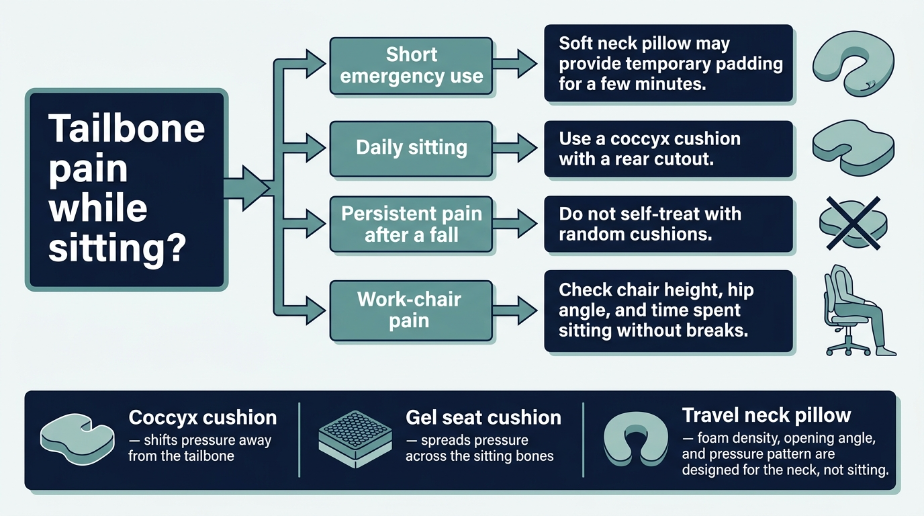
A U-shaped travel pillow may look similar to some seat cushions, but it is built for the neck. The foam density, opening angle, and pressure pattern are not designed for sitting.
- Short emergency use: A soft neck pillow might work as temporary padding for a few minutes.
- Daily sitting: Use a coccyx cushion with rear cutout support.
- After a fall: Do not self-treat persistent tailbone pain with random cushions.
- Work chair pain: Check chair height, hip angle, and how long you sit without breaks.
In my opinion, this is one of the easiest places to waste money. Buy the product built for the body part that hurts.
When a seat cushion is smarter
A coccyx cushion shifts pressure away from the tailbone. A gel seat cushion spreads pressure more evenly across the sitting bones.
Those designs make sense for tailbone discomfort. A neck pillow does not.
Can you use a neck pillow for hemorrhoids?
You can use a neck pillow as temporary soft padding, but I would not recommend it as a real hemorrhoid comfort solution. Hemorrhoids involve swollen veins around the anus or lower rectum, and pressure relief needs to be planned carefully.
MedlinePlus lists anal pain, especially when sitting, as one possible hemorrhoid symptom. It also notes that prolonged sitting and straining can contribute to the problem.
Why I would be cautious
A U-shaped pillow may seem useful because it creates an opening. The problem is that neck pillows are not shaped to distribute body weight safely while sitting.
- Too soft: The pillow may collapse and create uneven pressure.
- Too narrow: It may press into sensitive tissue instead of relieving it.
- Too unstable: It can shift under you and change your posture.
- Too temporary: It does not address constipation, straining, or sitting habits.
If there is rectal bleeding, severe pain, or a lump that does not improve, treat that as a medical issue. A pillow is not enough.
The practical rule I use
Use a neck pillow for neck support. Use a seat cushion for sitting pain.
That sounds obvious, but product shapes can be misleading. Similar-looking cushions often solve very different pressure problems.
If you are deciding whether a neck pillow belongs in your setup at all, this overview on whether neck pillows are good for you gives a balanced starting point.
If you’re ready to pick one, here’s what I’d actually consider based on the type of support you need:
🏆 Best for Neck Alignment
EPABO Contour Memory Foam Pillow
★★★★☆ 4.4/5
This contoured memory foam pillow is built to cradle the neck while keeping the head from sinking too far. I like it most for back sleepers and careful side sleepers who need structure without a tall, aggressive wedge.
🪑 Best for Sitting Pressure
ComfiLife Gel Enhanced Seat Cushion
★★★★☆ 4.5/5
This is a gel-and-memory-foam seat cushion with a rear cutout designed for sitting pressure, not neck support. I would choose this kind of cushion over a travel neck pillow for tailbone discomfort or long chair sessions.
FAQ
Can a neck pillow make headaches worse?
Yes, a neck pillow can make headaches worse if it is too high, too firm, or shaped wrong for your sleep position. Stop using it if headaches increase after switching pillows, especially if you also notice dizziness, numbness, or stronger neck stiffness.
Is a travel neck pillow good for sleeping in bed?
Usually no. Travel neck pillows are designed for upright sitting, such as planes, cars, and trains. Bed pillows need to support your neck differently because your head, shoulders, mattress, and sleep position all affect alignment.
What pillow height is best for neck pain?
The best height keeps your neck neutral. Side sleepers usually need enough loft to fill the shoulder gap, while back sleepers need lower support that cradles the neck without pushing the chin toward the chest.
Can a neck pillow cure vertigo?
No, a neck pillow cannot cure vertigo. It may help you keep your head steadier while resting, but vertigo can involve the inner ear, nerves, medications, or other health conditions that need proper evaluation.
Should I use a neck pillow every night?
You can use a neck pillow every night if it improves comfort and does not cause new symptoms. If you wake with more pain, headaches, tingling, or dizziness, reassess the height, firmness, and shape.
The takeaway is simple: a neck pillow helps when your pain comes from poor support, awkward sleep posture, or travel-related neck strain.
It is not a cure for vertigo, hemorrhoids, tailbone injuries, migraines, or structural posture changes. Match the pillow to the problem, and do not ignore symptoms that deserve medical care.

I’m a home decor enthusiast who loves discovering beautiful room ideas, creative DIY projects, and Pinterest-worthy decorating inspiration. At DecorMinty, I share simple tips, fresh trends, and practical ideas to help you create a home you’ll truly love—one room at a time.