How to Wash and Clean a Neck Pillow Safely
Quick Answer
To wash and clean a neck pillow safely, check its care label first and identify the filling before adding water. Some polyester pillows can handle a gentle machine cycle, while solid memory foam usually needs spot cleaning and air drying. If you are unsure what’s inside yours, my guide to what neck pillows are made of can help you identify the material first.
Quick cleaning steps
- Check the label: Follow the manufacturer’s washing, water-temperature, and drying instructions.
- Remove the cover: Unzip washable covers and remove detachable supports when the design allows it.
- Treat stains: Blot marks with a small amount of mild detergent instead of saturating the pillow.
- Match the material: Wash polyester only when permitted and keep solid memory foam out of the washer.
- Dry completely: Never store a neck pillow while its filling or foam is still damp.
The safest rule
- When general cleaning advice conflicts with your pillow’s care label, follow the care label.
Neck pillows collect sweat, skin oils, hair products, dust, and plenty of grime during travel. I treat them more like specialty bedding than an ordinary pillowcase.
The filling is what changes everything. A cleaning method that works for polyester can ruin molded memory foam or create a mess with loose microbeads.
A neck pillow is a support pillow designed to stabilize or cushion the head and neck during sleep, rest, or upright travel. Common fills include memory foam, polyester fiber, microbeads, latex, inflatable chambers, and other loose materials.


Are neck pillows washable?
Yes, many neck pillows are washable, but that does not mean the entire pillow can always go into water. A removable cover, inner filling, foam insert, and structural support may each require different cleaning methods.
Start with the care label. In 2026, neck-pillow construction varies too much for one washing rule to fit every model.
Washability depends on what is inside
| Pillow type | Typical cleaning method | Machine wash? | Typical drying method |
|---|---|---|---|
| Solid memory foam | Spot clean core; wash cover separately | Usually no | Air dry |
| Polyester fiber | Gentle wash when label permits | Often | Label-dependent |
| Memory-foam travel pillow | Wash removable cover; wipe foam | Cover only on many models | Air dry foam |
| Microbead | Usually spot clean unless stated otherwise | Often no | Air dry |
| Inflatable | Wipe bladder; wash removable cover | Usually not the bladder | Air dry |
I pay special attention to zippers before opening anything. Some expose a washable cover, while others lead directly to loose filling.
Can you wash a neck pillow?
 Save
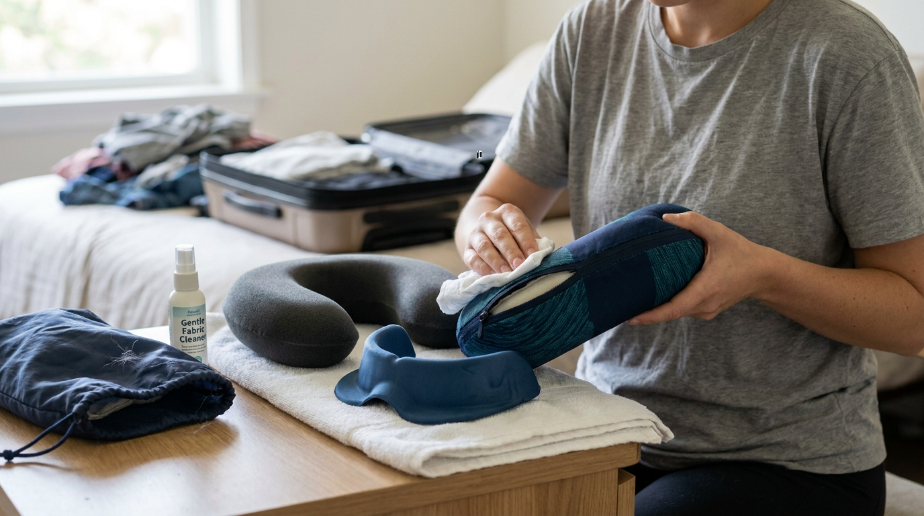
SaveYou can wash a neck pillow when its materials and care instructions allow it. Sometimes “washing” means laundering only the removable outer cover rather than soaking the whole pillow.
My rule is simple: inspect first, separate removable parts, then use the mildest cleaning method that will solve the problem.
My safe neck-pillow cleaning routine
- Inspect the seams. Look for openings, broken zippers, or stitching that could release filling.
- Read the care tag. Check water temperature, washing cycle, bleach, and dryer restrictions.
- Remove the cover. Wash removable fabric separately when the manufacturer allows it.
- Remove detachable supports. Take out plastic or foam pieces only when they are designed to come out.
- Blot stains first. Use a damp cloth and a small amount of mild detergent.
- Wash carefully. Use the permitted hand-wash or machine-wash method.
- Remove detergent residue. Avoid leaving concentrated soap inside fabric or filling.
- Dry completely. Give thick areas and seams enough time to lose trapped moisture.
If you use a travel pillow with several straps or supports, take a quick look at how to use and wear a neck pillow correctly before disassembling it. That makes putting the parts back in the right position much easier.
What detergent should you use?
I prefer a modest amount of mild liquid detergent because excess soap is difficult to rinse from thick fabric. Strong fragrances, bleach, and aggressive stain treatments are unnecessary for routine cleaning unless the care label permits them.
If ingredient sensitivity matters to you, the EPA Safer Choice program provides a searchable way to identify cleaning products that meet its ingredient criteria.
Can you wash a travel neck pillow?
Many travel neck pillows can be cleaned, but you need to know what sits beneath the outer fabric first. Travel designs can combine foam, plastic supports, straps, fasteners, and inflatable parts.
That is why I never put a new travel pillow directly into the washer after a flight.
Clean the areas that get dirtiest first
- Under the chin: This area often collects skin oil, makeup, sunscreen, and moisture.
- Along the jaw: Fabric here stays in direct contact with your face for long periods.
- Back of the neck: Sweat can build up where the pillow presses against your skin.
- Fasteners: Hook-and-loop closures and straps can trap lint and hair.
- Travel case: Clean the storage pouch too if the pillow goes back inside it.
Real manufacturer examples
Trtl currently instructs owners of its original travel pillow to remove the internal plastic support and wash the fabric on a cool 30°C cycle. Its official care instructions show why removing structural pieces matters.
Cabeau takes a different approach with its memory-foam models. For the Evolution line, the company says to machine wash the removable fabric cover on cool while wiping the memory-foam insert with a damp cloth rather than washing the foam itself.
| Example | Washable part | Current care example |
|---|---|---|
| Trtl Travel Pillow | Fabric after support removal | 30°C/cool wash |
| Cabeau Evolution memory-foam models | Removable cover | Cool wash; foam wiped and air dried |
If easy cleaning matters when you replace a worn pillow, my neck pillow selection guide explains why removable covers and material type deserve attention before you buy.
Can you wash a neck pillow in a washing machine?
You can machine wash a neck pillow only when its label specifically permits machine washing. Agitation can tear weak seams, deform foam, damage internal supports, or release loose filling.
If the care label is missing, I would not treat the washer as the default option.
Check these five things before using the washer
- Machine-wash symbol: Confirm that the pillow or cover is intended for machine washing.
- Removable components: Take out approved foam, plastic, or support pieces first.
- Seam condition: Repair openings before water and agitation make them worse.
- Cycle setting: Use the gentlest cycle allowed by the manufacturer.
- Detergent amount: Use enough to clean without creating difficult-to-rinse residue.
For a machine-washable polyester pillow, avoid stuffing the washer too tightly. The pillow needs enough space for water to move through the fabric.
A laundry bag can reduce snagging for some removable covers, but it does not make an otherwise non-washable pillow safe for the machine.
Can memory foam neck pillows be washed?
Solid memory foam neck pillows generally should not be machine washed or submerged unless the manufacturer clearly says otherwise. Water can penetrate the foam deeply, while agitation can affect its structure.
That does not mean you have to live with stains or odors. Spot cleaning is usually the safer approach.
How to clean solid memory foam
- Remove the washable cover.
- Vacuum loose dust with a gentle upholstery attachment if needed.
- Mix a small amount of mild detergent with lukewarm water.
- Dampen a clean cloth without soaking it.
- Blot the stained area gently.
- Use another lightly dampened cloth to lift soap residue.
- Leave the foam in a ventilated area until completely dry.
Tempur-Pedic makes this distinction clear in its current pillow-care guidance. The company advises washing removable covers separately and not submerging the insert unless specific product instructions say it is washable.
What about shredded memory foam?
Shredded foam needs its own care instructions. Some designs place washable fill inside a protective shell, while others require the entire inner pillow to remain dry.
Never assume a shredded filling is washable simply because it is not one solid block.
Can neck pillows go in the dryer?
Some neck-pillow covers and fiber-filled pillows can go into a dryer on a permitted low or cool setting. Memory foam should normally be kept away from the dryer unless the manufacturer explicitly allows it.
Heat is not the only issue. Tumbling can also distort a structured insert.
Drying rules by material
- Solid memory foam: Air dry in a ventilated place away from concentrated heat.
- Removable fabric cover: Follow its tag; some allow low tumble drying.
- Polyester fiber: Low heat may be acceptable when the label permits it.
- Microbeads: Air drying is the cautious default unless instructions say otherwise.
- Inflatable bladder: Wipe and air dry rather than tumble drying.
Complete drying matters more than speed. A pillow can feel dry on the surface while holding moisture around seams or deep inside the filling.
I press thick areas with a clean, dry towel before storing a pillow. If the towel picks up moisture or the pillow feels cool and damp inside, it gets more air-drying time.
Can you wash a neck pillow with beads?
 Save
SaveA microbead neck pillow needs more caution than a simple polyester pillow. Tiny beads can escape through damaged seams, and many bead-filled pillows are intended for spot cleaning rather than full machine washing.
Always inspect the stitching before adding water.
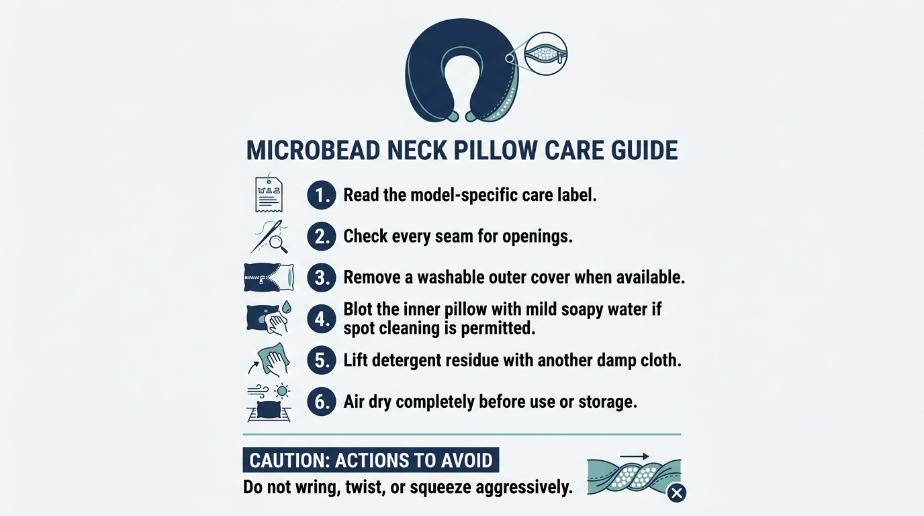
How to clean a microbead neck pillow
- Read the model-specific care label.
- Check every seam for openings.
- Remove a washable outer cover when available.
- Blot the inner pillow with mild soapy water if spot cleaning is permitted.
- Lift detergent residue with another damp cloth.
- Air dry completely before use or storage.
Avoid wringing, twisting, or squeezing a bead pillow aggressively. Pressure can strain the seams and force thousands of small beads toward one weak point.
Once a bead pillow starts leaking, replacement is often more practical than trying to keep repairing stressed fabric.
Can you wash a bean-bag neck pillow?
You may be able to clean a bean-bag-style neck pillow, but “bean bag” describes a shape and feel more than one specific filling. The pillow might contain microbeads, synthetic pellets, foam pieces, or another loose material.
Identify the fill before you immerse anything.
Bean-bag pillow cleaning checklist
- Find the care label: Do not rely only on the pillow’s appearance.
- Look for a removable shell: Wash the shell separately when allowed.
- Check the zipper: Make sure it is not simply an access point for loose filling.
- Avoid soaking unknown fill: Some materials clump or dry poorly.
- Blot instead of scrubbing: Keep moisture limited to the dirty area.
- Dry before storage: Never zip a damp bean-bag pillow into luggage.
As of 2026, the care label still beats any universal cleaning hack. Neck pillows simply use too many different materials for one method to work safely on all of them.
If a pillow is difficult to clean and no longer comfortable, it may be time to ask whether your neck pillow is still doing its job. A damaged or badly compressed pillow can be clean and still be a poor fit.
If you’re replacing a hard-to-clean travel pillow, these are two designs I’d compare first:
🧼 Best for washable fabric
Trtl Travel Pillow
★★★★★ 4.7/5
The Trtl uses a removable internal support and a fabric section designed for a 30°C/cool machine wash. I like this setup for frequent travel because you can clean the high-contact fabric without washing a bulky foam core.
✈️ Best removable-cover design
Cabeau Evolution S3 Neck Pillow
★★★★☆ 4.4/5
The Evolution S3 combines a supportive memory-foam insert with a removable cover that can be washed separately. I prefer this style when I want the feel of memory foam without having to immerse the foam itself during routine cleaning.
Frequently Asked Questions
How often should you wash a neck pillow?
Clean a neck pillow according to how often you use it, how much skin contact it gets, and its care instructions. For frequently used travel pillows, I would clean the removable cover after dirty or sweaty trips and spot clean the core whenever visible marks or odors appear.
How do you get a smell out of a neck pillow?
Start by cleaning the removable cover and airing the pillow in a ventilated place. For foam, avoid soaking it just to remove an odor; use the manufacturer’s approved spot-cleaning method and give the material enough time to dry completely.
Can you hand wash a neck pillow?
Some fabric and fiber-filled neck pillows can be hand washed, but solid foam and structured pillows may not tolerate immersion. Read the label first, and remember that “hand wash” does not automatically make soaking safe for every pillow material.
Can you wash a U-shaped neck pillow?
Yes, some U-shaped neck pillows can be washed, while others need spot cleaning. The U shape does not determine washability; the filling, removable cover, seams, internal supports, and manufacturer’s care instructions determine which method is safe.
What happens if a memory foam neck pillow gets wet?
A small damp area can usually be air dried, but soaking solid memory foam makes complete drying difficult and may affect the material. Blot excess moisture gently, improve airflow around the pillow, and avoid trying to speed drying with strong direct heat.
Final takeaway:
Check the label before cleaning any neck pillow, then treat the cover and filling as separate materials when necessary.
When you cannot verify that a pillow is machine washable, gentle spot cleaning and thorough air drying are safer than gambling on a washer or dryer. A few minutes of checking the material can save an otherwise good pillow.

I’m a home decor enthusiast who loves discovering beautiful room ideas, creative DIY projects, and Pinterest-worthy decorating inspiration. At DecorMinty, I share simple tips, fresh trends, and practical ideas to help you create a home you’ll truly love—one room at a time.