What Size Neck Pillow Should You Get? A Practical Fit Guide
Quick Answer
The right neck pillow size is the one that keeps your head level with your spine without forcing your neck upward or letting it sag. As a starting point, stomach sleepers usually need a low loft under 3 inches, back sleepers often suit a 3–5-inch medium loft, and many side sleepers need medium-to-high support. Use this guide to choosing the right neck pillow to compare height, firmness, and shape together.
Choose your size using these checks
- Stomach sleeping: Start with a low-profile pillow, often under 3 inches thick.
- Back sleeping: Medium loft around 3–5 inches usually gives the neck space to rest naturally.
- Side sleeping: Look for enough height to fill the space between your ear and mattress.
- Shoulder width: Broader shoulders can create a larger gap that needs more pillow height.
- Mattress firmness: A firm mattress usually requires more pillow loft than a softer mattress.
- Cervical shape: Measure support height, not just the pillow’s overall length and width.
My simplest sizing rule
- Size the space between your neck and sleep surface first. Standard, queen, or petite labels come second.
Buying a neck pillow gets confusing because “size” can mean several things. It may describe overall dimensions, loft, cervical-roll height, or even how much the fill compresses.
I recommend focusing on working height first. A correctly sized pillow should support your neck after your head has settled into it, not just look thick on the shelf.


What are neck pillows made of?
Neck pillows are made from materials such as memory foam, latex, polyester fiber, down alternative, buckwheat hulls, and blended fills. The material changes how much of the pillow’s advertised height you actually feel.
Neck pillow size is best understood as the height and shape that remain while your head is resting on the pillow.
Start with loft rather than standard or queen size
Pillow height is commonly called loft. Sleep Foundation categorizes low-loft pillows as under 3 inches, medium loft as 3–5 inches, and high loft as more than 5 inches.
| Sleep position | Useful starting loft | Why |
|---|---|---|
| Stomach | Low, under 3 inches | Reduces excessive upward neck angle. |
| Back | Medium, 3–5 inches | Fills the neck curve without pushing the head too far forward. |
| Side | Medium to high | Fills the larger space created by the shoulder. |
These are starting points rather than exact prescriptions. Your shoulder width, mattress, body build, and pillow compression can change the height you need.
Why material changes the size you should buy
A 5-inch pillow that collapses significantly can feel lower than a dense 4-inch pillow. That is why I would never choose by package dimensions alone.
- Solid memory foam: Compresses gradually and contours closely around the head and neck.
- Latex: Usually feels springier and keeps more of its original height under pressure.
- Polyester fiber: Can compress more and may need regular fluffing.
- Shredded foam: Often lets you remove fill to change the working loft.
- Buckwheat: Allows substantial height adjustment by adding or removing hulls.
If you switch positions during the night, adjustability can matter more than a perfect fixed measurement. Our neck pillow guide by sleeping position explains those differences in more detail.
Sleep Foundation also notes that mattress firmness affects pillow requirements. Your body sinks farther into a soft mattress, which can reduce the pillow height needed beside your head.
What is a cervical neck pillow?
 Save
SaveA cervical neck pillow is shaped to support the cervical spine, which is the neck portion of your spine. Many designs combine a lower head area with raised sections that support the natural neck curve.
The important measurement is often the cervical support height, not the pillow’s total width.
Cervical pillows can have their own size systems
Unlike conventional pillows, some cervical models are sold in petite, midsize, and full sizes. Manufacturer measurements can vary significantly between designs.
Core Products, for example, currently lists three sizes for its Tri-Core Cervical Support Pillow:
| Tri-Core size | Overall dimensions | Maximum listed height |
|---|---|---|
| Petite | 19 × 12 inches | 4 inches |
| Midsize | 22 × 15 inches | 4 inches |
| Full | 24 × 16 inches | 5 inches |
Those measurements are specific to that product, not universal cervical-pillow standards. Always use the manufacturer’s chart when a pillow has molded contours or different neck rolls.
How should a cervical pillow fit?
Your neck should feel supported without your chin being pushed strongly toward your chest. Side sleepers also need enough height to keep the head from dropping toward the mattress.
- Too low: Your head may tilt downward or your neck may feel unsupported.
- Too high: Your head can be pushed away from a neutral position.
- Too soft: The pillow may start at the correct height but collapse during the night.
- Too firm: A correct height can still feel uncomfortable if pressure builds around the neck.
Cleveland Clinic discusses contour pillows and neck support as part of choosing a pillow that adapts to your sleeping position. You can review its neck-pillow guidance here.
If discomfort is the reason you’re changing pillows, compare sizing with our guide to choosing a neck pillow for neck pain. Persistent or worsening pain deserves professional medical advice rather than repeated pillow changes.
What is an ergonomic neck pillow?
An ergonomic neck pillow is designed around body positioning rather than a simple rectangular shape. It may use contours, shoulder cutouts, neck rolls, side-sleeping zones, or adjustable fill.
“Ergonomic” doesn’t automatically tell you which size to buy. You still need to match the pillow’s working height to your body and sleeping position.
Look at the shape before the label
Two ergonomic pillows can both measure 24 inches wide yet fit completely differently. A deep center cradle can reduce head height while raised side wings increase side-sleeping support.
Check these measurements when the manufacturer provides them:
- Center height: Matters most when your head rests in a molded depression.
- Neck-roll height: Determines how strongly the pillow fills your cervical curve.
- Side height: Important if you turn from your back onto your side.
- Shoulder cutout: Changes how close your body can sit to the pillow.
- Compression: Determines the real height once your head settles.
My three-point fit check
I recommend judging an ergonomic pillow in your normal sleep position rather than sitting upright and pressing it by hand. The pillow only proves its fit once your shoulder, mattress, head, and neck are all in their usual positions.
- Relax your head: Don’t consciously hold your neck straight.
- Check alignment: Your head shouldn’t tip noticeably toward or away from the mattress.
- Check pressure: Support should feel steady without one ridge digging into your neck.
As of 2026, there still isn’t one ergonomic shape that suits every sleeper. That is why our guide on whether neck pillows are good for you focuses on fit rather than marketing labels.
Sleep Foundation’s guidance on side sleeping likewise emphasizes filling the gap between the head and mattress to support alignment.
What is a memory foam neck pillow?
A memory foam neck pillow uses viscoelastic foam that compresses under your head and gradually conforms around it. Neck versions commonly use either a solid molded core or shredded adjustable foam.
The distinction matters because those two designs behave differently when you’re choosing size.
Solid foam gives you a fixed contour
A molded memory foam pillow usually has fixed high and low edges. You should check the manufacturer’s actual contour heights before buying.
- Good match: The contour fits the gap under your neck without forcing your head upward.
- Possible problem: You cannot remove a molded ridge if it feels too high.
- Best buying habit: Compare the low and high contour measurements with your current comfortable pillow.
Shredded memory foam gives you more sizing freedom
Adjustable shredded foam lets you remove fill when the pillow is too tall. Some models also include extra fill if you need more height.
This is useful for combination sleepers because one fixed loft can be difficult to balance between back and side sleeping.
Before assuming firmer foam will solve a sizing problem, compare our firm versus soft neck pillow guide. Firmness and height affect your neck differently.
Watch for heat and compression
Memory foam can retain more heat than some breathable fills. Solid foam may also soften as it warms, changing how deeply your head settles.
Sleep Foundation’s pillow testing methodology notes that solid memory foam generally contours closely but can retain more heat than materials such as shredded latex.
What types of neck pillow materials are available?
 Save
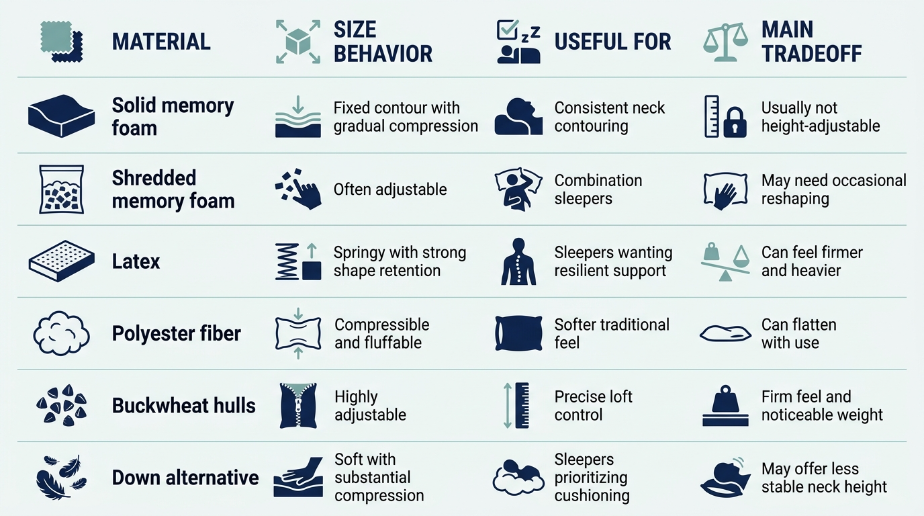
SaveThe most common neck pillow materials include memory foam, latex, polyester fiber, down alternative, buckwheat, and hybrid fills. Your best choice depends on whether you prioritize fixed support, adjustability, cooling, or softness.
Material should come after fit. A premium fill can’t compensate for the wrong loft.
| Material | Size behavior | Useful for | Main tradeoff |
|---|---|---|---|
| Solid memory foam | Fixed contour with gradual compression | Consistent neck contouring | Usually not height-adjustable |
| Shredded memory foam | Often adjustable | Combination sleepers | May need occasional reshaping |
| Latex | Springy with strong shape retention | Sleepers wanting resilient support | Can feel firmer and heavier |
| Polyester fiber | Compressible and fluffable | Softer traditional feel | Can flatten with use |
| Buckwheat hulls | Highly adjustable | Precise loft control | Firm feel and noticeable weight |
| Down alternative | Soft with substantial compression | Sleepers prioritizing cushioning | May offer less stable neck height |
So, what size should you choose?
Start with your sleeping position, then adjust for shoulder width and mattress firmness. Finally, account for how much the chosen material compresses.
- Mostly stomach sleeper: Start low and soft enough to avoid excessive neck extension.
- Mostly back sleeper: Start with medium loft and support under the cervical curve.
- Mostly side sleeper: Choose enough height to bridge the ear-to-mattress gap.
- Back-and-side sleeper: Consider adjustable fill or separate high and low contour zones.
- Unsure of your ideal height: An adjustable model is safer than guessing at a tall fixed contour.
My rule is simple: size the gap, not the label. A pillow called “medium” isn’t useful if its compressed height doesn’t match your body and mattress.
If you’re ready to pick one, these are two practical designs to compare:
🏆 Best structured cervical support
Core Products Tri-Core Cervical Support Pillow
★★★★☆ 4.4/5 fit rating
The Tri-Core comes in petite, midsize, and full dimensions, with raised side areas and two cervical-roll options. I like it for shoppers who want a structured size system instead of guessing from a generic rectangular pillow.
↕️ Best for adjustable loft
Coop Sleep Goods Original Adjustable Pillow
★★★★½ 4.6/5 fit rating
The Original uses adjustable fill and comes in multiple standard bed dimensions, including queen and king. I prefer this approach when someone doesn’t yet know their ideal loft because removing or adding fill makes sizing less permanent.
Frequently Asked Questions
How do I know if my neck pillow is too high?
Your neck pillow may be too high if it pushes your head forward while back sleeping or tilts your head upward while side sleeping. New morning stiffness can also be a clue. Check your posture while fully relaxed instead of judging the pillow while sitting upright.
How do I know if my neck pillow is too low?
A pillow may be too low when your head drops toward the mattress or the natural neck curve feels unsupported. Side sleepers often notice this as a downward head tilt toward the bed. Extra shoulder pressure can also appear when the pillow doesn’t fill enough space.
Should side sleepers use a 5-inch neck pillow?
A 5-inch pillow can be appropriate for some side sleepers, but the measurement isn’t universal. Broad shoulders and firmer mattresses may require more loft, while softer mattresses can reduce the needed height because the shoulder sinks farther into the bed.
Is a cervical pillow better than a regular pillow?
A cervical pillow can be useful when its contours fit your neck and sleep position, but the label alone doesn’t make it better. A correctly sized conventional or adjustable pillow can also provide good support. Comfort, alignment, height, and firmness matter more than the product category.
Should I choose pillow size based on my height?
Some cervical-pillow manufacturers use body height as a starting point, but it shouldn’t be your only measurement. Neck length, shoulder width, sleeping position, mattress firmness, and the pillow’s compression can all change the size that feels right.
Bottom line: Don’t choose a neck pillow because “standard,” “medium,” or “full” sounds right. Start with the height needed to keep your neck comfortable, then choose the material and overall dimensions that maintain that support.
If you’re between two sizes, an adjustable-fill design gives you more room to fine-tune the loft instead of forcing your neck to adapt to a fixed pillow.

I’m a home decor enthusiast who loves discovering beautiful room ideas, creative DIY projects, and Pinterest-worthy decorating inspiration. At DecorMinty, I share simple tips, fresh trends, and practical ideas to help you create a home you’ll truly love—one room at a time.