Can You Take a Neck Pillow on a Plane? TSA & Airline Rules for 2026
Quick Answer
Yes, you can take a neck pillow on a plane. TSA lists pillows as permitted in both carry-on and checked baggage, according to its What Can I Bring guidance. The bigger issue is usually your airline’s baggage policy, because a bulky pillow may sometimes be treated as part of your carry-on allowance.
What travelers should know
- Standard pillows: Foam, memory-foam, and ordinary travel pillows are generally allowed through U.S. airport security.
- Airline limits: Your carrier can decide whether a large pillow counts toward your carry-on or personal-item allowance.
- Security screening: You may be asked to remove the pillow temporarily if it interferes with screening.
- During takeoff: A small neck pillow is normally fine if it doesn’t interfere with your seat belt or crew instructions.
- Inflatable pillows: These are usually the simplest option when luggage space is limited.
- Powered pillows: Vibrating, massage, or heated models may be subject to battery rules.
Before leaving home
- Check your airline’s current carry-on policy if you plan to attach a large pillow outside your bag.
- Check the battery label before packing any electronic or vibrating travel pillow.
I understand why this question comes up before almost every long flight. A neck pillow looks harmless, but it can be surprisingly bulky when you’re already trying to meet a strict baggage allowance.
The good news is that airport security is usually the easy part. This guide separates TSA rules, airline baggage rules, takeoff restrictions, inflatable pillows, stuffable designs, and battery-powered models so you know what to expect in 2026.
Definition: A travel neck pillow is a compact support pillow designed to stabilize your head and neck while you sit upright. Common types include U-shaped memory foam, inflatable, wrap-around, stuffable, and electronic massage pillows.


Can you bring a neck pillow on a plane?
Yes, you can generally bring a neck pillow onto a plane in the United States. TSA lists pillows as permitted in both carry-on and checked baggage.
That means an ordinary foam, polyester, memory-foam, or inflatable neck pillow isn’t a prohibited security item. However, TSA permission doesn’t automatically mean your airline will ignore its size when counting baggage.
TSA rules and airline rules are different
TSA decides what can pass through a U.S. security checkpoint. Your airline decides how many items you can bring into the cabin and how large those items may be.
- TSA: Determines whether an item is permitted through security.
- Airline: Sets carry-on and personal-item size, weight, and quantity limits.
- Flight crew: Controls how belongings must be secured inside the cabin.
The U.S. Department of Transportation specifically advises passengers to check their airline’s limits on carry-on size, weight, and number. There isn’t one universal federal carry-on allowance covering every U.S. airline.
I treat my travel pillow as part of my packing plan rather than assuming it gets a free pass. That avoids surprises when flying a low-cost carrier or boarding with an already full personal item.
If you’re deciding whether carrying one is worthwhile, my guide on whether neck pillows really work explains where travel pillows make the biggest difference.
Can you take a neck pillow on an airplane?
 Save
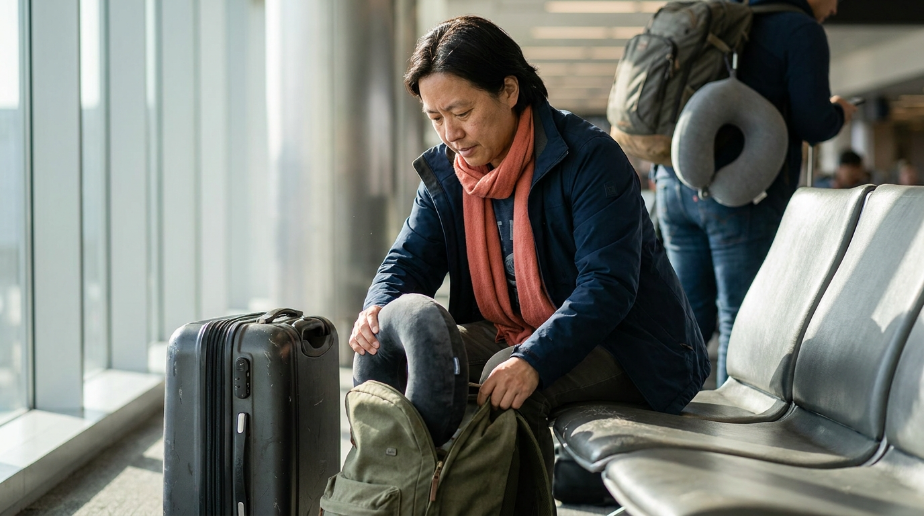
SaveYes, but how you carry it matters. A compact pillow inside your backpack is unlikely to cause a baggage-count issue because it’s already contained within an approved item.
A large memory-foam pillow clipped to the outside of your backpack is less predictable. The airline may consider it another loose cabin item, especially when baggage rules are strictly enforced.
Where should you pack it?
- Inside a personal item: The safest choice for avoiding baggage-count disputes.
- Inside a carry-on: Good for compressible memory foam or small travel pillows.
- Attached externally: Convenient, but more visible to gate staff.
- Worn around your neck: Common, although airline staff can still enforce their cabin-item policy.
- Checked baggage: Allowed for ordinary pillows, but rarely necessary.
The FAA also recommends following individual airline requirements because carrier rules can be stricter than general federal baggage guidance. Its carry-on baggage guidance is a useful starting point before a trip.
Size is one reason I favor compact designs for flying. If you’re still choosing a style, this guide to choosing the right neck pillow explains how shape, support, and portability differ.
| Neck Pillow Type | TSA Screening | Packing Space | Extra Rule to Check |
|---|---|---|---|
| Memory foam | Generally allowed | Medium to bulky | Airline item-count policy |
| Inflatable | Generally allowed | Very small when deflated | None beyond normal baggage rules |
| Stuffable | Generally allowed | Depends on contents | May be treated as another bag |
| Vibrating or massage | Generally allowed | Medium | Battery restrictions |
Can you wear a neck pillow through airport security?
You can usually approach airport security wearing a normal neck pillow. Still, you should be prepared to remove it and place it in a screening bin if an officer requests that.
TSA can require additional screening for an otherwise permitted item if it obscures screening, triggers an alarm, or raises a security concern. Its general travel security guidance makes clear that permitted items can still receive extra screening.
The easiest checkpoint routine
- Keep your neck pillow easy to remove.
- Empty its pockets before reaching the scanner.
- Remove electronic accessories if instructed.
- Place the pillow in a bin when an officer asks.
- Collect it after completing screening.
I wouldn’t tightly fasten a complicated wrap-around pillow before reaching the checkpoint. A design you can remove in seconds keeps the process simpler.
Can you wear a neck pillow through TSA?
Yes, in most situations, but wearing a pillow doesn’t exempt it from screening. TSA officers retain authority to inspect items and make the final checkpoint decision.
A plain U-shaped pillow contains little that complicates screening. Pillows with hidden storage compartments, electronics, dense inserts, wires, or batteries may deserve more attention.
What could cause additional screening?
- Electronic components: Wires, controls, motors, or battery packs can appear differently during X-ray screening.
- Dense stuffing: An unusually packed pillow may be inspected to identify its contents.
- Hidden compartments: Storage pockets may need to be opened.
- Unusual modifications: Homemade additions can make an otherwise ordinary pillow harder to identify.
If your pillow has several unusual features, pack it where you can reach it quickly. Don’t bury it beneath your entire carry-on.
Can you wear a neck pillow during takeoff?
A normal neck pillow can generally be worn while seated for takeoff if it doesn’t interfere with required safety equipment or crew instructions. Your seat belt still needs to fit correctly, and loose belongings may need to be secured.
The safest approach is simple: keep the pillow around your neck rather than holding a bulky bag or accessory across your lap. Follow the cabin crew immediately if they ask you to reposition or stow anything.
Make sure the pillow doesn’t interfere with safety
- Seat belt: Keep the belt properly fastened around your waist.
- Aisles: Don’t leave straps or storage pouches hanging into the aisle.
- Emergency equipment: Avoid anything that could obstruct oxygen-mask use or movement.
- Crew instructions: Their directions take priority over personal comfort.
A pillow should support your head without pushing it sharply forward. If comfort and alignment matter to you, see my breakdown of the best neck pillow for different sleeping positions.
Comfort also shouldn’t mean forcing your neck into an awkward angle. I explain that balance further in my guide to neck pillow benefits and risks.
Can you take an inflatable neck pillow on a plane?
Yes. An ordinary inflatable neck pillow is generally one of the easiest travel-pillow styles to take on a plane because it can be deflated and packed into a small pouch.
It also avoids the bulk that makes large foam pillows more noticeable during boarding. For travelers using only a personal item, that’s a major advantage.
Should you fully inflate it before takeoff?
You can use an inflatable pillow in the cabin, but don’t overinflate it. Adjust the pressure until it supports your head without feeling rigid against your neck.
Cabin pressure changes can alter how an air-filled item feels during flight. Leaving a little room for adjustment is more comfortable than inflating it rock-hard before departure.
- Pack it deflated: This saves the most luggage space.
- Inflate after boarding: You’ll know exactly how much room you have.
- Use an adjustable valve: It makes firmness changes easier.
- Inspect for leaks: A slow leak can leave you unsupported halfway through a long flight.
Can you take a stuffable neck pillow on a plane?
Yes, a stuffable neck pillow can normally pass through airport security. These designs use a zippered pillow shell that you fill with clothing instead of foam or air.
The important distinction is baggage policy. Filling a pillow with shirts, socks, underwear, or other belongings can make it function more like an additional luggage container.
Does a stuffable pillow count as a personal item?
There isn’t one federal rule saying every airline must treat a stuffed travel pillow as free clothing or as an extra bag. Airlines set their own carry-on limits.
If avoiding an extra baggage fee is the main reason you’re using one, read your carrier’s policy before leaving home. Don’t rely on a viral packing trick as if it were an official exemption.
- Keep it reasonable: Don’t expand the pillow into an oversized sack.
- Use soft contents: Clothing is more appropriate than hard or fragile objects.
- Avoid prohibited items: Everything inside still has to comply with security rules.
- Make contents accessible: TSA may inspect what’s inside.
My preference is to use stuffable pillows for clothing I’d already pack, not as a loophole for doubling my cabin luggage. That keeps the pillow useful without creating unnecessary uncertainty at the gate.
Can you take a vibrating neck pillow on a plane?
 Save
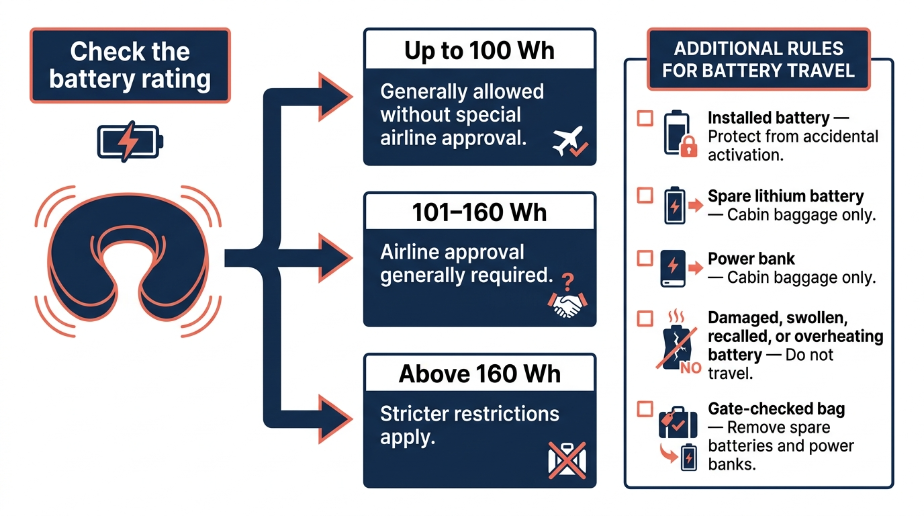
SaveUsually, yes, but this is the category where you need to check the power source. A vibrating or massage neck pillow containing a lithium-ion battery falls under aviation battery-safety rules.
The FAA says most personal portable electronic devices with lithium batteries can travel in carry-on baggage when they meet applicable battery limits. Spare lithium batteries and power banks must remain in the cabin rather than checked baggage.
Check the battery rating first
For most passenger electronics, lithium-ion batteries rated up to 100 watt-hours are allowed without special airline approval. Batteries between 101 and 160 Wh generally require airline approval, while larger batteries face stricter restrictions.
You can review the current FAA lithium battery rules before packing an electronic travel pillow. Battery ratings are often printed on the battery, charging label, manual, or manufacturer specifications.
- Installed battery: Keep the device protected from accidental activation.
- Spare lithium battery: Carry it in cabin baggage, not checked luggage.
- Power bank: Treat it as a spare battery and keep it in your carry-on.
- Damaged battery: Don’t travel with a swollen, recalled, overheating, or damaged battery.
- Gate-checked bag: Remove spare batteries and power banks before handing over the bag.
What if the pillow also heats up?
A vibrating pillow with a heating function deserves another check because heat-producing battery devices can receive additional restrictions. The FAA provides separate guidance for battery-powered heat-producing devices.
If the model combines massage, heat, and a rechargeable battery, I would check both the battery label and the airline’s policy before packing it. That’s safer than assuming every powered pillow follows the same rules.
If you want a straightforward travel pillow without electronic complications, these are the two styles I’d consider first:
🏆 Best Support
Cabeau Evolution S3 Travel Pillow
★★★★☆
Memory foam, raised side supports, a thin flat back, adjustable front closure, and seat straps give this pillow more structure than a basic U-shaped model. I’d choose it for long flights when support matters more than packing the smallest possible pillow.
🎒 Best for Packing Light
Sea to Summit Aeros Premium Travel Pillow
★★★★☆
This inflatable design weighs only a few ounces, packs into a small stuff sack, and lets you adjust firmness by changing the air pressure. I’d pick it for one-bag trips because it uses far less luggage space than a full memory-foam pillow.
FAQ
Does a neck pillow count as a carry-on?
Not automatically. TSA allows pillows through security, but your airline determines its own carry-on and personal-item limits. A small pillow around your neck may cause no issue, while a large pillow attached to your luggage could potentially be treated as an additional item.
Can I attach my neck pillow to the outside of my backpack?
Usually, but the airline can still consider the pillow when enforcing baggage limits. If you’re flying on a restrictive fare, compressing the pillow inside your approved backpack is the safer choice.
Can TSA search a neck pillow?
Yes. TSA can inspect an allowed item when needed during screening. Stuffable pillows, models with storage compartments, and electronic pillows may be easier to inspect when you keep zippers, battery compartments, and controls accessible.
Can I bring a memory-foam neck pillow on an international flight?
Generally yes, but TSA rules only govern U.S. security screening. International airports, aviation authorities, and airlines may apply different procedures, so check the rules for your departure country and carrier before traveling.
Should I put a neck pillow in checked baggage?
You can check an ordinary neck pillow, but keeping it in the cabin makes more sense if you plan to sleep during the flight. Battery-powered models deserve extra attention because installed and spare lithium batteries have different packing requirements.
Final takeaway
Yes, you can take a neck pillow on a plane in 2026, and ordinary travel pillows are generally straightforward at U.S. security checkpoints. The details that matter most are your airline’s cabin-baggage limits and whether your pillow contains batteries, electronics, heating elements, or extra storage.
For the simplest trip, pack a compact pillow inside your approved bag whenever possible. Check your airline before departure, keep electronic components accessible, and you’ll avoid most neck-pillow surprises at security or the boarding gate.

I’m a home decor enthusiast who loves discovering beautiful room ideas, creative DIY projects, and Pinterest-worthy decorating inspiration. At DecorMinty, I share simple tips, fresh trends, and practical ideas to help you create a home you’ll truly love—one room at a time.