Can I Bring a Bed Pillow on a Plane? TSA Rules & Tips
Quick Answer
Yes, you can bring a bed pillow on a plane. The TSA allows pillows in carry-on and checked bags. The catch is size: a small or compressible pillow usually fits your personal-item allowance, while a full-size bed pillow often counts as your carry-on or personal item instead.
That split causes most of the confusion. Security and the airline are answering two different questions. Security asks whether a pillow is safe to bring through the checkpoint. The airline asks whether it fits in the space you have already paid for. Once you separate those two decisions, the answer becomes much easier to plan around.
What the TSA Actually Allows
The TSA allows pillows in both carry-on and checked bags. That covers a standard bed pillow, a small travel pillow, a neck pillow, an inflatable pillow, and a memory foam pillow. The TSA page for pillows lists carry-on bags as yes and checked bags as yes, with the final decision resting with the TSA officer at the checkpoint.
You do not normally need to take a pillow out of your bag at security. It goes through the X-ray machine like other soft items. A dense pillow, especially memory foam or one with a thick fill, can be harder to see through on the scanner. In that case, an officer may open the bag for a quick hand check. That is a screening step, not a ban.
The TSA does not set a size limit for pillows. It does not count a pillow as a bag, and it does not charge for one. If a pillow is stopped or questioned at the gate, that is almost always an airline decision about space, not a TSA rule about safety.
Does a Bed Pillow Count as a Personal Item or a Carry-On?
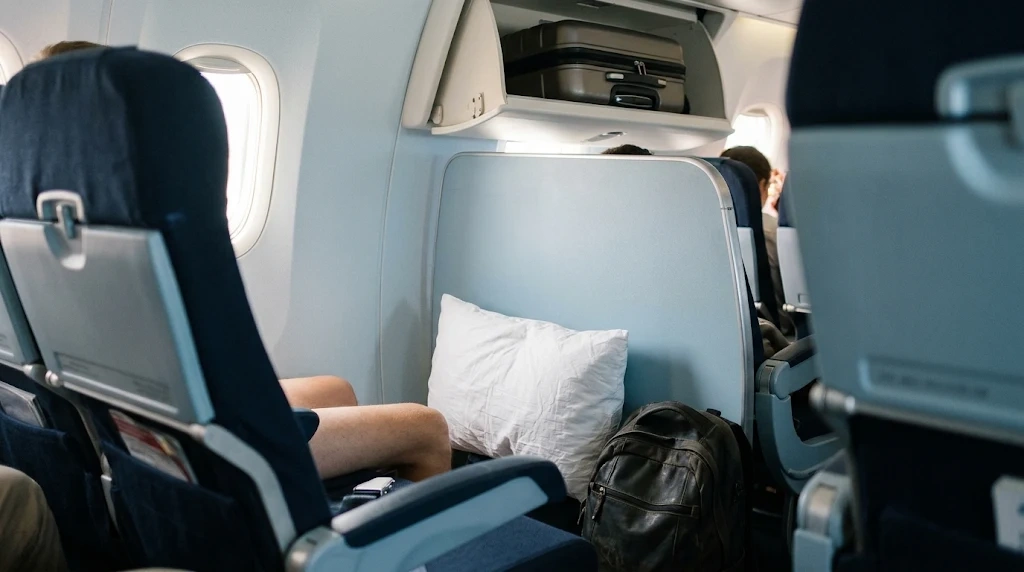
It depends on how you carry it and how big it is. Most U.S. airlines allow one carry-on bag and one personal item. A personal item must fit under the seat in front of you. A carry-on must fit in the overhead bin. A pillow that fits inside one of those bags is simply part of that bag.
A pillow carried loose is judged on its own. If it is small enough to fit under the seat, many airlines treat it as your personal item. If it is too large for that space, it is more likely to be treated as your carry-on. That matters because you cannot then also bring a separate roll-aboard and a separate backpack without consolidating or paying for an extra bag.
A neck pillow worn around your neck is usually treated differently. Gate staff rarely count it as a separate item, in the same way they rarely count a coat. A full-size bed pillow carried in your arms does not get that same treatment. It is visible, bulky, and hard to stow, so it draws attention on a full flight.
Budget airlines tend to enforce the one-plus-one rule more strictly. On a full flight, a gate agent may ask you to fit the pillow into your carry-on or personal item before boarding. If it will not fit, you may be asked to gate-check a bag. Checking your airline’s baggage page before you leave is the only way to know its exact personal-item dimensions.
Full-Size Pillow vs. Travel Pillow: How Size Changes the Answer
A standard bed pillow is usually about 20 by 26 inches when fluffed up. That is larger than a typical personal-item limit. American Airlines, for example, publishes a personal-item limit of 18 by 14 by 8 inches. A full-size pillow does not fit inside those measurements, even though it can be squeezed and folded.
A travel pillow is a different shape and a different problem. It is smaller, often compressible, and designed to fit in a bag or around your neck. That is why it rarely causes a problem at the gate, even when a bed pillow would.
| Pillow type | Usually counts as | Main risk |
|---|---|---|
| Full-size bed pillow | Carry-on or personal item | Too large for under-seat space |
| Small bed pillow | Personal item, if it fits | May still need compressing |
| Neck pillow | Usually not counted | Less support for side sleepers |
| Inflatable travel pillow | Part of your bag when deflated | Needs inflating after boarding |
Size is not the only factor. A compressible down or polyester pillow can be folded into a much smaller shape than a firm latex or dense memory foam pillow of the same nominal size. If you plan to bring a bed pillow, knowing how big a standard bed pillow is helps you judge whether it can realistically be compressed to fit under a seat.
How to Bring a Bed Pillow Without Losing Your Bag Allowance
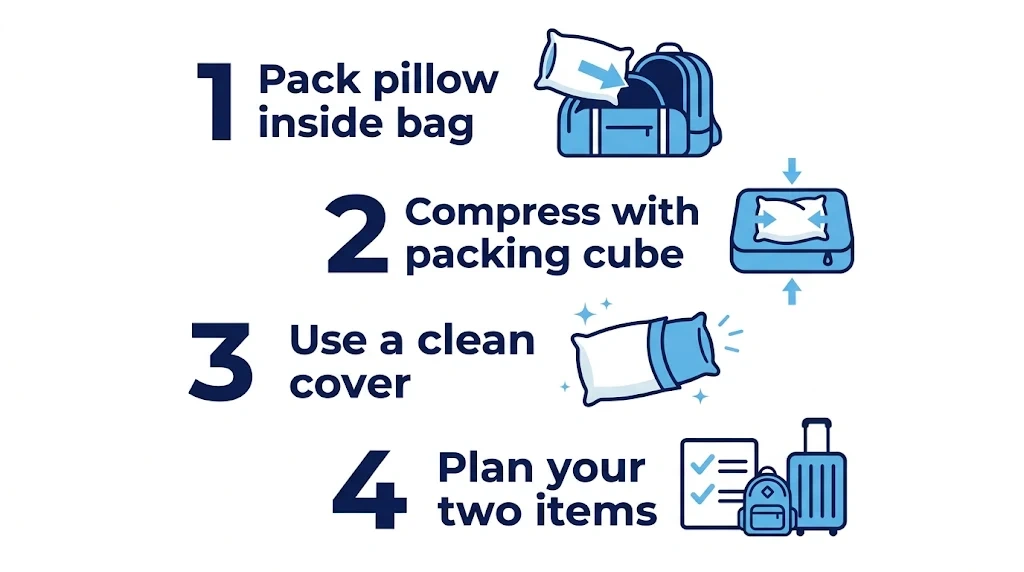
The simplest method is to pack the pillow inside your carry-on or personal item until you board. Once you are seated, take it out and use it. A pillow inside a bag does not create a third item for the gate agent to count.
Use a compression bag or a large packing cube if your pillow can be squeezed without damage. Vacuum-sealed bags work well for down and polyester fill, but check the care label first. Memory foam should not be vacuum-compressed for long periods, and a pillow that loses its shape in the bag may not recover well on the flight.
Put the pillow in a clean pillowcase or a washable cover before you pack it. Airport floors, overhead bins, and seat pockets are not clean, and a cover is easier to wash than the pillow itself. If you are travelling with a bed pillow for a longer trip, our guide to how to travel with a bed pillow covers packing, carrying it through the airport, and getting it back to shape after the flight.
Plan your two items before you reach the gate. If the pillow is your personal item, your other bag must be your carry-on and must fit overhead. If the pillow is inside your carry-on, your personal item can be a backpack or laptop bag. Decide which arrangement you will use, and do not try to carry three loose items through boarding.
What Happens at Security and at the Gate
At security, place the bag containing your pillow on the belt as normal. If the pillow is loose, place it in a bin. An officer may ask to inspect it if the X-ray image is unclear. Keep it near the top of your bag so it can be removed without unpacking everything else.
At the gate, the check is visual and practical. Staff look for the number of items you are carrying and whether they look too large for the cabin. A pillow stuffed into a backpack is unlikely to be questioned. A large white pillow carried under one arm, plus a roll-aboard and a backpack, is likely to be questioned on a full flight.
If you are asked to consolidate, stay calm and practical. Put the pillow inside the larger bag, wear the neck pillow, or move smaller items into the pillow’s compression bag. Gate-checking usually applies to the roll-aboard, not the pillow, because a soft pillow is easier to stow in the cabin than a hard-sided bag.
Tip
Board with the pillow already inside a bag or worn around your neck. That removes the most common reason a gate agent flags it, and you can take it out once you are seated.
When a Bed Pillow Is Worth Bringing, and When a Travel Pillow Works Better
A bed pillow makes sense when sleep quality matters more than packing light. That includes overnight flights, long-haul travel, and trips where you know you sleep badly without your usual pillow. It also helps if you have neck or shoulder discomfort and a travel pillow does not give you enough support.
A travel pillow works better for short flights, light packing, and trips with tight connections. Packable neck pillow options fold or compress into a small pouch, so they do not use up a bag allowance. Inflatable neck pillows for airplanes are even smaller when deflated, and you can adjust firmness after boarding.
For a long flight, the choice is less clear-cut. A bed pillow gives more surface to lean on, especially in a window seat. A good travel pillow gives better neck support in an upright seat. If you are flying long-haul, a long-flight neck pillow guide can help you compare shapes before you decide to carry a full-size pillow instead.
Children and light sleepers are another case where a familiar pillow helps. A small pillow from home can make an unfamiliar seat feel more settled. For a child, a smaller pillow is also easier to fit under a seat or inside a backpack, so it is less likely to be counted as a separate item.
How to Keep It Clean and Comfortable on the Flight
Use a removable, washable cover. Wash it after the flight, even if the pillow looks clean. A pillowcase that has been in an overhead bin or on a tray table has picked up more than it appears to have.
Do not place a bare pillow directly on the floor, even for a moment while you rearrange bags. Keep it in its cover or in a clean plastic bag until you are seated. If you need to store it during takeoff and landing, put it under the seat in front of you or in the overhead bin, not in the aisle.
Inflate or fluff the pillow after you sit down, not while you are standing in the aisle. That keeps the aisle clear and gives you time to adjust it to your seat. If you use a travel pillow as well, use the bed pillow for leaning and the neck pillow for head support, rather than stacking both behind your neck.
Mistakes That Get Pillows Gate-Checked or Left Behind

The most common mistake is carrying three loose items. A roll-aboard, a backpack, and a loose bed pillow look like an extra bag, even if the pillow is soft. Pack one of them inside another before boarding.
Another mistake is assuming every airline treats a pillow the same way. A policy that worked on one carrier may not work on a budget airline with a stricter personal-item size. International flights can also differ, especially where the personal-item allowance is smaller or where only one cabin bag is allowed.
A third mistake is bringing a pillow you cannot compress and expecting it to fit under a seat. Test it at home first. Fold it, roll it, and measure the compressed size against your airline’s personal-item limit. If it will not fit, plan to carry it as your carry-on and check your other bag, or choose a smaller pillow for that flight.
Related Product
Travel Neck Pillow for Airplane
A packable travel neck pillow fits inside your personal item and avoids the size problem of a full-size bed pillow.
As an Amazon Associate, we earn from qualifying purchases.
Frequently Asked Questions
Can I bring a full-size bed pillow on a plane?
Yes. The TSA allows it in carry-on and checked bags. Your airline may count it as your personal item or carry-on if it is too large to fit inside another bag, so pack it inside a bag when you can.
Does a pillow count as a personal item?
It can. If you carry it loose and it fits under the seat, many airlines treat it as your personal item. If it is inside your carry-on or personal bag, it does not count separately. A neck pillow worn around your neck is usually not counted at all.
Do I need to take my pillow out at TSA security?
Usually no. It can stay in your bag through the X-ray machine. A dense pillow may be pulled for a hand check if the scanner cannot see through it clearly, so keep it easy to reach.
Can I bring a pillow on a budget airline?
Yes, but budget airlines enforce bag limits more strictly. A loose full-size pillow is more likely to be counted as an extra item. Pack it inside your allowed bag, wear a neck pillow, or check the airline’s personal-item size before you travel.
Can I bring a pillow on an international flight?
Yes, in most cases. The same TSA principle applies for U.S. departures, but the airline’s cabin-bag allowance may be smaller on international or low-cost carriers. Check that carrier’s size and item count before you fly.
Can I bring a pillow and a blanket on a plane?
Yes. A blanket is usually treated like a coat or personal comfort item and is rarely counted separately. A pillow and a blanket together are fine if the pillow still fits your bag allowance, so keep the pillow inside a bag or wear a neck pillow when boarding.
Conclusion
You can bring a bed pillow on a plane, and security is rarely the obstacle. The real decision is space. Pack the pillow inside your carry-on or personal item, or choose a travel pillow that fits easily, and you keep your bag allowance intact. Check your airline’s personal-item size before a full-size pillow becomes a third item at the gate, and you can sleep better without a surprise fee or a gate-check.

I’m a home decor enthusiast who loves discovering beautiful room ideas, creative DIY projects, and Pinterest-worthy decorating inspiration. At DecorMinty, I share simple tips, fresh trends, and practical ideas to help you create a home you’ll truly love—one room at a time.