The One Pillow That Makes Your Bed Look Finished — How to Style a Body Pillow
Quick Answer
To decorate a bed with a body pillow, place it horizontally in front of your sleeping pillows as the middle layer, then add one or two smaller cushions in front of it. Match its cover to your bedding, keep the bed size in mind, and move it to the side or foot of the bed at night if you use it for sleep support.
A body pillow can make a bed look finished in seconds, but only when it has a clear place in the arrangement. Without that, it looks like an extra pillow that was left on the bed by accident. The difference is not the pillow itself. It is size, position, and what sits in front of and behind it.
This guide shows the core method first, then five arrangements for different beds and styles. You will also learn how to choose the right cover, layer it without clutter, and keep it looking neat day after day.
What a Body Pillow Actually Does on a Made Bed
A body pillow is a long, rectangular pillow, usually about 20 inches wide and 48 to 54 inches long. On a made bed, it works as a bridge. It fills the wide gap between two sleeping pillows, creates a long horizontal line across the head of the bed, and adds softness without the fuss of many small cushions.
That long shape is also why it can look wrong. A standard pillow disappears into a row. A body pillow is hard to miss. If its colour clashes with the duvet, if it sags in the middle, or if it sits at an angle, the whole bed looks untidy.
It is not the same as a bolster pillow. A bolster is cylindrical and often used as a single accent in front of Euro pillows. A body pillow is flat and rectangular, so it reads more like bedding than decoration. The Saatva guide to bolster pillows explains that difference well: bolsters are usually a decorative or lumbar-support accent, while a body pillow is longer and more versatile for full-body support and layering.
Think of the body pillow as both decor and function. During the day, it is a styling layer. At night, it can support your back, knees, or side-sleeping position. An arrangement that works for both uses will always look more natural than one designed only for a photo.
Choose the Right Body Pillow Before You Style It
Styling starts before you place the pillow. A cover that fights your bedding cannot be fixed by moving cushions around it.
First, check the size against your bed. A 54-inch body pillow spans most of a queen or king bed and creates one clean line. On a twin or full bed, that same pillow can overwhelm the head of the bed and leave no room for sleeping pillows. A shorter 48-inch pillow usually fits a smaller bed better and leaves space at the edges.
Second, choose a cover with intention. A plain cover in a colour taken from your duvet, throw, or wall art will look calm and deliberate. A patterned cover can work as the main accent, but then the pillows in front of it should be plainer. Two strong patterns competing across the same row make the bed look busy.
Third, consider texture and firmness. A flat, limp body pillow will fold and sag. A firmer fill holds its shape when propped upright and keeps the front edge straight. If your pillow has lost its shape, a fresh cover will not fix it. Plumping, airing, and washing the insert on a regular schedule help. Our guide to how big a bed pillow is explains standard, queen, king, and body pillow sizes, so you can check the fit before you buy a new cover or insert.
Finally, match the cover fabric to how you will use it. Cotton and linen-look covers suit a relaxed, everyday bed. Velvet, faux fur, and quilted covers add warmth in winter but can look heavy in a light, airy room. Washable covers are the practical choice if the pillow will be used every night.
How to Decorate a Bed With a Body Pillow: The Core Method

Most good arrangements follow the same order: largest at the back, body pillow in the middle, smallest at the front. Work from the headboard outward.
- Make the base neat first. Smooth the fitted sheet, pull the duvet or coverlet straight, and fold the top edge down by about 30 to 40 cm. A wrinkled base makes even a well-placed pillow look messy.
- Place your sleeping pillows upright. Stand two standard or king pillows against the headboard. On a king bed, use two king pillows or three standards. Keep them even in height and angle.
- Add the body pillow horizontally in front of them. Centre it so the ends are equal on both sides. It should sit just below the top edge of the sleeping pillows, not cover them completely. Press the middle gently so it does not bow forward.
- Add one layer in front. Place two small square cushions, one lumbar cushion, or a single round cushion in the centre. This front layer breaks up the long line of the body pillow and gives the bed a finished look.
- Finish with a throw. Fold a throw across the foot of the bed or drape it diagonally over one corner. The throw should pick up a colour from the body pillow cover, not introduce a completely new palette.
Step back after step four. If the bed looks balanced from the foot of the bed and from the doorway, it is done. Adding more pillows after that point usually adds clutter, not style.
Tip
Centre the body pillow by eye, then check the gap on each side. If one end hangs over the edge of the bed, it will look accidental even if the rest of the arrangement is perfect.
5 Arrangements That Work for Different Beds and Styles
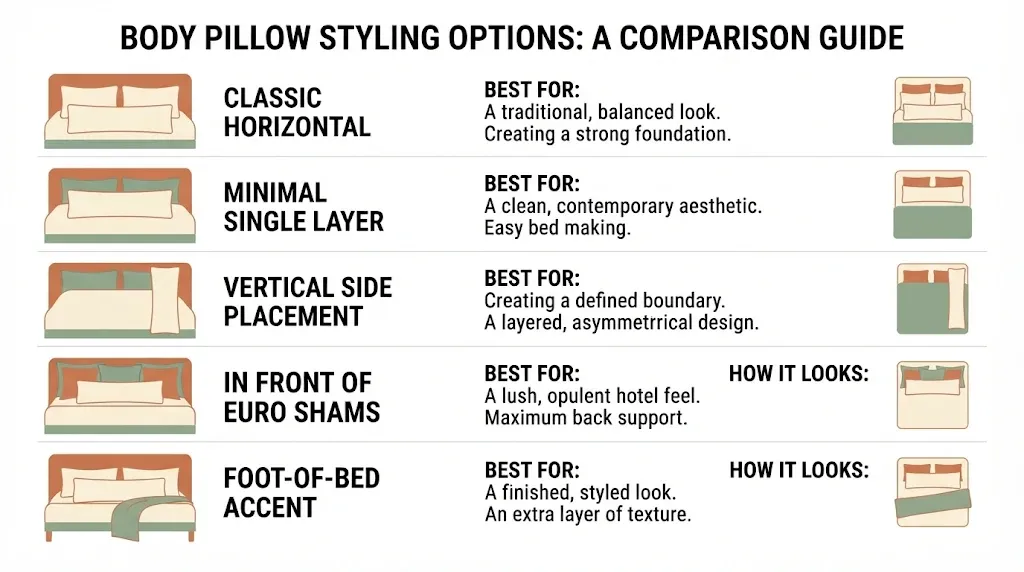
There is no single correct placement. The best choice depends on bed size, who sleeps there, and whether you want a minimal or layered look.
| Arrangement | Best for | How it looks |
|---|---|---|
| Classic horizontal | Queen and king beds | Clean, hotel-style, balanced |
| Minimal single layer | Small rooms, twin and full beds | Calm, uncluttered, easy to remake |
| Vertical side placement | Side sleepers, single sleepers | Modern, functional, asymmetrical |
| In front of Euro shams | Formal or layered bedrooms | Tall, structured, traditional |
| Foot-of-bed accent | Guest rooms, daytime display | Neat, out of the way, decorative |
The table above is a starting point, not a rule. Choose the arrangement that matches how you actually use the bed.
1. Classic horizontal
This is the most reliable option. The body pillow sits across the bed, in front of the sleeping pillows and behind smaller cushions. It works best on a queen or king because the pillow length matches the bed width. Use a solid or lightly textured cover and let the front cushions add pattern.
2. Minimal single layer
Skip the extra cushions. Place the sleeping pillows at the back and the body pillow directly in front of them, with nothing else. This suits small bedrooms, minimalist decor, and anyone who does not want to move five pillows every night. The key is a good cover: it becomes the main visual feature, so choose a colour and fabric you like looking at every day.
3. Vertical side placement
Place the body pillow lengthwise down one side of the bed, like a long bolster by the edge. This works well if you sleep on your side and hug the pillow at night, or if the bed is against a wall and you want a cosy reading corner. It looks intentional when the other side is kept simple. If both sides are cluttered, the vertical pillow can make the bed feel lopsided.
4. In front of Euro shams
For a more formal look, start with two large Euro square pillows at the back, add sleeping pillows, then the body pillow, then small cushions at the front. This creates four clear layers and a tall, plush headboard effect. It suits larger bedrooms and traditional or hotel-style decor. On a small bed, this many layers will crowd the head of the bed.
5. Foot-of-bed accent
If you do not want the body pillow near your head during the day, lay it across the foot of the bed over the folded throw. It still adds colour and texture without interfering with sleeping pillows. This is a useful option for guest rooms, where the bed should look inviting but the pillow can be moved easily at night.
How to Layer It With Sleeping Pillows, Euro Shams, and Throws
Layering works when each layer is a different size and stays visible. If a layer is completely hidden, it is not styling the bed. It is just taking up space.
Start tall at the back and get shorter toward the foot. Euro shams, at about 26 inches square, are the tallest layer. Standard pillows come next, then the body pillow, then lumbar or square cushions at the front. Each step down should be clear from the foot of the bed.
Use odd numbers in the front layer when you can. One lumbar cushion looks deliberate on a twin or full bed. Two small squares look balanced on a queen. Three small pieces can work on a king, but only if they are different sizes or shapes.
Texture matters as much as size. If your bedding is smooth cotton, a velvet or knitted body pillow cover adds contrast. If your duvet is already textured, choose a smooth cover so the bed does not look heavy. Keep at least one plain layer in the mix, even in a patterned room.
The size of your sleeping pillows also affects the fit. If you are unsure whether to use standard, queen, or king pillows behind the body pillow, our guide to how big a standard bed pillow is compares the common sizes and helps you plan the back row without guessing.
Colour, Pattern, and Texture: Making It Look Intentional
A body pillow looks intentional when its colour connects to something else in the room. That connection can be subtle. It does not need to match the duvet exactly.
Pick one main colour from your bedding and repeat it in the body pillow cover. Then add a second, smaller accent in the front cushions or throw. For example, a sage green cover with cream bedding and a rust-coloured lumbar cushion creates a clear palette without matching everything.
Neutral bedding gives you the most freedom. White, cream, light grey, and beige beds can carry a bold body pillow in deep green, navy, terracotta, or mustard. A patterned cover in those colours still works because the base is quiet.
If your bedding is already patterned, keep the body pillow plain. A floral duvet with a floral body pillow cover will compete for attention. A solid cover in a colour pulled from the duvet pattern will calm the bed down.
Seasonal changes are an easy way to refresh the look without buying a new pillow. A light linen cover suits spring and summer. A heavier velvet or faux-fur cover suits autumn and winter. Swapping only the cover, rather than the whole pillow, keeps the styling flexible and affordable.
Key Insight
The body pillow should repeat a colour already in the room, not start a new one. One repeated colour makes the bed look designed. A new colour on every layer makes it look random.
Common Mistakes That Make a Body Pillow Look Messy

Most styling problems come from a few repeated mistakes.
- Too many pillows. If you have to remove four or five items before you can lie down, the bed will feel like work. Keep the daytime display to three layers at most.
- Wrong size for the bed. A body pillow that hangs over the edge or leaves a large gap at one end looks like it belongs on a different bed. Measure the width of your bed before choosing a 48-inch or 54-inch pillow.
- A sagging middle. A pillow that folds in the centre makes the whole row look tired. Fluff it, prop it upright, or replace the insert if it no longer holds its shape.
- Clashing covers. A body pillow cover that does not relate to the bedding, wall colour, or throw will stand out for the wrong reason. Change the cover, not the whole arrangement.
- Uneven placement. A pillow that is tilted or pushed to one side breaks the symmetry of the bed. Centre it every morning as part of making the bed, not as a separate styling task.
- Hiding the sleeping pillows. The body pillow should sit in front of them, not cover them. If the top of the sleeping pillows is invisible, pull the body pillow down slightly.
Fix one mistake at a time. In most cases, correcting size and centring alone will make the bed look noticeably neater.
How to Keep It Looking Good Night to Night
A good arrangement should survive real use. Decide where the body pillow goes at night before you style it in the morning.
If you sleep with it, move it to your usual side and use it for support, then return it to the centre in the morning. If you do not sleep with it, place it at the foot of the bed or on a nearby chair or bench at night. That keeps it clean and avoids it ending up on the floor.
Wash the cover regularly, especially if the pillow is used for sleep. Follow the care label, and wash pillowcases and covers on a normal cycle unless the label says otherwise. Our guide to how to wash a bed pillow covers machine washing, drying, and mistakes that can damage fill. For day-to-day care, spot-clean small marks quickly and air the pillow in a well-ventilated room. You can also read our guide to how to clean a bed pillow for stain removal and freshening between washes.
Store a spare cover in the same place as your spare bedding. When you want a quick change, you can swap the cover in minutes without rethinking the whole bed. Rotate covers by season and keep one neutral cover for guests, so the room always looks tidy even when you have not restyled it.
Related Product
Body Pillow Cover
A washable cover in the right size and colour is the easiest way to change the look of a body pillow without buying a new pillow.
As an Amazon Associate, we earn from qualifying purchases.
Frequently Asked Questions
Should a body pillow go in front of or behind regular pillows?
In front. Place your sleeping pillows against the headboard first, then the body pillow horizontally in front of them. That order keeps the sleeping pillows visible and gives the body pillow a clear middle layer to fill.
What size body pillow looks best on a queen bed?
A 54-inch body pillow usually looks best on a queen bed because it spans most of the width without hanging over the edge. A 48-inch pillow can also work if you want more space at the sides for other cushions.
Can you decorate with a body pillow on a twin bed?
Yes, but keep it simple. Use a shorter body pillow, place it in front of one or two sleeping pillows, and skip extra cushions. A minimal arrangement prevents a twin bed from looking crowded.
How many pillows should be on the bed with a body pillow?
For most beds, three layers are enough: sleeping pillows at the back, the body pillow in the middle, and one or two small cushions in front. More than that often looks cluttered and makes the bed harder to use at night.
Where do you put a body pillow at night?
If you sleep with it, move it to your side for support. If not, lay it across the foot of the bed or place it on a chair or bench. Avoid leaving it on the floor, where it can pick up dust and lose its shape.
Does a body pillow cover need to match the bedding?
It does not need to match exactly, but it should relate to it. Choose a colour from your duvet, throw, curtains, or wall art. A plain cover in a repeated colour usually looks more intentional than a new pattern that appears nowhere else in the room.
Conclusion
Decorating a bed with a body pillow works best when the pillow has a defined role: the middle layer between sleeping pillows and smaller cushions. Choose a size that fits your bed, a cover that repeats a colour already in the room, and an arrangement you can remake in a minute. Keep the layers to three, centre the pillow, and move it to the side or foot of the bed at night. That simple routine keeps the bed looking layered and inviting without adding clutter.

I’m a home decor enthusiast who loves discovering beautiful room ideas, creative DIY projects, and Pinterest-worthy decorating inspiration. At DecorMinty, I share simple tips, fresh trends, and practical ideas to help you create a home you’ll truly love—one room at a time.