Stop Waking Up Sore: How to Choose a Good Bed Pillow for Your Sleep Position
Quick Answer
Choose a pillow by your sleep position first. Side sleepers need a high, firm pillow, back sleepers need a medium-loft, medium-firm pillow, and stomach sleepers need a low, soft pillow. The right pillow keeps your head level with your spine, fills the gap under your neck, and still feels comfortable after a full night.
A good pillow does one job well: it holds your head so your neck stays in line with the rest of your spine while you sleep. When that alignment is right, you usually wake up without stiffness, numb arms, or the urge to fold your pillow in half.
When it is wrong, the problem rarely fixes itself. You toss, you flip the pillow, you wake up sore, and you blame the mattress. In many cases, the pillow is the simpler place to start.
This guide works through the choice in the order that matters most: position, loft and firmness, fill, body and mattress, then a quick at-home test.
Start With Your Sleep Position

Your sleep position decides how much space the pillow has to fill. That space is different on your side, on your back, and on your stomach, so no single loft works for everyone.
Think about the position you fall asleep in most often, not the position you wake up in. Most people shift during the night, but the starting position is the best guide for loft and firmness.
| Sleep position | Loft | Firmness | Why it works |
|---|---|---|---|
| Side | High, about 4–6 inches | Firm to medium-firm | Fills the shoulder gap and keeps the head level |
| Back | Medium, about 3–5 inches | Medium | Supports the curve under the neck without pushing the head forward |
| Stomach | Low, under 3 inches | Soft | Keeps the neck from arching back |
| Combination | Medium, or adjustable | Medium | Adapts when you change position during the night |
Side sleepers have the widest gap to fill, roughly the width of the shoulder. A pillow that is too low lets the head drop toward the mattress. A pillow that is too high bends the neck upward. Broad shoulders usually need the higher end of the range, while narrower shoulders need less height.
Back sleepers need less height, but they still need support under the neck. A contoured pillow, with a slightly raised edge for the neck and a lower area for the back of the head, often works well here. A pillow that is too thick pushes the chin toward the chest, which can make snoring worse and leave the neck stiff.
Stomach sleepers need the least height of all. Lying face down already turns the head to one side for hours. A thick pillow adds backward bending on top of that twist. A very thin, soft pillow, or no pillow under the head at all, is often more comfortable. Some stomach sleepers do better with a thin pillow under the pelvis instead, to reduce lower-back arching.
If you change position a lot, do not buy for one position only. An adjustable pillow, or a medium-loft pillow with a responsive fill, is the safer choice. Shredded memory foam and shredded latex let you add or remove fill until the height feels right in more than one position.
Loft and Firmness Are Not the Same Thing
Loft is height. Firmness is how much the pillow compresses under your head, and how hard it pushes back.
That distinction matters because a tall, soft pillow can end up lower in use than a medium, firm one. What counts is the height under the weight of your head, not the height on the shelf.
There is no industry-wide standard for soft, medium, or firm. One brand’s medium can feel like another brand’s firm. Treat the label as a starting point, then check the pillow in your normal sleeping position.
Use this simple rule: if your head sinks too far, you need more loft, more firmness, or both. If your head sits too high and your chin tucks down, you need less loft. If the pillow feels right for ten minutes but flattens by morning, the fill is not holding its shape for you.
Key Insight
Loft decides alignment, firmness decides whether that loft lasts all night. A pillow can have the right height in the shop and the wrong height by 3 a.m. if the fill collapses under your head.
Choose a Fill That Matches How You Sleep
Fill affects feel, temperature, durability, and care. It does not replace loft and firmness, but it changes how they behave through the night.
| Fill | Feel | Best for | Watch out for |
|---|---|---|---|
| Memory foam | Slow, contouring support | Side and back sleepers who want steady support | Can sleep warm; solid foam is harder to wash |
| Latex | Springy, responsive | Side and back sleepers; combination sleepers | Heavier and often more expensive |
| Down and feather | Soft, mouldable, light | Stomach and back sleepers who like to shape the pillow | Needs regular fluffing; may not hold loft for side sleepers |
| Down alternative / polyester | Soft, affordable, washable | Budget buyers and allergy-sensitive sleepers | Flattens fastest; check the care label before washing |
| Buckwheat | Firm, adjustable, breathable | Side sleepers who want precise height control | Heavy, noisy when you move, and not for everyone |
Memory foam holds its shape well, which makes it useful for side sleepers who need the loft to stay put. Shredded memory foam is more adjustable and sleeps a little cooler than a solid block, because air can move between the pieces.
Latex has a quicker, bouncier feel than memory foam. It does not sink in the same slow way, so it suits people who change position and do not want to feel stuck. It is also one of the most durable fills, often lasting longer than polyester or down alternative.
Down and feather pillows feel soft and can be shaped by hand, but they compress easily. That makes them a good match for stomach sleepers, and a weaker match for broad-shouldered side sleepers who need firm, lasting height.
Down alternative and polyester are the easiest fills to wash and the most affordable to replace. The trade-off is lifespan. They tend to clump and flatten sooner, so a low price can mean more frequent replacement.
What about cooling and allergies?
If you sleep hot, look for breathable covers, ventilated foam, latex, or buckwheat, and avoid dense solid foam without airflow features. A pillow protector can help with sweat and hygiene, but it will not fix a fill that traps heat.
If you have dust-mite sensitivity, a washable fill or a zippered dust-mite-proof cover matters more than the word hypoallergenic on the box. Wash pillowcases weekly, follow the care label for the pillow itself, and replace a pillow sooner if morning sneezing or congestion improves when you sleep elsewhere. Our guide to how to clean a bed pillow explains the care steps by fill type.
Adjust for Your Body, Mattress, and Pillow Size
Sleep position is the starting point, not the whole answer. Three other factors change the loft you need.
Body size and shoulder width. A broader frame usually needs a higher pillow on the side. A smaller frame, or a lighter head, compresses a pillow less, so the same pillow can feel higher than it does for a heavier sleeper.
Mattress firmness. On a soft mattress, your shoulder sinks in, so you need a lower pillow than on a firm mattress. On a firm mattress, there is less sink, so the pillow has to do more of the work. If you recently changed mattresses and your old pillow suddenly feels wrong, this is often why.
Pillow size. A standard pillow is usually enough for one sleeper, but a queen or king pillow gives side sleepers more room to move without losing support at the edge. Before you buy, check how big a standard bed pillow is and whether your pillowcase size still fits. A pillow that is too small for the bed can also look out of proportion and leave a gap at the headboard.
Neck pain is a useful signal, but it is not a diagnosis. If a pillow change does not help, or pain comes with numbness, weakness, or pain that lasts more than a few weeks, get it checked rather than trying pillow after pillow. For the pillow side of that question, see can a pillow cause neck pain or headaches.
How to Test a Pillow Before You Commit
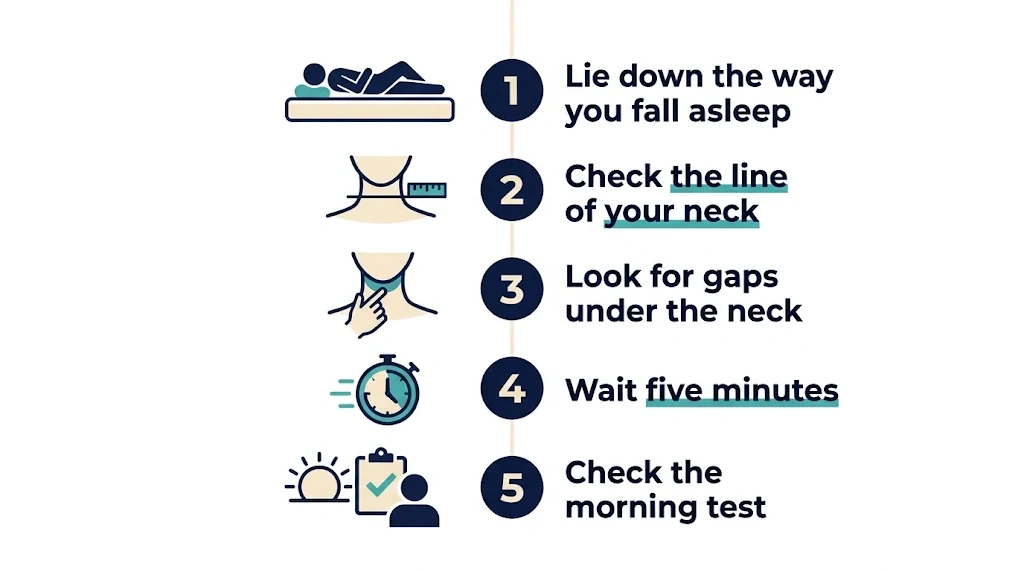
A pillow can feel perfect for two minutes in a shop and wrong after a full night. Use a short test in your normal position, on your own mattress if possible, and keep the trial period in mind.
- Lie down the way you fall asleep. Do not test a side-sleeper pillow while sitting up or lying on your back.
- Check the line of your neck. Your nose and chin should point forward, not down into your chest and not up at an angle. Your neck should feel like a continuation of your spine.
- Look for gaps. There should be no empty space under your neck, and your ear should not be pressed flat against your shoulder.
- Wait five minutes. Notice whether your head sinks, your shoulder goes numb, or you want to fold the pillow for extra height. Those are signs the loft or firmness is off.
- Check the morning test. After a few nights, ask whether you wake up in the same position, without stiffness, and without reaching for a second pillow.
If you sleep with a partner, test with your normal pillow arrangement, not with a spare pillow stacked underneath. Two thin pillows are not the same as one good pillow, because the top one can slide and the bottom one can compress unevenly.
Tip
If you are unsure between two lofts, choose the adjustable option or the one with a longer trial period. It is easier to remove fill or return a pillow than to keep adjusting a pillow that was wrong from the start.
Common Mistakes to Avoid
- Choosing by softness alone. Soft feels good at first, but soft without enough loft leaves side sleepers unsupported.
- Buying the same pillow as someone else. Shoulder width, weight, mattress, and position all change the answer.
- Stacking two pillows to fix a flat one. Stacking raises the head, but it often bends the neck forward and creates a new problem.
- Ignoring the mattress. A new mattress can change the loft you need, even if your sleep position has not changed.
- Keeping a pillow too long. A pillow that once worked can slowly lose loft, so a gradual return of morning stiffness is a clue, not just ageing.
- Choosing a fill you cannot care for. If you will not follow the washing or drying instructions, pick a fill with care steps you will actually do.
A good pillow should also fit your budget without forcing a compromise on loft. Prices vary widely by fill and brand, and a higher price does not guarantee better alignment. Before you set a budget, check how much a bed pillow costs by type, so you can tell whether you are paying for fill quality, adjustability, or branding.
When to Replace Your Pillow

Most pillows need replacing every 1 to 2 years, but the fill changes that range. The Sleep Foundation replacement guide puts polyester at 6 months to 2 years, down alternative at 1 to 2 years, down and feather at 1 to 3 years, memory foam at 2 to 3 years, and latex at 2 to 4 years.
Use the calendar as a guide, and the pillow itself as the test. Replace it sooner if it stays lumpy after fluffing, fails the fold test, smells musty after washing, or leaves you waking up sore. For down and feather pillows, fold the pillow in half and let go: if it does not spring back, the fill has lost its recovery.
Care helps, but it does not restore lost support. Follow the care label, use a protector, and wash when the label allows it. Our guide to how to wash a bed pillow covers which fills can go in the machine and which should only be spot-cleaned or hand-washed.
Related Product
Adjustable Bed Pillow
An adjustable pillow lets you add or remove fill to match your sleep position, shoulder width, and mattress, which makes it a practical choice if you are unsure between lofts.
As an Amazon Associate, we earn from qualifying purchases.
Frequently Asked Questions
What is the best pillow for side sleepers?
A high-loft, firm to medium-firm pillow, usually about 4 to 6 inches high. It should fill the gap between your ear and the mattress so your head stays level with your spine. Memory foam, latex, and buckwheat hold that height better than soft down for most side sleepers.
How do I know if my pillow is too high or too low?
Lie in your normal sleep position and check your neck line. If your chin tucks toward your chest, the pillow is too high. If your head drops toward the mattress, or you wake up wanting to fold the pillow, it is too low. Your neck should feel straight, not bent up or down.
Is a firm or soft pillow better for neck pain?
Neither is better on its own. The right choice depends on position and loft. Side sleepers usually need firmer support, back sleepers usually need medium support, and stomach sleepers usually need a soft, low pillow. A pillow that is the wrong height can cause neck pain even if the firmness feels comfortable at first.
Should I choose memory foam or latex?
Choose memory foam if you want slow, contouring support that holds its shape. Choose latex if you want a springier, more responsive feel and a longer-lasting fill. Combination sleepers often prefer latex or shredded fills because they adapt more easily when you change position.
How long should a bed pillow last?
Most pillows last 1 to 2 years, but fill matters. Polyester and down alternative often last 1 to 2 years, down and memory foam often last 2 to 3 years, and latex often lasts 2 to 4 years. Replace a pillow sooner if it stays flat, lumpy, or unsupportive after fluffing and washing.
Can I use two pillows instead of one good pillow?
You can, but it is rarely the best fix. Two pillows can slide, compress unevenly, and push the head too far forward, especially for back sleepers. One pillow with the right loft and firmness usually gives more stable support through the night.
Conclusion
A good bed pillow is not the softest or the most expensive one. It is the one that matches your sleep position, keeps your head level with your spine, and still supports you in the morning. Start with position, get loft and firmness right together, then choose a fill you can live with and care for. If you are between sizes, an adjustable pillow or a good trial period removes most of the guesswork.

I’m a home decor enthusiast who loves discovering beautiful room ideas, creative DIY projects, and Pinterest-worthy decorating inspiration. At DecorMinty, I share simple tips, fresh trends, and practical ideas to help you create a home you’ll truly love—one room at a time.