How to Use a Lumbar Pillow in Bed: Back & Side Guide
Quick Answer
Slide a low, wide lumbar pillow into the natural curve of your lower back, just above your belt line. On your back, it fills the gap between your waist and the mattress. On your side, it sits under your waist, between your ribs and hip. It should fill the gap without pushing your back into an arch. If it feels like it is lifting you up, it is too thick.
Morning stiffness in the lower back often comes down to a gap. On your back, your waist does not touch the mattress the way your shoulders and hips do. On your side, your waist can sag toward the bed between your ribs and hip. A lumbar pillow fills that gap, so your spine can rest closer to its natural curve.
What a Lumbar Pillow Does in Bed
Your lower spine curves gently inward toward your belly. That curve is normal, and it helps spread weight. When you lie down, a mattress supports the broad, flat areas of your body, but it cannot always reach into the curve at your waist. The muscles around that unsupported space may stay tense while you sleep.
A lumbar pillow fills that space. It does not straighten your spine or force it into a new shape. It supports the curve that is already there. The Saatva guide to lumbar support puts it plainly: lumbar support during sleep works by preserving the spine’s natural S curve and keeping it in neutral alignment through the night. If the pillow pushes your lower back upward, it is creating an arch, not supporting a neutral curve.
A lumbar pillow is a comfort aid, not a treatment. It does not diagnose or treat back pain, sciatica, or a problem after injury or surgery. If pain is new, severe, spreading down a leg, or linked to numbness or weakness, follow your doctor or physical therapist.
How to Place a Lumbar Pillow in Bed

Start on your back, even if you usually sleep on your side. It is the easiest position for finding the right spot.
- Find the gap. Slide a flat hand under the small of your back. The space between your waist and the mattress is the gap the pillow needs to fill.
- Slide the pillow in low and flat. Place it crosswise under that curve, centred on your spine, with its lower edge just above your belt line.
- Let your weight settle. Relax for a minute. It should feel like it is touching your back, not pressing into it.
- Check for an arch. If your lower back feels lifted, slide the pillow down a little or switch to a thinner one.
- Add knee support on your back. A small pillow under your knees takes pull off the lower back.
- Give it two or three nights. Judge it by how you feel on waking, not only by the first few minutes.
| Sleep position | Where to put the lumbar pillow | Pair it with |
|---|---|---|
| Back | Under the small of the back, just above the belt line | A pillow under the knees |
| Side | Under the waist, between the ribs and hip | A pillow between the knees |
| Stomach | Under the hips and lower belly, thin and flat | A very flat head pillow, or none |
| Combination | Start on your back, then move it with you when you turn | A knee pillow you can shift easily |
If You Sleep on Your Back
Back sleeping puts the least pressure on the spine for many people, but only when the legs are supported. Lying flat with straight legs can pull the lower back into a deeper arch, especially if your hamstrings are tight after a day of sitting.
Place the pillow under the curve at your waist, then put a second small pillow under your knees. The knee pillow lets your hips relax, so the lumbar pillow does not have to do all the work. The Cleveland Clinic guide to sleeping positions for pain makes the same point: a small pillow under the knees works with the spine’s natural curve and takes pressure off the lower back.
If You Sleep on Your Side
Side sleeping creates a different gap. Your shoulder and hip press into the mattress, while your waist sits higher and can sag down toward the bed. A lumbar pillow placed under the waist stops that sag and helps keep your spine in a straighter line from neck to hips.
Lie on your side with your knees slightly bent. Slide the pillow into the space between your ribs and your hip, on the mattress side, sitting crosswise rather than lengthwise. A pillow between your knees matters just as much: without it, your top leg drops forward and twists your pelvis. Our guide to the best sleeping position for neck pain covers the same alignment idea from the neck down: head, shoulders, and hips in one line, with pillows filling the gaps in between.
If You Sleep on Your Stomach
Stomach sleeping is the hardest position for the lower back. It arches the lumbar spine and twists the neck, because you have to turn your head to one side to breathe. Most sleep guidance suggests moving away from it when you can, and a lumbar pillow will not make it a neutral position.
If you do sleep on your stomach, use the thinnest pillow you can, placed under your hips and lower belly, not under your chest. The aim is to flatten the lower back arch slightly by raising the pelvis. Keep your head pillow very flat, or try without one. For the neck side of this, see how to sleep with a neck pillow.
Choosing the Right Thickness, Firmness, and Size
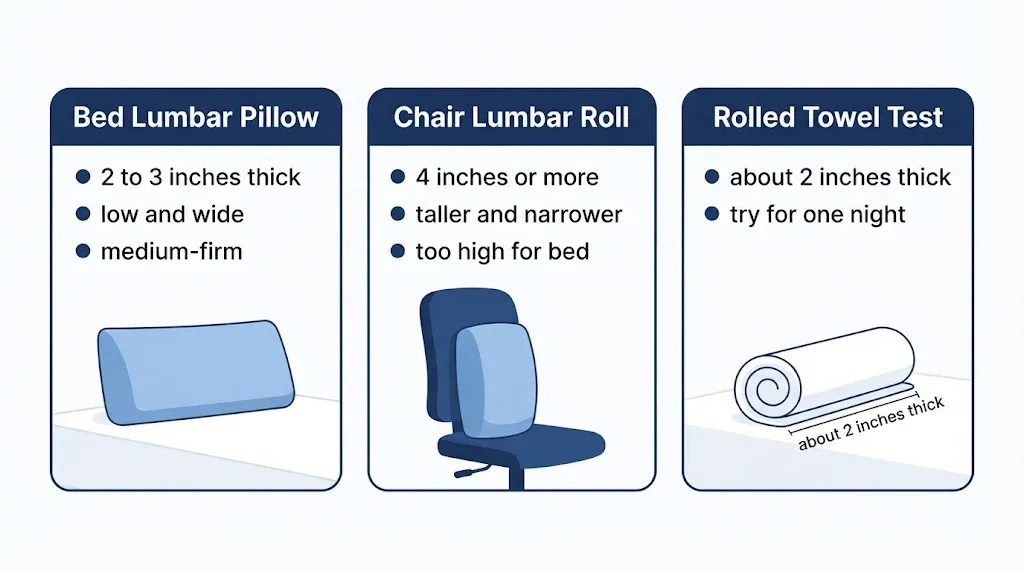
Thickness matters most. For most adults in bed, a lumbar pillow about 2 to 3 inches thick at its fullest point is enough to fill the gap. A chair lumbar roll is often 4 inches or more, and that extra height is what pushes the back into an arch when you lie down. Start low. You can add a folded towel under a thin pillow to test a little more height, but you cannot easily make a thick pillow thinner.
Firmness comes next. The pillow needs to hold its shape under your weight for hours, not flatten after ten minutes. Memory foam and dense foam usually do this better than soft down or loose fill. Look for a medium-firm feel that springs back slowly when you press it. A wide, low pillow, roughly the width of your lower back, also stays in place better than a small round cushion, which can roll or slip to one side.
Your mattress changes the answer too. On a soft mattress, your hips and shoulders sink in, so the gap is smaller and you need a thinner pillow. On a firm mattress, the gap is larger. Test it on the bed you actually sleep in. Our guide to firm or soft pillows for neck pain uses the same rule: fill the gap without pushing the spine out of line.
Tip
Test thickness with a rolled towel first. Roll a hand towel to about 2 inches thick, place it where the lumbar pillow would go, and sleep with it for a night. If it helps, you know the height is about right.
What to Pair It With, and Common Mistakes
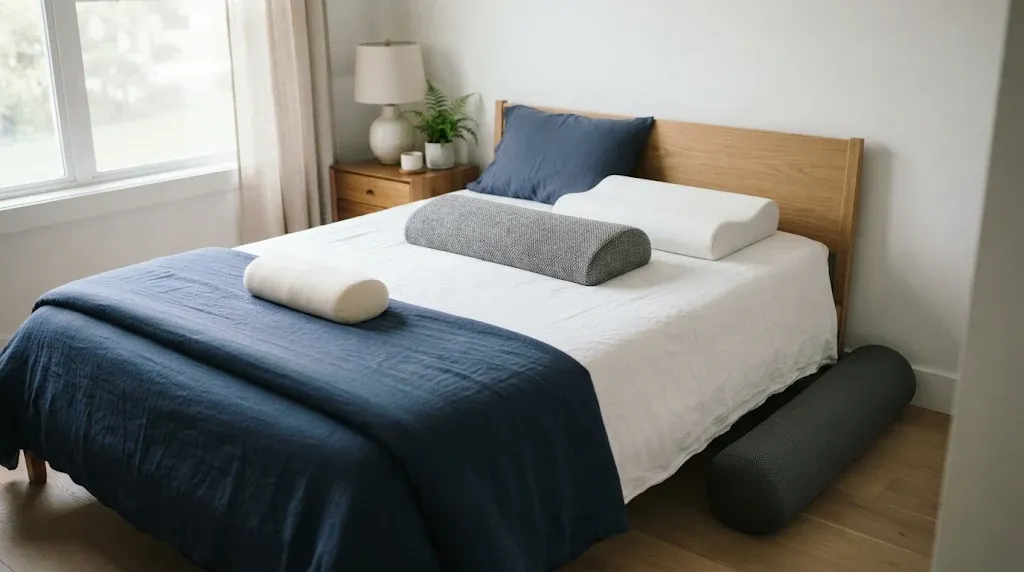
A lumbar pillow works as part of a setup, not on its own. For back sleepers, the pair is a knee pillow plus a low-to-medium head pillow. For side sleepers, it is a knee pillow plus a head pillow thick enough to fill the gap between ear and mattress. Introduce support pillows one at a time, so you know which change helped. The guide to choosing the right neck pillow walks through loft and firmness by sleep position.
Most complaints come back to a few mistakes. A chair pillow is taller and narrower, and it lifts the back too far. Placing the pillow too high, under the ribs, or too low, on the hips, tilts the pelvis instead of supporting the curve. Choosing a pillow that is too thick is the most common mistake of all. Leaving it in place when you turn over is another, because a pillow set up for back sleeping will sit in the wrong spot on your side.
When It Is Not Helping, and When to Get Checked
A lumbar pillow should make lying down feel easier within a few nights. Pressure should ease as you settle, not build. If it digs in, pushes you up, or makes you twist to get comfortable, take it out. Try a thinner pillow or a rolled towel before you decide lumbar support is not for you. Some people do better with a pillow under the knees alone, with no direct lumbar pillow at all.
Get medical advice promptly if back pain comes with numbness, tingling, or weakness in a leg, loss of bladder or bowel control, fever, unexplained weight loss, pain after a fall or injury, or pain that is severe, constant, or getting worse. The same applies if pain wakes you repeatedly or follows surgery.
Warning
Do not use a lumbar pillow to keep sleeping in a position that causes sharp or spreading pain. If a position leads to pain, stop using it for that position.
Replace the pillow when it no longer holds its shape. If neck and lower back stiffness appear together, our round-up of the best neck pillows for neck and back pain covers pillows that help both ends of the spine.
Related Product
Lumbar Support Pillow for Sleeping
A low, wide lumbar pillow made for bed fills the gap at your waist without lifting your back into an arch.
As an Amazon Associate, we earn from qualifying purchases.
Frequently Asked Questions
Where exactly should a lumbar pillow go in bed?
On your back, put it under the small of your back, just above your belt line. On your side, put it under your waist, between your ribs and hip. It should fill the gap without lifting your back into an arch.
How thick should a lumbar pillow be for sleeping?
About 2 to 3 inches thick is right for most adults. A thicker pillow, especially one made for a chair, often pushes the lower back up and makes morning stiffness worse.
Can you sleep all night with a lumbar pillow?
Yes, if the thickness and placement are right and it stays comfortable through the night. If it digs in or pushes you up, remove it or switch to a thinner one.
Is a lumbar pillow good for side sleepers?
Yes, when it sits under the waist to stop the waist sagging toward the mattress. Pair it with a pillow between your knees so your hips stay level.
Should I use a lumbar pillow under my back or under my knees?
They do different jobs. A lumbar pillow fills the gap at your waist. A pillow under your knees, for back sleepers, relaxes the hips and reduces the pull on the lower back. Many back sleepers do best with both.
Can I use a regular pillow as a lumbar pillow in bed?
A standard bed pillow is usually too thick and too soft, and it flattens during the night. A rolled hand towel is a better test: roll it to about 2 inches thick and try it for a night.
Conclusion
A lumbar pillow works when it fills the gap at your waist without lifting your back. Start low, about 2 to 3 inches thick, place it just above your belt line on your back or under your waist on your side, and pair it with a knee pillow. Give it two or three nights and judge it by how you feel on waking.

I’m a home decor enthusiast who loves discovering beautiful room ideas, creative DIY projects, and Pinterest-worthy decorating inspiration. At DecorMinty, I share simple tips, fresh trends, and practical ideas to help you create a home you’ll truly love—one room at a time.