How to Keep Pillow From Falling Behind Bed: 7 Easy Fixes
Quick Answer
Close the gap first, then stop the bed from moving. Push the mattress flush to the headboard or wall, fill any gap wider than about 2 inches with a wedge filler, a rolled towel, or a pool noodle under the fitted sheet, and anchor the frame so it cannot creep forward. A gap of 2 to 4 inches needs a filler. A gap over 4 inches usually needs a frame, foundation, or bed position fix.
A pillow behind the bed is rarely a pillow problem. It is a gap problem, a movement problem, or both. During the night, a sleeper shifts and pushes against the pillow, and if there is open space behind the mattress, gravity slides it down a little at a time.
Why Pillows Fall Behind the Bed
Most beds have a gap at the head end. A small space between the mattress and the headboard makes it easier to lift the mattress and change the sheets, but the trouble starts when that space becomes wide enough for a pillow to fit into it.
There are three common gaps: between the mattress and the headboard, between the headboard and the wall, and between the mattress and the wall when there is no headboard. Movement makes every gap worse. A mattress can creep forward on a smooth floor, a foundation smaller than the frame leaves the head end unsupported, and a soft pillow compresses and rolls backward. A slippery case, such as silk or satin, adds slide to a setup that already has space to slide into.
Measure the Gap Before You Buy Anything

Measure before choosing a fix, because the width of the gap decides which fix will work. Strip the bed, push the mattress as far toward the headboard or wall as it will go, and measure what is left in three places: the left side, the middle, and the right side. Gaps are often uneven, and a filler that fits the middle may leave a corner open.
| Gap width | What usually works | What usually does not work |
|---|---|---|
| Under 2 inches | Push the mattress flush, adjust bedding, use a larger pillow | A tall wedge, which pushes the pillow too far forward |
| 2 to 4 inches | A wedge filler, a pool noodle, a rolled towel, or a body pillow bolster | Bedding changes alone, which leave the gap open |
| Over 4 inches | Move the bed, wall-mount the headboard, or change the frame or foundation | A single wedge, which will sink or leave a side gap |
If the gap grows again after a few nights, the frame is creeping, and anchoring the bed matters more than filling the gap.
Free Fixes to Try Tonight
Start with the fixes that cost nothing. They work best for gaps under 2 inches, and they show whether a bigger fix is needed. If a free fix holds for a week, the problem was placement.
- Push the mattress flush to the headboard. Strip the bed, slide the mattress and foundation as far toward the headboard as they go.
- Push the head of the bed against a wall. If there is no headboard, move the bed so the head end touches a solid wall.
- Tighten the frame. Check that the frame is square and the headboard bolts are tight.
- Pull the fitted sheet tight. A deep-pocket sheet that fits the mattress depth adds grip.
- Stand the pillows upright. Place sleeping pillows upright against the headboard, larger pillows behind smaller ones.
Fill the Gap With Things You Already Have
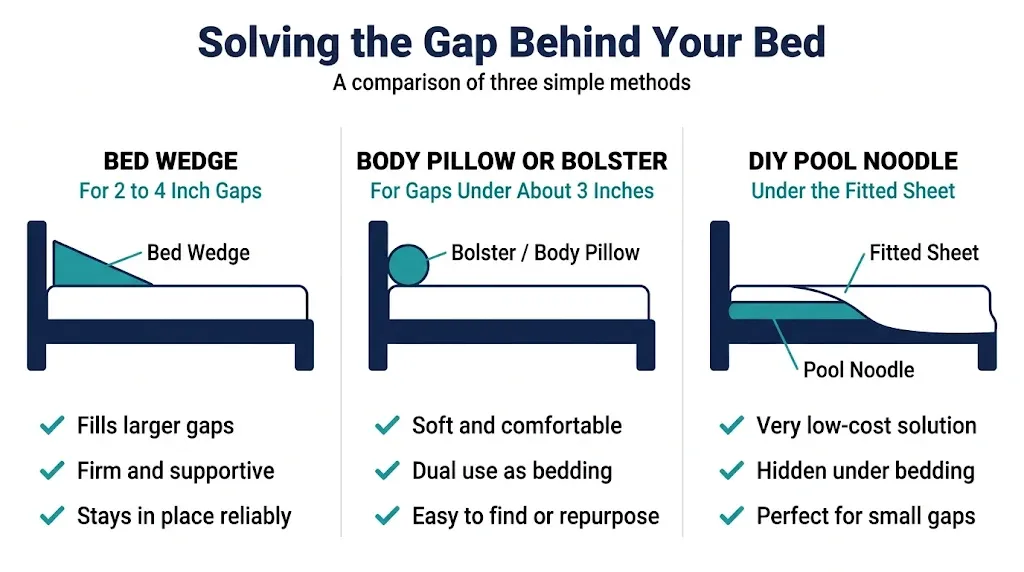
For a gap of 2 to 4 inches, a filler turns a valley into a flat surface. It needs to be firm enough to hold its shape under a pillow, wide enough to span the full width of the bed, and tall enough to sit flush with the top of the mattress.
A tightly rolled bath towel is the fastest test. Roll it lengthwise, place it across the head of the mattress in the gap, and slide it under the fitted sheet so it stays in place. A draft stopper, also called a door snake, does the same job. A pool noodle, or two side by side for a wider gap, works well because it is light, firm, and easy to cut to the width of the bed.
Wash or cover any filler regularly, swapping it for a clean one when you change the sheets. Guidance on how to wash a bed pillow covers the same care idea.
Tip
Test a filler for three nights before buying a purpose-built one. If the towel or pool noodle stays in place and the pillow stays put, you already know the size and firmness that work.
Use a Purpose-Built Bed Wedge or Gap Filler
A purpose-built wedge is the cleanest fix for a 2- to 4-inch gap, because it is sized to the bed and shaped to sit flush with the mattress. These fillers are usually long triangular or rectangular cushions, sold by mattress size, in twin, full, queen, and king widths. The wedge sits between the mattress and the headboard, and the sleeping pillow rests against its sloped face instead of hanging over open space.
Choose by height first, then by width. A filler that is too short leaves a step the pillow can still tip into, and one that is too tall pushes the sleeping pillow forward. Firmness matters more than the brand name: a soft foam wedge compresses and recreates the valley it was meant to fill, while a high-density wedge holds its shape. Look for a washable cover.
Stop the Bed and Mattress From Creeping Forward
A filler will not hold if the bed keeps moving. Every time a sleeper sits up, turns, or gets out of bed, a small amount of force pushes the frame forward. On a smooth floor, that force adds up night after night.
Start at the floor. Rubber caster cups or felt traction pads under each frame leg add grip and stop the legs from sliding. A non-slip mat under the mattress adds friction. Tighten every bolt on the frame and the headboard, and check them again after a month. Check the foundation too: a box spring shorter than the mattress leaves the head end unsupported, so the mattress sags toward the gap.
Bedding and Pillow Placement That Helps
Bedding changes will not close a wide gap, but they can stop a small gap from swallowing a pillow. The goal is grip and size: more friction under the pillow, and a pillow large enough that it cannot fit through the space behind it.
A snug-fitting case holds the pillow in shape. Cotton cases usually grip better than silk or satin, and a sham with a zipper or envelope closure adds containment.
Size is the simplest lever. A standard pillow measures 20 by 26 inches, a queen measures 20 by 30 inches, and a king measures 20 by 36 inches, according to the Sleep Foundation guide to shopping for pillows. A longer pillow spans more of the bed width, so it is less likely to tip into a corner gap. For the right fit, our guide to how big a standard bed pillow is compares standard, queen, and king sizes. Layer the largest, firmest pillow at the back against the headboard, with smaller pillows in front.
When to Change the Headboard or Frame
Some gaps are structural. A headboard that is too short, a frame that is too long for the mattress, or a headboard that cannot be attached to the frame will keep opening a gap no matter how many fillers are added. In those cases, the permanent fix is to change the structure.
A solid headboard that reaches down to the mattress, with no slats or open panels at pillow height, is the best barrier. Wall-mounting the headboard is often the simplest structural fix: detach it from the frame, bolt it to the wall, and slide the mattress all the way to the wall. Replacing the frame is the right call when it is the wrong size for the mattress or cannot be tightened. Our guide to the best neck pillow for sleeping in bed covers pillow support for people who sleep sitting up, where the head end also needs a solid backstop.
Do not ignore a growing gap: it usually means a bolt is loosening or the foundation is sagging. A flat pillow may stay put, but it can leave the neck unsupported, so check the signs in our guide on whether a pillow can cause neck pain or headaches.
A Simple Plan That Works for Most Beds
Measure the gap in three places. Push the mattress flush, tighten the frame, and add grip under the legs. Test a rolled towel or pool noodle for three nights. If the test works, replace it with a firm wedge filler in the same size, with a washable cover. If the gap is over 4 inches, or it keeps returning, move the bed, wall-mount the headboard, or change the frame or foundation. Check the setup after a week. If the pillow has stayed put, the fix is done.
Related Product
Bed Wedge Gap Filler
A firm wedge filler sized to your mattress closes a 2- to 4-inch gap and gives your pillow a solid backstop through the night.
As an Amazon Associate, we earn from qualifying purchases.
Frequently Asked Questions
Why does my pillow keep falling behind the bed every night?
There is a gap behind the mattress, and movement during the night pushes the pillow into it a little at a time. The gap is usually between the mattress and the headboard, the headboard and the wall, or the mattress and the wall.
What is the best way to fill the gap between the mattress and headboard?
For a gap of 2 to 4 inches, a firm wedge filler sized to your mattress is best, because it sits flush with the mattress and holds its shape. A rolled towel or a pool noodle under the fitted sheet works as a test and as a low-cost fix.
Will a pool noodle stop my pillow from falling behind the bed?
Yes, for a small to medium gap. Cut it to the width of the bed, place it across the head of the mattress in the gap, and slide it under the fitted sheet. Use two noodles side by side for a wider gap, and replace it with a firmer wedge if it compresses.
How do I stop my bed from sliding away from the headboard?
Add grip under the frame legs with rubber caster cups or felt traction pads, tighten all the frame and headboard bolts, and add a non-slip mat under the mattress. If the bed still moves, move it against a wall or wall-mount the headboard.
Does a headboard stop pillows from falling behind the bed?

A solid headboard that sits flush with the mattress does, because it leaves no space for the pillow to pass through. A headboard with slats or a gap at pillow height may not.
Should I use a bigger pillow to stop it falling behind the bed?
A bigger pillow can help, because a longer pillow spans more of the head end and is less likely to tip into a corner gap. A king pillow measures 20 by 36 inches, compared with 20 by 26 inches for a standard pillow. Size alone will not close a wide gap, though.
Conclusion
Keeping a pillow from falling behind the bed comes down to closing the gap and stopping the movement that opens it again. Measure the gap, push the mattress flush, and test a firm filler for a few nights. If it is 2 to 4 inches, a wedge filler sized to the bed is the reliable fix. If it is wider, or it keeps returning, fix the frame, the foundation, or the headboard position. Once the pillow has a solid backstop, it stays where it belongs.

I’m a home decor enthusiast who loves discovering beautiful room ideas, creative DIY projects, and Pinterest-worthy decorating inspiration. At DecorMinty, I share simple tips, fresh trends, and practical ideas to help you create a home you’ll truly love—one room at a time.