Are Neck Pillows Good for Travel? Flight Guide
Quick Answer
Yes, neck pillows can be good for travel because they support your head when you rest upright and may reduce uncomfortable side-to-side or forward head dropping. They work best when the shape fits your neck, seat, and sleeping position rather than simply being thick or soft. If you’re unsure whether the basic concept works, see my guide on how neck pillows actually work.
When a travel neck pillow is most useful
- Upright sleep: It supports your head when you doze in an airplane, train, bus, or passenger seat.
- Side head drop: Raised sides can limit how far your head falls toward one shoulder.
- Forward nodding: Wrap-around designs may support the chin better than a loose traditional U-shape.
- Long trips: Support becomes more useful when you’re sitting for several hours and expect to sleep.
- Limited headrests: A pillow can fill gaps when the seat itself gives your head little support.
Before you pack one
- Check the fit: A bulky pillow that pushes your head forward can feel worse than no pillow.
- Test it seated: Try the pillow against a chair or headrest before relying on it during a long flight.
I see travel neck pillows as support tools, not automatic comfort fixes. The right one can make upright sleep easier, while the wrong shape can spend an entire trip clipped uselessly to your bag.
For 2026 travel, I’d choose based on how your head moves when you fall asleep. That simple detail matters more than choosing the biggest pillow or the most expensive foam.


Are neck pillows good for travel?
Yes, neck pillows are good for travel when they help keep your head closer to a comfortable, neutral position. They are most useful when you plan to nap while sitting upright.
A travel neck pillow is a compact pillow designed to support the head and cervical spine while you sit rather than lie flat. Unlike a normal bed pillow, it usually wraps around part of your neck or supports one side of your head.
What a travel pillow can realistically do
- Support your head: It gives your head somewhere to rest instead of relying entirely on your neck muscles.
- Limit sideways tilting: Taller side panels can reduce the distance your head falls toward your shoulder.
- Reduce forward dropping: Some wrap-around designs provide support beneath or beside the chin.
- Improve resting comfort: Good support can make it easier to stay relaxed while sitting for long periods.
- Add seat support: It can compensate for airplane or train headrests that do not fit your height well.
The main goal is comfortable alignment, not holding your neck rigid. Mayo Clinic recommends keeping the head centered over the spine and taking movement breaks during long-distance travel.
You can also read my broader guide on whether neck pillows are good for you if you’re comparing travel use with everyday sleep.
Travel pillow types compared
| Pillow Type | Best For | Main Support Area | Packing | Main Trade-Off |
|---|---|---|---|---|
| U-shaped foam | General flights and road trips | Back and sides of neck | Bulky | May allow forward head drop |
| Wrap-around | People who lean sideways | Side of jaw and neck | Usually compact | Can feel restrictive |
| Inflatable | Light packers | Varies by shape | Excellent | Less plush than foam |
| High-sided memory foam | Long flights | Back, sides, and jaw | Moderate to bulky | Warmer and heavier |
Are neck pillows good for flights?
Neck pillows can be especially useful on flights because airplane passengers often sleep in a mostly upright position. Your seat and headrest otherwise have to provide nearly all your support.
The problem begins when you relax. Your head may fall sideways, tilt forward, or rotate toward the aisle or window.
Where a flight pillow helps most
- Window seats: Side support may stop you from pressing your head awkwardly against the cabin wall.
- Middle seats: A supportive pillow gives you a resting point without leaning toward another passenger.
- Aisle seats: Wrap-around support can reduce head movement when you cannot lean against a wall.
- Reclined seats: A correctly fitted pillow fills the space around your neck as the seat moves backward.
Cleveland Clinic has specifically noted that a neck pillow can be helpful while traveling. Its guidance also stresses comfortable posture and getting up to stretch during prolonged trips.
I wouldn’t expect the pillow to compensate for every uncomfortable seat. It works better as one part of your setup alongside sensible reclining, movement, and proper back support.
Do neck pillows help on planes?
 Save
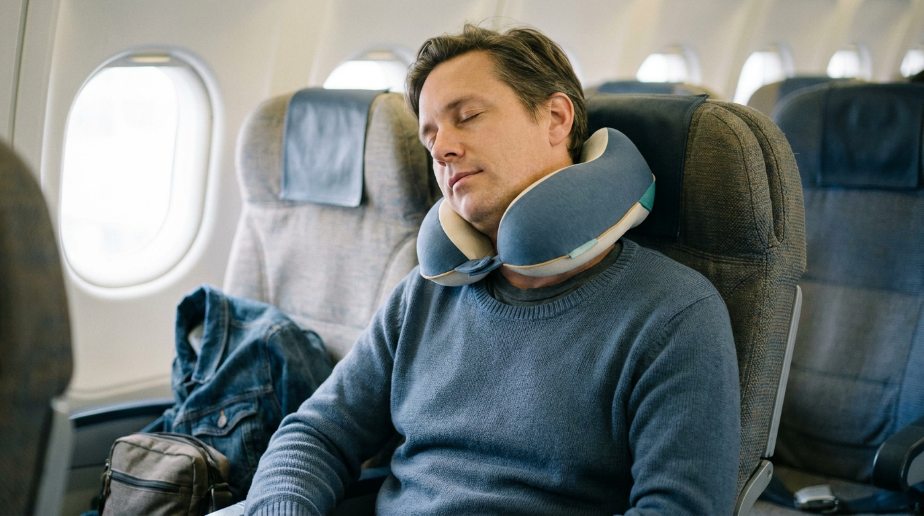
SaveYes, they can help on planes by limiting unsupported head movement while you rest. The benefit is usually easier positioning rather than guaranteed prevention of neck pain.
A common mistake is assuming that more padding always means more support. Extra foam behind your neck can push your head forward when the airplane headrest already projects forward.
Try this fit test before boarding
- Sit upright: Use a dining chair or office chair with a backrest.
- Put the pillow on: Adjust it exactly as you would during the flight.
- Relax your shoulders: Avoid consciously holding your head straight.
- Close your eyes: Let your head naturally move toward its preferred resting direction.
- Check your chin: It should not feel sharply pushed toward your chest.
- Check the sides: Your head should meet support before it falls deeply toward your shoulder.
If you need help matching shape, height, and firmness, my guide to choosing the right neck pillow breaks those factors down in more detail.
Do neck pillows work on flights?
Travel neck pillows work on flights when their design matches your personal head-drop pattern. A pillow cannot help much if your head simply slides past the area it was designed to support.
This is why two travelers can use the same pillow and have completely different reactions. Body size, shoulder width, seat design, reclining angle, and sleeping habit all affect fit.
Match the pillow to the problem
- Head falls left or right: Choose tall side support or a wrap-around design.
- Chin falls toward chest: Look for front or jaw support rather than only thick padding behind the neck.
- You overheat easily: Prioritize a breathable cover and avoid unnecessary foam bulk.
- You pack light: Inflatable or compressible designs make more sense than dense foam.
- You move constantly: Avoid a design that depends on keeping your head in one exact position.
One of my practical rules is to judge a travel pillow while sitting, not while standing in a store. The seatback changes how the pillow positions your head.
That small test can expose an otherwise comfortable-looking pillow that is simply too thick behind your neck.
Do neck pillows help you sleep on a plane?
A neck pillow may make sleeping on a plane easier because it gives your head a stable resting point. It cannot, however, solve every reason people struggle to sleep while flying.
Cabin noise, light, seat pitch, temperature, stress, and your normal sleep schedule still matter. Think of the pillow as one part of a more comfortable sleep setup.
For better in-flight rest
- Recline when allowed: Even a modest recline can reduce the tendency for your head to drop forward.
- Support your lower back: Better torso posture makes it easier to position your neck comfortably.
- Use the headrest: Fold adjustable wings inward when your seat provides them.
- Limit screen hunching: Looking down at a phone for long periods can leave your neck tired before you sleep.
- Move periodically: Get up when appropriate on longer journeys instead of staying fixed in one position.
Mayo Clinic advises people traveling long distances to get up regularly and stretch the neck and shoulders. That matters even when your pillow feels comfortable.
Are neck pillows worth it for long flights?
For many travelers, a neck pillow is more worthwhile on a long flight than on a short one. The longer you expect to rest upright, the more opportunities there are for your head to settle into an awkward position.
I would especially consider one for an overnight or long-haul itinerary where sleeping matters. On a short daytime flight where you remain awake, the benefit may be much smaller.
When I would pack one
- Overnight flight: You expect to spend meaningful time trying to sleep.
- Long-haul journey: Several hours of upright sitting makes sustained comfort more important.
- Multiple connections: The pillow can also be useful while resting at the airport.
- Poor seat support: You already know standard headrests do not suit your height.
- Frequent head dropping: You routinely wake when your head falls sideways or forward.
Sleep Foundation’s 2026 travel-pillow testing also emphasizes support during upright sleep and notes that different designs suit different travelers. There isn’t one universally best shape.
If neck discomfort is already a concern, my guide to choosing a neck pillow for neck pain explains why alignment and fit deserve more attention than marketing labels.
Do you need a neck pillow for travel?
No, you don’t need a neck pillow for every trip. It becomes worthwhile when you actually need extra head support while sitting or sleeping upright.
Plenty of travelers can rest comfortably using a supportive seat headrest, folded jacket, or other simple setup. Carrying another accessory makes little sense if you never sleep while traveling.
You probably don’t need one when
- Your trip is short: You expect to remain awake for the journey.
- Your headrest fits well: The seat already supports your preferred resting position.
- You dislike neck pressure: Wrap-around products may feel distracting rather than relaxing.
- Your bag is packed tightly: A bulky memory-foam pillow may not justify its space.
You may appreciate one when
- You fall asleep easily: Your head often starts nodding within an hour of departure.
- You wake stiff: Upright naps regularly leave your neck uncomfortable.
- You travel overnight: Rest is a major part of the journey.
- You lack side support: The seat does little to prevent lateral head movement.
I prefer treating a neck pillow like any other travel tool: pack it because it solves a problem you actually have. Don’t carry one only because it appears on every travel checklist.
Do you need a neck pillow for a long flight?
You still don’t strictly need a neck pillow for a long flight, but it becomes much easier to justify. Sleeping upright for several hours makes reliable head support more valuable.
The key is choosing support that works with the seat rather than fighting it. A poor pillow can force your chin downward or make the back of your neck feel crowded.
What I would prioritize for a long flight
- Stable side support: Your head should meet the pillow before reaching an extreme sideways angle.
- Minimal rear bulk: Avoid unnecessary thickness that moves your head away from the seat.
- Secure fit: The pillow should stay where you position it as you relax.
- Breathable material: Heat buildup becomes more annoying over several hours.
- Washable cover: Long trips expose the pillow to airports, seats, bags, and repeated handling.
- Reasonable packing size: Make sure the pillow still earns its luggage space after landing.
Remember that prolonged sitting itself can become uncomfortable. Changing position and moving periodically still matter even when your head and neck feel well supported.
Do you need one for an international flight?
 Save
SaveA neck pillow can be a smart addition to an international flight when the itinerary includes long or overnight segments. It is optional, but the potential benefit rises when you expect to sleep for several hours.
International travel also involves more than the time shown for one flight. Airport waits, connections, immigration queues, and ground transfers can turn the overall journey into a full day of travel.
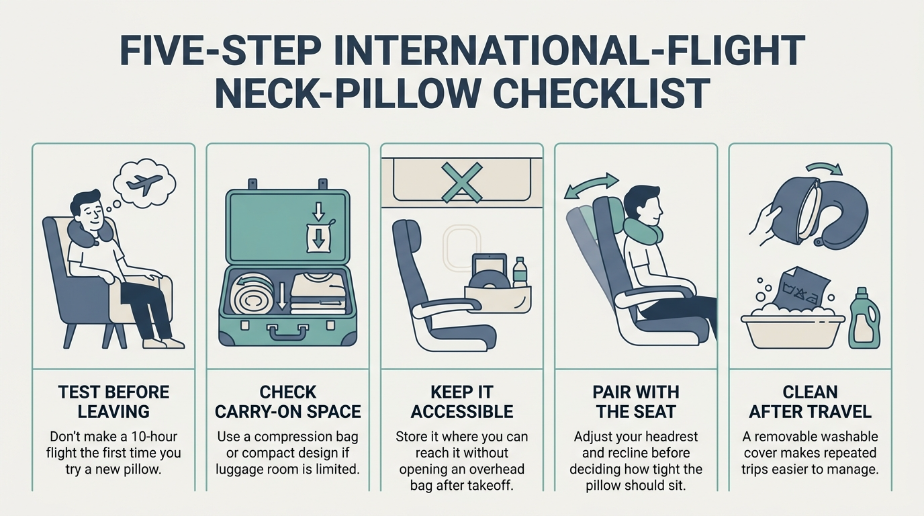
My international-flight checklist
- Test before leaving: Don’t make a 10-hour flight the first time you try a new pillow.
- Check carry-on space: Use a compression bag or compact design if luggage room is limited.
- Keep it accessible: Store it where you can reach it without opening an overhead bag after takeoff.
- Pair with the seat: Adjust your headrest and recline before deciding how tight the pillow should sit.
- Clean after travel: A removable washable cover makes repeated trips easier to manage.
For an international red-eye, I would value stability over softness. Plush material feels nice at first, but it still needs enough structure to support your head after you relax.
If you’re ready to choose one for an upcoming trip, these are the two designs I’d compare first:
🏆 Best for Long Flights
Cabeau The Neck’s Evolution S3 Neck Pillow
★★★★☆
This medium-firm memory-foam model uses raised support around the neck plus a system designed to work with a seat headrest. I like this style for longer trips because stability matters more once you start spending hours asleep or half-asleep in the same seat.
✈️ Best Wrap-Around Comfort
Ostrichpillow Go Neck Pillow
★★★★☆
The Go uses solid memory foam in a wrap-around shape intended to support upright rest and reduce side tilting. I would consider it when comfort around both sides of the neck matters more than minimizing every bit of carry-on bulk.
FAQ
Which way should you wear a travel neck pillow?
Wear it in the direction that prevents your own head from dropping uncomfortably. Some travelers do better with thicker support toward the front or side rather than automatically putting the opening in front. Test both orientations while seated and choose the one that keeps your head most comfortable.
Can a travel neck pillow prevent neck pain?
A travel pillow may reduce strain caused by unsupported head movement, but it cannot guarantee that you will avoid neck pain. Existing injuries, prolonged sitting, posture, seat design, and pillow fit all matter. Persistent, severe, or neurological symptoms should be discussed with a healthcare professional.
Is memory foam better than an inflatable neck pillow?
Memory foam usually feels more cushioned and maintains a consistent shape, while inflatable pillows pack much smaller and let you change firmness by adjusting the air. Neither is automatically better. Choose memory foam for comfort and structure, or inflatable support when luggage space matters most.
Should a travel pillow feel tight around your neck?
A travel pillow should feel secure enough to provide support without creating uncomfortable pressure. It should not make breathing, swallowing, or natural head movement difficult. If you feel trapped, overheated, numb, or more painful after using it, loosen the pillow or choose a different shape.
The Takeaway:
neck pillows are good for travel when they solve the specific problem of your head losing support as you rest upright. They are especially useful for long and overnight flights, but they are not mandatory for every traveler.
Choose by fit first. If the pillow comfortably limits your usual head drop without pushing your chin forward, it has a much better chance of earning space in your carry-on.

I’m a home decor enthusiast who loves discovering beautiful room ideas, creative DIY projects, and Pinterest-worthy decorating inspiration. At DecorMinty, I share simple tips, fresh trends, and practical ideas to help you create a home you’ll truly love—one room at a time.