12 Best Succulent Plants for Bedroom Spaces That Are Easy to Style
Quick Answer
The best succulent plants for bedroom spaces include zebra haworthia, ox tongue gasteria, Christmas cactus, African spear plant, aloe vera, jade plant, burro’s tail, string of pearls, panda plant, moonstones, Echeveria elegans, and mistletoe cactus. These picks combine compact growth, decorative foliage, manageable watering needs, or better indoor-light tolerance than many sun-hungry succulents.
Here’s the short version before you scroll further:
- Zebra Haworthia — compact and forgiving in filtered light
- Ox Tongue Gasteria — one of the better shade-tolerant choices
- Christmas Cactus — winter flowers without desert-level sunlight
- African Spear Plant — upright shape for narrow bedroom corners
- Aloe Vera — architectural leaves for a sunny windowsill
- Jade Plant — miniature-tree look with long-term potential
- Burro’s Tail — dramatic trailing stems for hanging displays
- String of Pearls — bead-like foliage with a modern look
- Panda Plant — fuzzy foliage with unusual brown edging
- Moonstones — pastel pebble-like leaves for sunny rooms
- Echeveria Elegans — classic rosettes for bright bedrooms
- Mistletoe Cactus — soft trailing growth for indirect light
Your bedroom’s light level should make the final decision. Gasteria, zebra haworthia, Christmas cactus, African spear, and mistletoe cactus are more adaptable indoors, while aloe, jade, moonstones, Echeveria, and other sun lovers belong close to a bright window or under supplemental lighting.
Our Top Picks at a Glance
Easiest to Care For — Zebra Haworthia
Best for Lower Light — Ox Tongue Gasteria
Most Beautiful Bloom — Christmas Cactus
Best Upright Pick — African Spear Plant


12 Best Succulent Plants for Bedroom Spaces
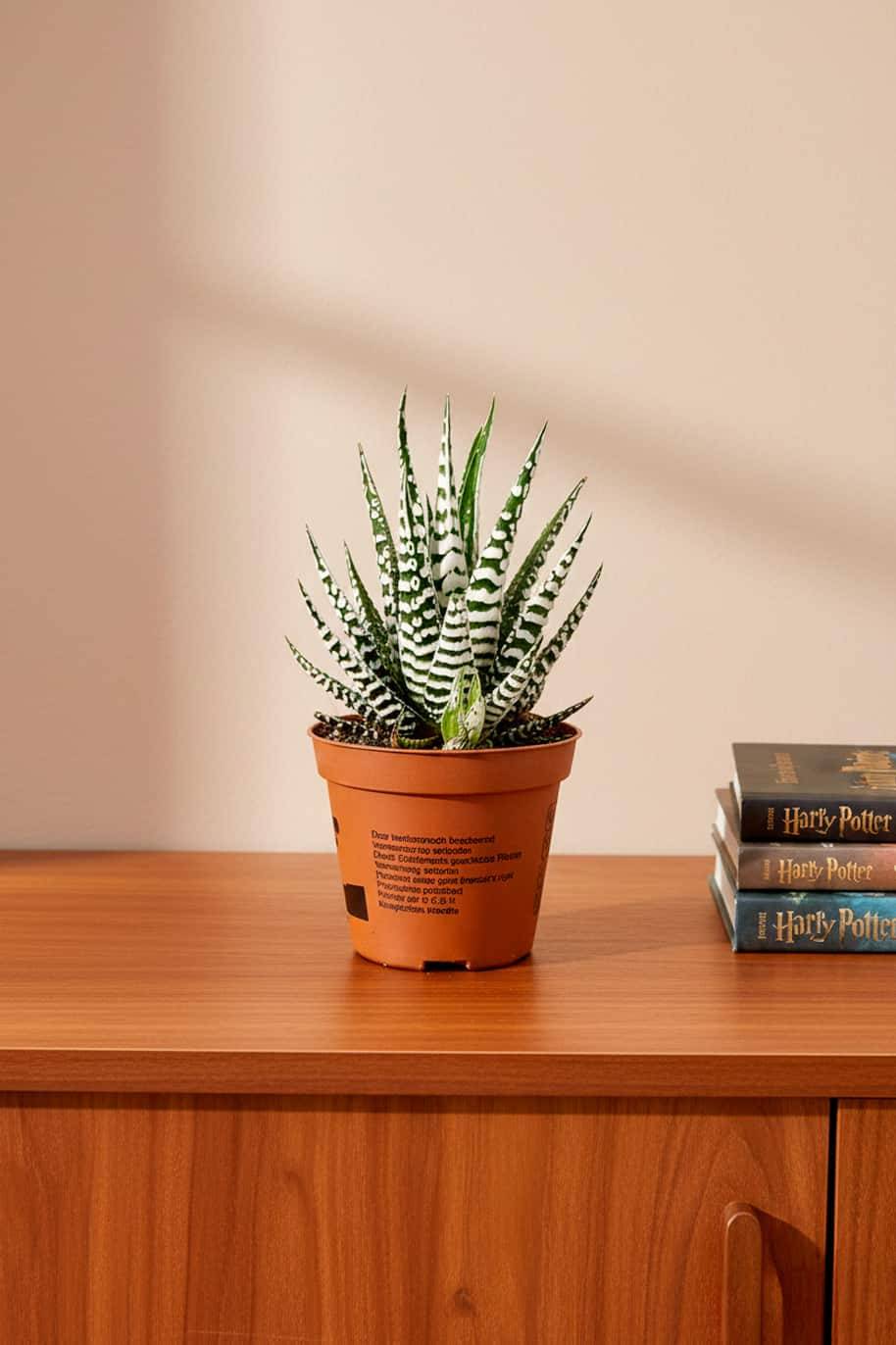
#1. Zebra Haworthia — “The Forgiving Mini”
| Sunlight | Bright indirect light, tolerates some lower-light conditions |
| Watering | About every 2-3 weeks indoors, only after the mix dries |
| Pot Size | Usually 4-6 inches for a compact plant, with drainage |
| Care Level | Easy |
| Bloom Time | Late spring to summer |
Haworthiopsis attenuata comes from South Africa’s Cape Provinces and forms compact rosettes marked with raised white bands. It stays manageable enough for a shelf or bedside table.
It prefers bright filtered light but is more forgiving of imperfect indoor exposure than many rosette succulents. Fading markings or stretched growth are signs that it needs a brighter spot.
Let the potting mix dry between waterings and divide the offsets when the clump becomes crowded. A small terracotta succulent pot with drainage helps excess moisture escape.
Pros
- Handles filtered indoor light well
- Compact, slow-growing form
- Non-toxic to pets and people
Watch For
- Root rot in constantly wet soil
- Hot direct sun can scorch leaves
- Mealybugs may hide between leaves
#2. Ox Tongue Gasteria — “The Shade Tolerator”
| Sunlight | Bright filtered light, with some shade tolerance |
| Watering | Water after the mix dries, usually every 2-3 weeks indoors |
| Pot Size | Compact 4-6 inch pot with drainage |
| Care Level | Easy |
| Bloom Time | Late winter to spring, depending on species |
Gasteria species are South African succulents related to aloe. Their thick, tongue-shaped leaves often carry attractive spots, bands, or rough texture.
Unlike many succulents, gasterias tolerate some shade. That makes them useful when your bedroom is bright enough for reading during the day but doesn’t receive hours of strong direct sun.
Use a sharply draining cactus mix and allow it to dry before watering again. Mature clumps can be divided, and many gasterias also propagate from leaf cuttings.
Pros
- Better shade tolerance than many succulents
- Slow, compact growth
- Interesting textured foliage
Watch For
- Root rot from overwatering
- Hot afternoon sun may scorch leaves
- Growth is naturally slow
#3. Christmas Cactus — “The Winter Showstopper”
| Sunlight | Bright indirect light, avoid strong midday sun |
| Watering | Water when the top inch begins to dry |
| Pot Size | Usually 6-8 inches, slightly snug |
| Care Level | Easy |
| Bloom Time | Winter |
Schlumbergera × buckleyi is an epiphytic cactus descended from Brazilian rainforest species, not a desert cactus. Its segmented stems eventually arch over the edge of the pot.
It likes bright indirect light and more consistent moisture than desert succulents. The Royal Horticultural Society’s Christmas cactus guide also emphasizes protecting it from strong direct sun.
Repot only when necessary and use an airy, well-drained mix. A free-draining Christmas cactus potting mix helps balance moisture with airflow around the roots.
Pros
- Spectacular winter flowers
- Doesn’t demand harsh direct sun
- Considered non-toxic to pets
Watch For
- Root rot in soggy compost
- Dry air can contribute to bud drop
- Sudden temperature changes stress buds
#4. African Spear Plant — “The Space Saver”
| Sunlight | Bright light preferred, tolerates partial shade |
| Watering | About every 2 weeks in summer, less in winter |
| Pot Size | 6-10 inches depending on plant size |
| Care Level | Easy |
| Bloom Time | Summer, occasional indoors |
Dracaena angolensis, formerly Sansevieria cylindrica, is an African succulent with stiff cylindrical leaves. Its strong vertical shape takes up little floor space.
It handles dappled sun and partial shade but grows best near a reasonably bright window. The thick leaves store water, making an occasional missed watering much safer than constant moisture.
Use gritty soil and a stable pot as the plant matures. Keep it away from pets and small children because ingestion can cause digestive symptoms.
Pros
- Narrow upright footprint
- Excellent drought tolerance
- Slow-growing and low maintenance
Watch For
- Toxic if pets chew it
- Wet soil can rot roots
- Very low light slows growth
#5. Aloe Vera — “The Sunny-Window Classic”
| Sunlight | Full sun to bright partial sun |
| Watering | Usually every 2-3 weeks, after soil dries completely |
| Pot Size | 6-8 inches for a medium plant |
| Care Level | Easy |
| Bloom Time | Mature plants may flower seasonally |
Aloe vera is an Asphodelaceae succulent native to the Arabian Peninsula. Mature plants produce offsets around the base, so one plant can gradually become a small collection.
Aloe needs substantially more light than its reputation as an easy houseplant sometimes suggests. Place it close to a bright window rather than on a dim dresser across the room.
Allow the soil to dry completely before soaking it again, and choose a container with several drainage holes. Aloe is toxic to cats and dogs if ingested.
Pros
- Architectural upright foliage
- Excellent drought tolerance
- Produces easy-to-divide offsets
Watch For
- Needs a bright location
- Overwatering quickly causes rot
- Toxic to cats and dogs

#6. Jade Plant — “The Miniature Tree”
| Sunlight | Bright light, ideally several hours of sun |
| Watering | Water when soil is nearly or fully dry |
| Pot Size | 6-8 inches for a young to medium plant |
| Care Level | Easy |
| Bloom Time | Rare indoors |
Crassula ovata is a South African succulent shrub whose thick stems eventually create a miniature-tree appearance. Leaf and stem cuttings are both common propagation methods.
Bright light keeps jade growth compact and sturdy. Too little light often creates longer gaps between leaves and weaker stems.
Wait until the soil dries before watering again and reduce moisture during lower-light winter months. Jade plants are toxic to cats and dogs, so don’t place one where a curious pet can nibble it.
Pros
- Can live for many years
- Distinctive tree-like form
- Easy to propagate
Watch For
- Leggy growth in poor light
- Leaf drop from excess water
- Toxic to cats and dogs
#7. Burro’s Tail — “The Cascading Statement”
| Sunlight | High indoor light with some gentle sun |
| Watering | Water after soil dries, less often in winter |
| Pot Size | 6-8 inch shallow hanging pot |
| Care Level | Moderate |
| Bloom Time | Spring to summer |
Sedum morganianum develops long stems covered in overlapping blue-green leaves. It is native to Mexico and is especially effective when allowed to trail freely.
Its biggest quirk is fragility. The fleshy leaves detach easily when bumped, although fallen leaves can root and produce new plants.
Keep it close to a bright window and handle it as little as possible. A hanging planter with drainage lets the stems cascade without resting on furniture.
Pros
- Beautiful cascading growth
- Dropped leaves propagate readily
- Drought-tolerant once established
Watch For
- Leaves fall off when handled
- Needs strong indoor light
- Wet soil encourages rot
#8. String of Pearls — “The Living Necklace”
| Sunlight | Bright light with several hours of gentle sun |
| Watering | Water lightly as the mix approaches dryness |
| Pot Size | 6-8 inch hanging pot |
| Care Level | Moderate |
| Bloom Time | Summer, flowers uncommon indoors |
Curio rowleyanus is a South African trailing succulent famous for round leaves that resemble green beads. Its stems can spill gracefully from shelves and hanging containers.
The tiny translucent windows on the leaves help light penetrate the leaf tissue. Sparse growth and long gaps between pearls usually mean the plant needs more light.
Keep the mix free-draining and avoid leaving the roots waterlogged. The plant can cause stomach upset if ingested and should stay out of reach of pets and young children.
Pros
- Unusual bead-shaped foliage
- Excellent hanging habit
- Easy to propagate from stems
Watch For
- Poor light causes sparse stems
- Overwatering causes stem rot
- Potentially harmful if eaten
#9. Panda Plant — “The Velvet One”
| Sunlight | Bright indirect light, ideally around 6 hours |
| Watering | Water after soil dries between drinks |
| Pot Size | 4-6 inches for a young plant |
| Care Level | Easy |
| Bloom Time | Summer, rare indoors |
Kalanchoe tomentosa comes from Madagascar and carries soft gray-green hairs over its fleshy leaves. Brown markings along the edges add contrast without flowers.
Wrinkled foliage can signal thirst, while yellow or mushy tissue points toward excess moisture. Leggy stems usually indicate insufficient light.
Prune stretched stems if needed and keep foliage dry when watering. Kalanchoe is poisonous if ingested, making this a poor choice for bedrooms shared with plant-chewing pets.
Pros
- Distinctive fuzzy leaves
- Likes normal low indoor humidity
- Slow-growing and decorative
Watch For
- Toxic if ingested
- Needs strong indirect light
- Overwatering causes mushy growth
#10. Moonstones — “The Pastel Pebbles”
| Sunlight | Full sun or a very bright windowsill |
| Watering | Moderately during growth, much less when resting |
| Pot Size | 4-6 inch shallow pot |
| Care Level | Moderate |
| Bloom Time | Spring |
Pachyphytum oviferum is a Mexican succulent with thick rounded leaves coated in a pale powdery bloom. The leaves can look blue, silver, or soft lavender depending on light.
This one isn’t suitable for a dim bedroom. Give it your sunniest windowsill so the growth stays compact and the characteristic coloring remains strong.
Avoid rubbing the leaves because the protective surface coating marks easily. Water moderately during active growth and keep the plant considerably drier during its resting period.
Pros
- Unusual pastel foliage
- Compact clumping growth
- Excellent minimalist accent
Watch For
- Needs considerable light
- Leaf coating marks when touched
- Wet compost encourages rot
#11. Echeveria Elegans — “The Perfect Rosette”
| Sunlight | Very bright light, sun to partial sun |
| Watering | Water thoroughly only after the mix dries |
| Pot Size | 4-6 inch shallow container |
| Care Level | Easy with enough light |
| Bloom Time | Late winter to spring |
Echeveria elegans comes from northeastern Mexico and forms tight silvery-green rosettes. Mature plants produce offsets, gradually creating a wider clump.
Light is the deciding factor indoors. If your rosette starts stretching upward instead of staying tight and symmetrical, move it closer to a bright window.
Keep water out of the crown when possible and let the potting mix dry between soakings. For a bedroom without enough natural light, a full-spectrum LED grow light is more useful than trying to compensate with less water.
Pros
- Classic symmetrical rosette
- Produces offsets for propagation
- Compact enough for windowsills
Watch For
- Stretches quickly in weak light
- Overwatering is the main disease risk
- Mealybugs may gather in rosettes
 Save
Save#12. Mistletoe Cactus — “The Soft-Trailing Cactus”
| Sunlight | Bright indirect light or partial shade |
| Watering | Moderate during growth, keep lightly moist rather than soaked |
| Pot Size | 6-8 inch hanging container |
| Care Level | Moderate |
| Bloom Time | Winter to spring |
Rhipsalis baccifera is an epiphytic cactus with slender trailing stems rather than the thick desert form most people expect. It naturally grows in tropical conditions.
Bright indirect light suits it better than baking afternoon sun. It also appreciates more atmospheric humidity and slightly more regular moisture than desert succulents.
Use a loose epiphytic cactus mix and trim excessively long stems if they become untidy. Stem cuttings taken during active growth are a practical way to propagate it.
Pros
- Handles indirect light well
- Graceful trailing form
- No desert-like spines when mature
Watch For
- Dislikes waterlogged roots
- Needs more humidity than desert types
- Long stems may require trimming
How to Choose the Right Bedroom Succulent
The prettiest succulent isn’t automatically the best one for your room. Start with the conditions you actually have.
- Check the window first — Aloe, jade, Echeveria, moonstones, burro’s tail, and string of pearls are much happier close to a bright window. Don’t treat them as plants for a dark corner.
- Choose adaptable plants for softer light — Gasteria, zebra haworthia, African spear, Christmas cactus, and mistletoe cactus give you more flexibility when direct sun is limited.
- Match the shape to your space — Pick African spear for narrow floor space, compact haworthia for a nightstand, or burro’s tail and mistletoe cactus when you have an unused hanging spot.
- Check pet safety before buying — Aloe, jade, kalanchoe, African spear, and string of pearls need extra caution around pets. The ASPCA’s succulent pet-safety guidance is a useful reference when you’re unsure.
Basic Succulent Care Tips for Beginners
The biggest improvement you can make is to stop treating every succulent like it needs the same schedule.
- Prioritize light — The University of Minnesota Extension notes that most cacti and succulents need abundant light. Place sun-loving varieties near a bright window and use supplemental lighting when your room can’t provide enough.
- Use drainage holes — Water should be able to move through the root ball and leave the container. Decorative outer pots are fine, but don’t let the inner pot sit in collected water.
- Check the soil before watering — Most desert-type succulents should dry substantially between waterings. Christmas cactus and mistletoe cactus are different because their rainforest origins mean they prefer somewhat more consistent moisture.
- Adjust with the seasons — Plants use less water when growth slows or bedroom light decreases. A watering routine that worked in summer may be excessive in winter.
Common Mistakes to Avoid With Bedroom Succulents
Most problems come from mismatched light or moisture rather than a lack of attention.
Putting a sun-loving succulent across the room from a window — Echeveria, moonstones, jade, and aloe may stretch, weaken, or lose characteristic color when light is inadequate.
Watering on the same weekday every time — Pot size, season, temperature, soil, and light all change how quickly a container dries. Check the mix before reaching for the watering can.
Using a decorative pot with no drainage — Trapped water keeps roots wet long after the leaves appear dry, creating ideal conditions for root and stem rot.
Treating rainforest cacti like desert succulents — Christmas cactus and mistletoe cactus prefer bright filtered light and somewhat more moisture than Echeveria, aloe, or jade.
Ignoring pet access when choosing a bedside plant — Several popular succulents on this list can cause illness when eaten. A high shelf isn’t enough if your cat regularly climbs there.
Give Light-Hungry Bedroom Succulents a Better Chance
If your Echeveria, moonstones, jade, or aloe is stretching even beside your brightest window, a compact full-spectrum LED grow light can supplement the natural light your bedroom lacks.
Frequently Asked Questions
Q: Can succulents live in a bedroom with low light?
A: Some tolerate lower light better than others, but complete darkness isn’t suitable. Gasteria, zebra haworthia, African spear, and certain epiphytic cacti are better bets than Echeveria or moonstones.
Q: Which succulent is easiest to keep in a bedroom?
A: Zebra haworthia is one of the easiest because it stays compact, doesn’t need constant watering, and handles filtered indoor light better than many colorful rosette succulents.
Q: How often should I water bedroom succulents?
A: Many common indoor succulents may need water roughly every two or three weeks, but never rely on the calendar alone. Check whether the potting mix has dried to the level appropriate for that species first.
Q: Can I put a succulent on my bedside table?
A: Yes, if the table receives enough daylight. Compact zebra haworthia and gasteria are practical choices, but a dark nightstand several feet from a window may not provide enough light long term.
Q: Are bedroom succulents safe for cats and dogs?
A: It depends on the species. Aloe, jade, kalanchoe, African spear, and string of pearls require caution, while plants such as zebra haworthia and Echeveria are generally considered safer choices.
Q: Do I need a grow light for bedroom succulents?
A: Not if your plant already receives enough bright natural light. A grow light becomes useful when sun-loving plants stretch, lose compact growth, or sit in a bedroom without a suitably bright window.
Final Thoughts
The best bedroom succulent is the one that matches your real light conditions. Choose adaptable gasteria or haworthia for softer light, or reserve your sunniest windowsill for aloe, Echeveria, moonstones, jade, and other light-loving varieties.
Get the light and drainage right first. Watering becomes much easier after that.
Which plant are you adding to your space first? Save this post to Pinterest so you can come back whenever you need fresh plant inspo!

I’m a home decor enthusiast who loves discovering beautiful room ideas, creative DIY projects, and Pinterest-worthy decorating inspiration. At DecorMinty, I share simple tips, fresh trends, and practical ideas to help you create a home you’ll truly love—one room at a time.