Can Neck Pillows Help With Snoring or Sleep Apnea?
Quick Answer
A neck pillow may reduce snoring for some people by encouraging a better head, neck, or side-sleeping position, especially when snoring gets worse on the back. However, a pillow does not diagnose or cure obstructive sleep apnea, so it should be treated as a comfort or positioning aid rather than a replacement for medical care. If you’re still deciding whether specialized support makes sense, see how neck pillows actually work.
What a neck pillow may and may not do
- Improve positioning: Some pillow shapes encourage side sleeping or reduce awkward head positions.
- Reduce some snoring: Positional snoring may improve when you spend less time flat on your back.
- Support CPAP comfort: CPAP-specific pillows can create space for a mask and tubing without replacing the machine.
- Not diagnose apnea: Snoring alone cannot tell you whether you have obstructive sleep apnea.
- Not replace treatment: A standard cervical pillow should not replace CPAP, an oral appliance, or clinician-directed care.
When to get checked
- Talk with a healthcare professional if snoring comes with witnessed breathing pauses, gasping, significant daytime sleepiness, or repeated morning headaches.
I understand why a pillow sounds appealing when snoring is keeping you or your partner awake. Changing a pillow is simple, inexpensive, and far less intimidating than thinking about a sleep study.
The important part is knowing where a neck pillow can realistically help and where it cannot. That distinction matters even more when sleep apnea could be involved.


Can a neck pillow help with snoring?
 Save
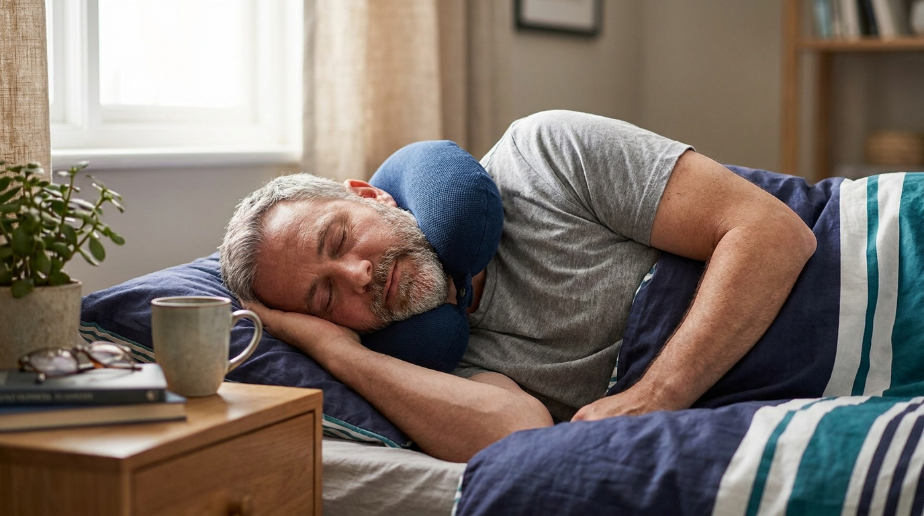
SaveYes, a neck pillow may help certain types of positional snoring, particularly when head and body position affect how easily air moves through the upper airway. The benefit is not guaranteed, and the pillow’s shape matters more than its marketing label.
A neck pillow is a pillow designed to support the cervical spine, meaning the seven vertebrae in your neck. Depending on the design, it may cradle the neck, encourage side sleeping, elevate part of the upper body, or simply keep the head more comfortably aligned.
Why sleeping position can affect snoring
When some people sleep flat on their backs, gravity allows the tongue and soft tissues to shift toward the back of the throat. That can narrow the airway and increase vibration during breathing.
- Back sleeping: Snoring may become louder in people whose airway narrows more in the supine position.
- Side sleeping: Moving onto the side can reduce airway obstruction in some positional sleepers.
- Head position: Excessive neck flexion or an awkward chin-down posture may feel restrictive and uncomfortable.
- Pillow height: Too much or too little loft can leave the head in an unnatural position.
A small published study gives us an interesting example. Researchers evaluated 25 adults with mild-to-moderate positional obstructive sleep apnea while they used a specially designed head-positioning pillow.
Across three nights, the median objective snoring index dropped from 218 to 115 snoring events per hour. The study was small and short, so it should not be treated as proof that ordinary neck pillows stop snoring for everyone.
You can review the study through the National Library of Medicine.
Which pillow features make the most sense?
I focus on positioning before foam type or brand. A fancy material cannot compensate for a pillow that puts your head at the wrong angle.
- Comfortable loft: Your chin should not be pushed hard toward your chest.
- Side-sleep support: The pillow should fill the shoulder-to-head gap without bending the neck sideways.
- Stable shape: Support should remain reasonably consistent instead of collapsing quickly.
- Adjustability: Removable fill or layers make it easier to fine-tune height.
If pillow height is your biggest uncertainty, my guide to choosing the right neck pillow explains what to check before buying.
Do neck pillows prevent snoring?
No neck pillow can reliably prevent all snoring. Snoring has several possible causes, and sleep position is only one of them.
Nasal congestion, alcohol use, airway anatomy, body weight, sleep stage, medications, and obstructive sleep apnea can all affect nighttime breathing. A positioning pillow cannot correct every one of those factors.
When a pillow is more likely to help
- Position-dependent snoring: Your snoring is noticeably worse when you sleep on your back.
- Poor head support: Your existing pillow lets your head tilt into an uncomfortable position.
- Side-sleep preference: A supportive pillow helps you remain comfortably on your side.
- CPAP mask interference: A specially shaped pillow gives the mask more clearance.
There is a practical distinction here. A pillow may help reduce a trigger for snoring without eliminating the underlying reason you snore.
When changing pillows is not enough
Frequent loud snoring deserves more attention when it comes with breathing pauses, choking, gasping, or excessive daytime tiredness. The National Heart, Lung, and Blood Institute’s sleep apnea guidance lists these among important symptoms.
A sleep study may be needed to determine whether obstructive sleep apnea is present. That is much more useful than repeatedly buying new pillows while significant symptoms continue.
| Pillow approach | What it may help with | Best fit | Main limitation |
|---|---|---|---|
| Standard cervical pillow | Neck support and comfortable alignment | Back or side sleepers needing cervical support | Not an established sleep apnea treatment |
| Head-positioning pillow | Encouraging a less snore-prone head or side position | Selected positional snorers | Evidence is limited and design-specific |
| CPAP pillow | Mask clearance, hose management, comfort | People already using prescribed PAP therapy | Supports treatment but does not replace PAP |
| Adjustable-height pillow | Fine-tuning head and neck position | People unsure which loft fits them | Better alignment does not guarantee less apnea |
The right choice also depends strongly on how you sleep. My breakdown of the best neck pillow for each sleeping position covers that part in more detail.
Can a cervical neck pillow help with sleep apnea?
A cervical neck pillow can sometimes make sleep more comfortable, but it should not be presented as a stand-alone treatment for obstructive sleep apnea. Its most plausible role is supporting positioning or helping you use prescribed therapy comfortably.
Obstructive sleep apnea happens when the upper airway repeatedly becomes blocked or narrowed during sleep. Those interruptions can lower sleep quality and place stress on the cardiovascular system over time.
Positional sleep apnea is different
Some people have obstructive events much more often while lying on their backs. This pattern is commonly called positional obstructive sleep apnea.
For those patients, a clinician may recommend strategies that reduce back sleeping. NHLBI also notes that side sleeping can help keep the airway open for some people with sleep apnea.
- Possible role: A pillow may make a recommended side position easier to maintain.
- Possible comfort benefit: Better neck support may reduce the urge to roll into another position.
- Important limitation: Position alone does not adequately control every case of OSA.
- Diagnosis matters: A sleep study can show whether apnea is positional and how severe it is.
What about elevating the head?
Some people feel more comfortable with gentle upper-body elevation, but simply stacking several pillows can bend the neck rather than elevate the torso evenly. That is one reason I prefer looking at overall body position instead of focusing only on how high the head sits.
A clinician who has reviewed your sleep study can tell you whether positional therapy makes sense for your particular pattern. That is especially important when apnea is moderate or severe.
For everyday cervical support questions unrelated to apnea treatment, see what to look for in a neck pillow for neck pain.
Do neck pillows work for sleep apnea?
Ordinary neck pillows do not work like CPAP and should not be treated as a replacement for proven sleep-apnea therapy. As of 2026, major NHLBI treatment guidance emphasizes PAP therapy, oral appliances, lifestyle measures, and other clinician-directed options.
You can review those established options in the NHLBI sleep apnea treatment overview.
Why CPAP is different from a pillow
Continuous positive airway pressure, or CPAP, sends pressurized air through a mask to help keep the airway open while you sleep. A neck pillow cannot create that airway pressure.
- CPAP: Actively provides positive airway pressure.
- Oral appliance: Can reposition the lower jaw or tongue when professionally prescribed.
- Positional strategy: Attempts to reduce time spent in a position that worsens apnea.
- Neck pillow: Primarily provides support, comfort, or positioning assistance.
A CPAP pillow can still be useful
This is where pillow terminology becomes confusing. A “CPAP pillow” is not an alternative treatment; it is a pillow designed to make sleeping with a CPAP mask easier.
Many have side cutouts so a full-face or nasal mask is less likely to press hard against the mattress pillow. Some also include adjustable layers or a hose-management strap.
That distinction is important. If a CPAP pillow reduces mask pressure or shifting, it may make prescribed therapy more comfortable without changing the prescribed treatment itself.
Signs you should not rely on a pillow experiment
- Witnessed pauses: Someone notices that your breathing repeatedly stops during sleep.
- Gasping or choking: You wake suddenly struggling for air.
- Heavy daytime sleepiness: You regularly struggle to stay awake during normal daytime activities.
- Persistent morning headaches: Headaches repeatedly occur alongside other sleep-apnea symptoms.
- Existing diagnosis: You have diagnosed OSA but are considering abandoning prescribed treatment for a pillow.
The NHLBI overview of sleep apnea explains why untreated apnea deserves attention. If PAP treatment is uncomfortable, it is usually better to troubleshoot the mask, pressure, humidification, or sleeping setup with your care team than to stop therapy on your own.
Can a neck pillow improve sleep?
 Save
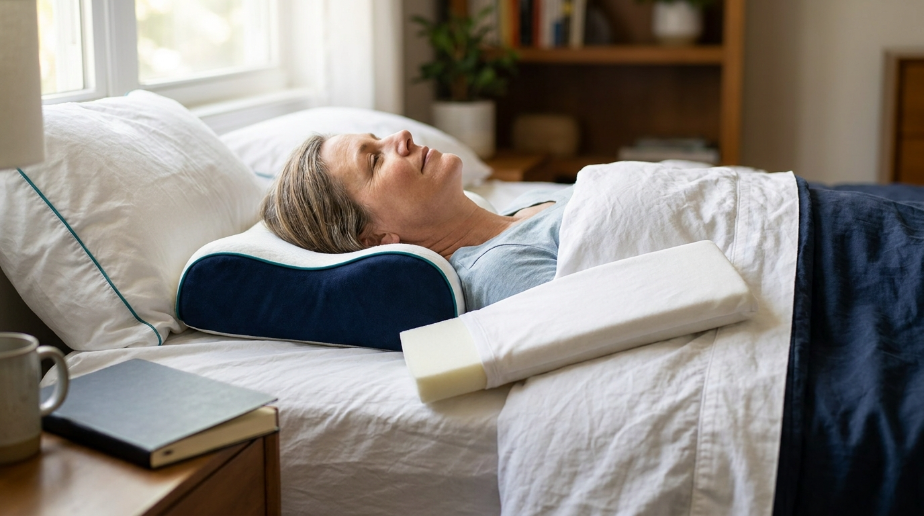
SaveA well-fitted neck pillow may improve sleep comfort when your existing pillow causes pressure, awkward positioning, or frequent repositioning. Comfort can matter even when the pillow has no direct effect on a sleep disorder.
My practical rule is simple: I look for neutral, relaxed support, not the deepest contour or firmest foam available. A pillow that constantly reminds you it is there is rarely helping you settle into sleep.
What better pillow fit should feel like
- On your back: Your head feels supported without your chin being forced toward your chest.
- On your side: Your head does not visibly sag toward the mattress or tilt toward the ceiling.
- During the night: You are not repeatedly folding, punching, or stacking the pillow.
- In the morning: You are not consistently waking with new neck stiffness caused by the pillow.
Comfort and alignment are also why the word “cervical” should not automatically persuade you to buy something. A cervical contour that fits one person’s shoulders and mattress can feel completely wrong for another person.
If you want the broader pros-and-cons before changing your sleep setup, read whether neck pillows are good for you.
A simple way to test a new pillow
- Start with your usual sleep position. Do not force yourself into an unfamiliar position just because of the pillow.
- Check head angle. Your neck should feel supported rather than sharply bent forward, backward, or sideways.
- Change one variable at a time. Adjust loft before changing your mattress, sleep position, and pillow simultaneously.
- Track snoring separately from comfort. Feeling better does not automatically mean sleep apnea has improved.
- Escalate concerning symptoms. Persistent gasping, breathing pauses, or major daytime sleepiness deserves medical evaluation.
If you’re choosing a pillow to support your existing sleep setup, these are the two designs I’d consider for two very different needs:
🏆 Best for CPAP Users
Contour CPAPMax Pillow 2.0
★★★★☆
This CPAP-specific pillow has side cutouts for mask clearance, removable layers that adjust the height from about 2.25 to 5.25 inches, and a hose tether. I like this design specifically for people already using PAP therapy because its purpose is improving mask comfort rather than pretending a pillow can replace treatment.
💤 Best for Cervical Support
Core Products Tri-Core Cervical Support Pillow
★★★★☆
The Tri-Core uses a recessed center, raised side areas, and two cervical rolls, with full, midsize, and petite options available. I would consider it when the goal is structured neck support for back or side sleeping, not as a treatment for sleep apnea itself.
Frequently Asked Questions
Can sleeping with your neck elevated stop snoring?
Elevation may reduce snoring for some people, but the effect depends on why they snore. Raising only the head with several pillows can also bend the neck awkwardly, so comfortable whole-body positioning is preferable to simply stacking pillows higher.
Is a cervical pillow safe if I have sleep apnea?
A cervical pillow is generally a support product, but it should not replace prescribed sleep-apnea treatment. If you use CPAP or another therapy, make sure a new pillow does not interfere with your mask, tubing, breathing comfort, or clinician’s positioning advice.
What sleeping position is best for snoring and sleep apnea?
Side sleeping can reduce obstruction in some people whose snoring or obstructive sleep apnea becomes worse on their back. However, not everyone has positional OSA, so a sleep study and professional guidance are more reliable than assuming one position will control the condition.
Can a CPAP pillow replace a CPAP machine?
No. A CPAP pillow only provides space, support, or mask clearance, while a CPAP machine supplies positive airway pressure to help keep the airway open. The pillow may improve comfort, but it does not perform the treatment delivered by the machine.
How do I know if my snoring could be sleep apnea?
Loud snoring becomes more concerning when it occurs with witnessed breathing pauses, gasping, choking, repeated awakenings, daytime sleepiness, or morning headaches. A healthcare professional may recommend an overnight sleep study to confirm whether sleep apnea is present.
Bottom Line:
A neck pillow can be worth trying when poor positioning contributes to snoring or when you want better cervical or CPAP-mask comfort. Just keep expectations realistic: support and positioning are not the same thing as treating obstructive sleep apnea.
If snoring is persistent or comes with breathing pauses, gasping, or major daytime tiredness, make medical evaluation the priority. Then use the pillow as part of a comfortable sleep setup rather than relying on it as the entire solution.

I’m a home decor enthusiast who loves discovering beautiful room ideas, creative DIY projects, and Pinterest-worthy decorating inspiration. At DecorMinty, I share simple tips, fresh trends, and practical ideas to help you create a home you’ll truly love—one room at a time.