Is It Better to Sleep With or Without a Pillow?
Quick Answer
For most side and back sleepers, sleeping with a properly fitted pillow is better because it supports neutral head and neck alignment. Some stomach sleepers may feel more comfortable with a thin pillow or no pillow, but sleeping without one is not a proven treatment for neck pain. If your pillow is causing stiffness, focus on fit rather than automatically removing it; this guide to the best neck pillow for neck pain explains what supportive fit looks like.
The practical rule
- Side sleepers: Usually need enough pillow height to fill the gap between the shoulder and head.
- Back sleepers: Usually benefit from gentle neck support without forcing the chin toward the chest.
- Stomach sleepers: May prefer a very thin pillow or none because extra height can increase neck extension.
- Neck pain: Going pillowless may help some people, but it can make alignment worse for others.
- Main goal: Keep your head and neck comfortably aligned with the rest of your spine.
Check your morning symptoms
- If changing your pillow repeatedly causes new stiffness, headaches, tingling, or worsening pain, stop experimenting and discuss the symptoms with a healthcare professional.
People often assume a pillow is either essential or harmful, but the answer depends heavily on how you sleep. The important question isn’t simply whether a pillow is present.
It’s whether your sleep setup keeps your neck comfortable and close to neutral. In this guide, I’ll break that down by sleep position, neck pain, health, and what you might notice during a longer pillowless trial.
Definition: Pillowless sleep means sleeping without a pillow directly beneath your head. It doesn’t necessarily mean sleeping without any support elsewhere, such as a pillow beneath your knees or hips.


Is it better to sleep with or without a pillow?
 Save
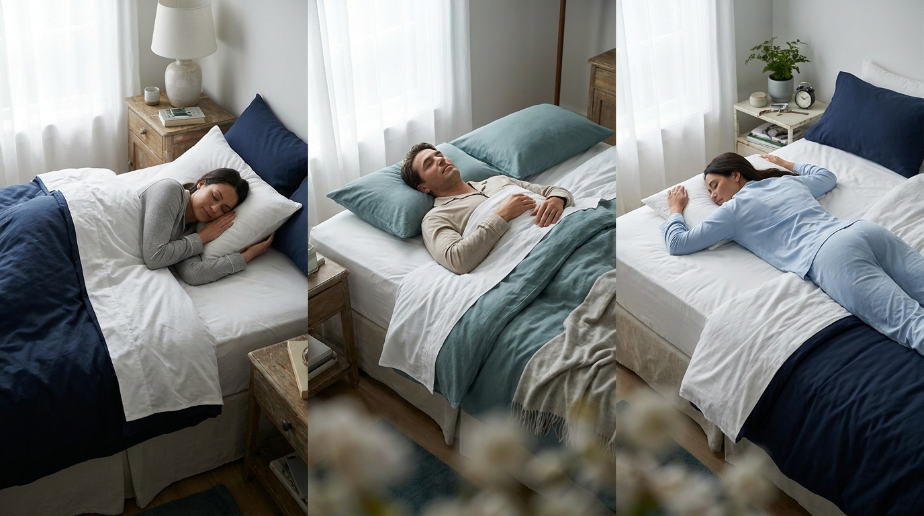
SaveFor most side and back sleepers, sleeping with a suitable pillow is the better starting point. A pillow helps fill the space between your head, neck, shoulders, and mattress.
Stomach sleepers are the main exception. Because the head already turns to one side, adding a thick pillow can increase an awkward neck angle.
Your sleeping position changes the answer
The cervical spine is the neck portion of your spine and contains seven vertebrae. During sleep, the goal is to avoid holding this area sharply bent forward, backward, or sideways for hours.
The Cleveland Clinic’s pillow guidance recommends choosing a pillow that keeps the neck relatively parallel with the mattress rather than dramatically bending it.
| Sleep position | Typical pillow approach | Main alignment goal | Common problem |
|---|---|---|---|
| Side | Supportive, usually higher loft | Fill the shoulder-to-head gap | No pillow can let the head drop toward the mattress |
| Back | Low-to-moderate support | Support the neck without pushing the head forward | A thick pillow can push the chin toward the chest |
| Stomach | Thin pillow or sometimes none | Limit added neck extension | The neck still stays rotated to one side |
| Combination | Adjustable or adaptable support | Maintain support while positions change | A fixed contour may suit one position better than another |
Don’t judge a pillow only by softness
A soft pillow can still be too tall, while a firm pillow can still be too low. Height, compression, mattress firmness, and shoulder width all affect the final position of your head.
If you’re unsure where to start, compare your position with this guide to choosing a neck pillow for your sleeping position.
Is it better to sleep without a pillow for neck pain?
Sleeping without a pillow can reduce discomfort for a small group of sleepers, especially some stomach sleepers. For side and back sleepers, removing the pillow can also make neck alignment worse.
That’s why I wouldn’t treat “no pillow” as a universal neck-pain rule. The better question is whether your current pillow holds your head too high, too low, or tilted sideways.
What research says about pillows and neck pain
A 2021 systematic review and meta-analysis indexed by PubMed examined 35 articles about pillow design. Nine higher-quality studies included 555 participants.
The review found that some pillow types were associated with lower neck pain and waking symptoms. It also highlighted pillow shape and height as important factors rather than proving that one universal pillow works for everyone.
A newer systematic review covering studies through June 2024 likewise concluded that appropriate pillow use may support spinal alignment and reduce muscle strain, while the evidence remains limited.
Try adjusting before removing the pillow
If neck discomfort seems connected to sleep, changing support gradually is more useful than making a dramatic switch overnight. You can test one variable at a time.
- Reduce loft: Try a thinner pillow if your chin feels pushed toward your chest.
- Add loft: Side sleepers may need more support if the head drops toward the mattress.
- Adjust the fill: Removable-fill pillows make small changes easier.
- Check your mattress: Your shoulder sinks farther into a soft mattress than a firm one.
- Watch symptoms: A setup that repeatedly worsens pain isn’t a good fit.
For a more detailed fit checklist, see how to choose the right neck pillow rather than assuming less support is always better.
Can sleeping without a pillow fix neck pain?
No strong evidence shows that simply sleeping without a pillow can fix neck pain. It may reduce one source of strain for certain sleepers, but neck pain has many possible causes.
A pillow change is best viewed as a comfort and positioning adjustment. It isn’t a diagnosis or treatment for an underlying neck condition.
Why removing a bad pillow can feel like a cure
Imagine a back sleeper using a pillow thick enough to push the head forward all night. Removing that pillow could quickly feel better because the original setup was creating an uncomfortable angle.
That doesn’t mean pillowless sleep cured the neck. It means the sleeper removed one aggravating factor.
Neutral positioning matters more than the rule
Mayo Clinic guidance for neck pain recommends keeping the head and neck aligned with the body during sleep and using appropriate neck support.
Harvard Health also describes back and side sleeping as easier on the neck and discusses using appropriate support to maintain a comfortable position.
The practical rule I use for this guide is simple: choose the smallest amount of support that keeps your neck comfortably neutral. That could mean a supportive pillow, a flatter pillow, or occasionally no head pillow at all.
Know when a pillow experiment isn’t enough
Persistent neck pain deserves more attention than another bedding purchase. Seek medical advice if pain is severe, follows an injury, persists, or occurs with symptoms such as numbness, weakness, or tingling.
A clinician can determine whether your sleep position is contributing to the problem or whether something else needs attention.
Is sleeping without a pillow healthy?
Sleeping without a pillow isn’t automatically healthy or unhealthy. Its effect depends on your position, anatomy, mattress, symptoms, and whether your neck stays comfortably supported.
For a stomach sleeper, eliminating a thick pillow can reduce extra elevation beneath the head. For a side sleeper, removing the pillow can create a large unsupported gap.
Potential advantages
- Less head elevation: Helpful when a stomach sleeper’s pillow is pushing the head too far upward.
- Simpler setup: It removes a poorly fitted pillow from the equation.
- Useful comparison: A short trial can reveal whether excessive pillow height contributes to morning stiffness.
Potential disadvantages
- Sideways neck bending: Side sleepers may lose the support needed between the shoulder and head.
- Reduced neck support: Some back sleepers may feel the neck isn’t comfortably supported.
- Morning stiffness: A new position can create soreness rather than relieve it.
- Sleep disruption: An unfamiliar setup may cause more repositioning during the night.
Pillow firmness can complicate the decision too. My firm vs. soft neck pillow comparison explains why support level and loft should be judged together.
What about other health conditions?
Some people use elevated pillows or wedges for reasons unrelated to neck pain. Certain sleep or digestive conditions may require positioning advice from a healthcare professional.
Don’t remove medically recommended support because a general article says pillowless sleep works for someone else. Individual needs matter more here.
What happens if you sleep without a pillow for 30 days?
 Save
SaveThere is no established 30-day transformation that happens when you stop using a pillow. You may feel better, worse, or notice little difference depending on whether pillowless sleep suits your normal position.
No good evidence shows that 30 days without a pillow permanently reshapes a healthy neck or cures chronic neck pain.
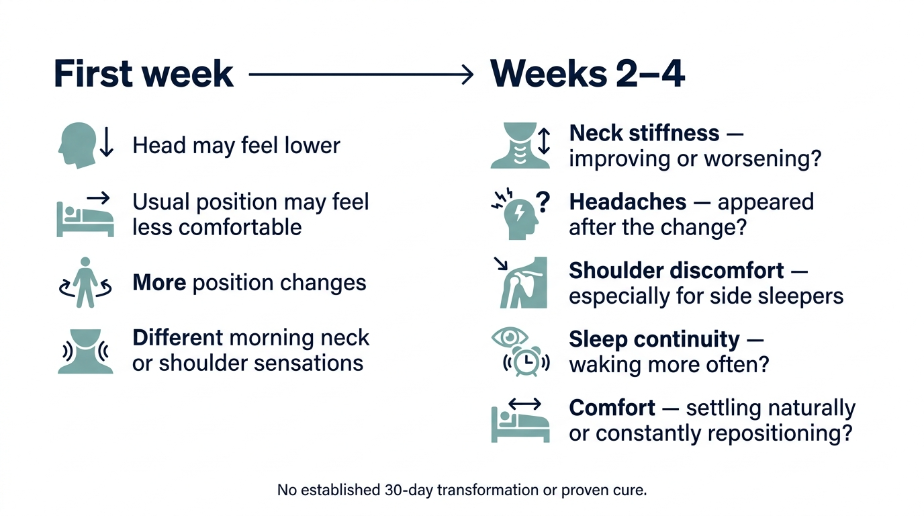
What you might notice during the first week
The first few nights mostly tell you how your body responds to a different sleeping surface. An unfamiliar position can feel strange even when it isn’t harmful.
- Your head may feel lower than expected.
- Your usual sleep position may become less comfortable.
- You may change positions more often.
- Morning neck or shoulder sensations may change.
What to watch during weeks two through four
Instead of counting days, monitor repeatable symptoms. A simple morning check is more useful than trying to force yourself through a 30-day challenge.
- Neck stiffness: Is it consistently improving or worsening?
- Headaches: Did they appear after changing your sleep setup?
- Shoulder discomfort: This matters especially for side sleepers.
- Sleep continuity: Are you waking more often?
- Comfort: Can you settle naturally without constantly repositioning?
If you’re testing pillow changes because you’re unsure whether neck support does anything, my guide on whether neck pillows really work explains where support is useful and where expectations become unrealistic.
Don’t force a 30-day experiment
There’s no prize for reaching day 30 if you’re consistently waking in more pain. A pillow trial should help you identify a comfortable setup, not become an endurance test.
If symptoms clearly worsen, return to the last comfortable arrangement and reassess the pillow height, firmness, and sleep position.
Should you sleep completely flat?
Most people don’t need to sleep completely flat. Your body has natural curves, so comfortable sleep often involves selective support rather than making every part of your body perfectly level.
Head support should work together with your mattress and sleeping position. Removing every pillow isn’t automatically more natural or healthier.
Back sleepers
Back sleepers often benefit from modest neck support that doesn’t push the head far forward. Some also feel more comfortable with support beneath the knees.
The goal isn’t maximum flatness. It’s a relaxed position that doesn’t force the spine into an uncomfortable posture.
Side sleepers
Side sleepers usually have the strongest reason to keep a head pillow. Your shoulder creates a physical gap between the side of your head and the mattress.
A properly sized pillow fills that space. Without it, the head may tilt downward for much of the night.
Stomach sleepers
Stomach sleepers may prefer the flattest head setup because a tall pillow adds height while the neck is already rotated. Some use no head pillow but place thin support beneath the pelvis or abdomen for comfort.
Stomach sleeping can still stress the neck because the face usually turns to one side. Removing the pillow doesn’t eliminate that rotation.
A simple alignment check
Don’t chase a perfectly straight-looking body at all costs. Instead, look for obvious extremes and pay attention to how you feel after several nights.
- Your chin shouldn’t be strongly pushed toward your chest.
- Your head shouldn’t be dramatically tipped backward.
- On your side, your head shouldn’t sag toward the mattress.
- Your pillow shouldn’t force you to brace your neck muscles.
- You should be able to relax without constantly adjusting the pillow.
If you’re replacing an uncomfortable pillow rather than eliminating one completely, these are the two options I’d consider first:
🏆 BEST FOR ADJUSTABILITY
Coop Sleep Goods Original Adjustable Pillow
★★★★☆ 4/5 editorial fit
Its cross-cut memory foam and microfiber fill can be added or removed, which makes loft easier to fine-tune for back, side, or combination sleeping. I prefer adjustability for this particular question because it lets you test less support without jumping immediately from a full pillow to no pillow.
🛏️ BEST FOR CONTOURED SUPPORT
TEMPUR-Neck™ Pillow
★★★★☆ 4/5 editorial fit
This molded TEMPUR-Material pillow uses a contoured profile designed for side and back sleepers and comes in multiple sizes. I’d look at this style when the problem is lack of structured neck support rather than simply wanting the softest possible pillow.
Frequently Asked Questions
Is sleeping without a pillow good for posture?
It depends on your sleeping position. Going without a pillow may reduce extra head elevation for some stomach sleepers, but side sleepers commonly need a pillow to fill the shoulder-to-head gap. The better posture goal is neutral, comfortable alignment rather than automatically sleeping flat.
Can sleeping without a pillow cause neck pain?
Yes. Side and back sleepers may develop stiffness or discomfort if removing the pillow leaves the head unsupported or tilted. Stomach sleepers may tolerate pillowless sleep better, although turning the head to one side can still strain the neck.
Should side sleepers ever sleep without a pillow?
Most side sleepers benefit from a pillow because the shoulder creates space between the mattress and head. Without enough support, the head may drop toward the bed and bend the neck sideways. Mattress firmness and shoulder width affect the amount of support needed.
Is one pillow better than two pillows?
The number matters less than the final height. Two thin pillows could work, while one thick pillow could be too high. Choose enough support to hold your head comfortably without pushing the chin forward or letting the head fall sideways.
How do I know if my pillow is causing neck pain?
Look for a repeatable pattern of waking with stiffness, headaches, shoulder discomfort, or a neck that feels better after you’ve been upright for a while. If symptoms began after changing pillows, reassess the pillow’s height and firmness before buying another one.
Bottom line:
Sleeping without a pillow isn’t inherently better. Side and back sleepers usually benefit from appropriate support, while some stomach sleepers may prefer a thin pillow or none.
Focus on how well your head, neck, shoulders, and mattress work together. If neck pain persists or comes with numbness, tingling, weakness, or other concerning symptoms, get medical advice instead of relying on another pillow experiment.

I’m a home decor enthusiast who loves discovering beautiful room ideas, creative DIY projects, and Pinterest-worthy decorating inspiration. At DecorMinty, I share simple tips, fresh trends, and practical ideas to help you create a home you’ll truly love—one room at a time.