What Are Neck Pillows Made Of? Materials, Fill & What to Choose
Quick Answer
Neck pillows can be made from memory foam, latex, polyester fiberfill, microbeads, buckwheat hulls, inflatable plastic chambers, or combinations of several materials. The best material depends on whether you need firm neck support, cooling, adjustability, or easy packing, so I recommend checking how to choose the right neck pillow before focusing on material alone.
Common neck pillow materials
- Memory foam: Molds around the head and neck and offers slow, pressure-relieving support.
- Latex: Feels springier than memory foam and usually returns to shape quickly.
- Polyester fiber: Feels soft and lightweight but can flatten faster than dense foam.
- Microbeads: Shift inside the pillow and are common in compact travel designs.
- Buckwheat hulls: Create firm, adjustable support with noticeable airflow and texture.
- Inflatable chambers: Use air for adjustable firmness and pack down extremely small.
What matters most
- Choose a material that maintains the right pillow height after your head settles into it.
Neck pillow labels can get confusing fast. One package says cervical, another says ergonomic, while another talks about memory foam as though all three terms mean the same thing.
They don’t. I find it more useful to separate a pillow’s design from the material inside it, then decide which combination suits the way you’ll use it.


What are neck pillows made of?
 Save
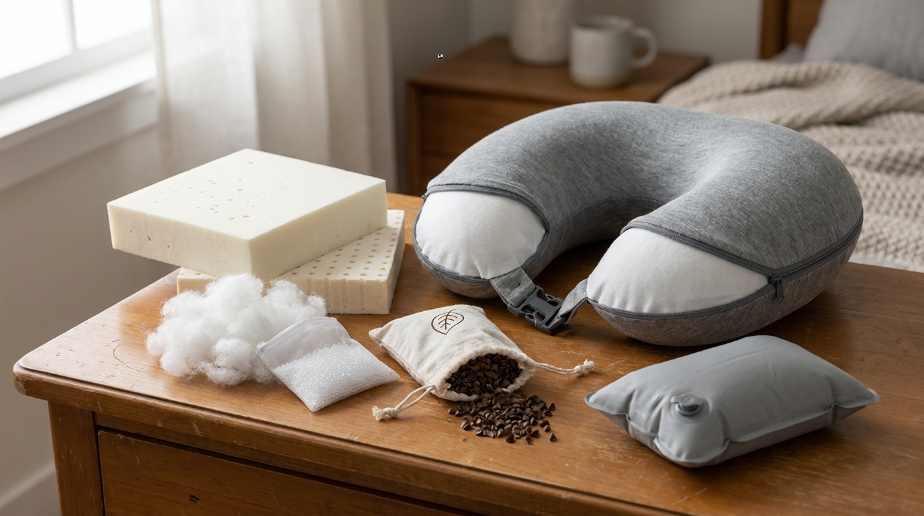
SaveNeck pillows are made from supportive fills such as memory foam, latex, polyester fiber, microbeads, buckwheat hulls, or air-filled chambers. Many designs combine a supportive core with a separate fabric cover.
The material affects how quickly the pillow compresses, rebounds, traps heat, packs, and adapts to your body. However, material isn’t the only factor that determines whether a pillow feels supportive.
- Core or fill: Provides most of the pillow’s structure and determines how deeply your head sinks.
- Inner liner: Keeps shredded foam, fiber, beads, or other loose fill contained.
- Outer cover: Creates the surface against your skin and may be removable for washing.
- Support inserts: Some travel designs add plastic or flexible structural pieces instead of relying only on cushioning.
- Fasteners: Travel pillows may include snaps, hook-and-loop straps, cords, or buckles to control fit.
A neck pillow therefore isn’t defined by one material. The term describes what the pillow is intended to support.
Does the material determine how supportive a neck pillow is?
Material matters, but height, shape, and firmness can matter just as much. A supportive foam used at the wrong height can still leave your head tilted for hours.
A systematic review indexed by the National Library of Medicine found that pillow shape and height can influence cervical alignment. The research also shows why it’s too simple to declare one pillow material best for everyone.
- Dense solid foam generally holds a defined contour well.
- Shredded fill lets you redistribute or remove material in some adjustable pillows.
- Latex tends to rebound rapidly after pressure is removed.
- Loose fiberfill creates a softer, more traditional pillow feel.
- Air lets travelers change firmness without carrying bulky filling.
This is also why I wouldn’t judge whether neck pillows really work by the fill material alone. A pillow still has to match your body and resting position.
What are neck pillow covers made from?
The cover may use polyester, cotton, viscose-based fabrics, nylon blends, spandex, fleece, or other textiles. Travel models often emphasize durability and easy cleaning, while bed pillows may focus more on breathability and softness.
I give removable covers extra weight when comparing travel pillows. A washable outer layer is much easier to maintain after flights, trains, hotels, and repeated handling.
What is a cervical neck pillow?
A cervical neck pillow is a pillow shaped to support the cervical spine, which is the neck portion of your spine. Cervical describes the intended support area, not a particular filling material.
A cervical pillow might therefore contain memory foam, latex, fiber, or another supportive material. Its defining feature is usually the contour or support profile.
How is a cervical pillow shaped?
Many cervical pillows use raised neck rolls, curved edges, center depressions, or different height zones. These features aim to support the neck while allowing the head to rest at a comfortable level.
- Neck roll: A raised area sits beneath the natural neck curve.
- Head recess: A lower center section allows the back of the head to settle.
- Dual-height edges: Two sides offer different loft choices.
- Shoulder cutout: Some pillows create more room around the shoulder area.
The goal is not to force your neck into a dramatic curve. Mayo Clinic advises keeping the head and neck aligned with the body during sleep and using appropriate support rather than bending the neck sharply. You can read its general neck-pain guidance for more context.
Are cervical pillows always memory foam?
No. Memory foam is common because manufacturers can mold it into stable contours, but cervical pillows can use latex, fiber, water-based systems, or other materials.
When comparing options, I look at the contour first and the label second. This guide to the best neck pillow for neck pain explains why fit deserves as much attention as the material itself.
- Back sleepers: Often need gentle support beneath the neck without excessive height behind the head.
- Side sleepers: Usually need enough loft to fill the larger shoulder-to-head gap.
- Stomach sleepers: Usually require much less height because the head is already rotated.
Persistent neck pain, numbness, weakness, or pain following an injury deserves medical evaluation. A pillow is a support product, not a diagnosis or treatment for every source of neck pain.
What is an ergonomic neck pillow?
An ergonomic neck pillow is designed around body positioning, comfort, and support. Like “cervical,” ergonomic describes a design goal rather than a specific material.
Manufacturers may call memory foam, latex, inflatable, or hybrid pillows ergonomic when their shapes are intended to reduce awkward head and neck positions.
What features make a neck pillow ergonomic?
An ergonomic pillow should make your resting position easier to maintain without constant muscle effort. For bed use, that usually means keeping your head reasonably aligned with your upper spine.
- Appropriate loft: The pillow fills the available space without lifting the head excessively.
- Stable support: The material doesn’t immediately collapse under the neck.
- Useful contour: Curves correspond with where the head and neck need support.
- Position compatibility: The design suits side, back, stomach, or upright travel use.
- Pressure comfort: The surface doesn’t create a distracting hard spot beneath the head or jaw.
For upright travel, ergonomics work differently. A U-shaped or wraparound pillow may focus on controlling sideways head drop or supporting the chin rather than copying the shape of a bed pillow.
Is an ergonomic pillow automatically better?
No. “Ergonomic” isn’t a guarantee that the pillow dimensions suit your shoulder width, mattress, neck length, or preferred sleeping position.
I treat the term as a reason to inspect the design, not as proof of better comfort. Matching your neck pillow to your sleeping position is a more useful starting point.
A simple check is to notice your head position once the pillow is compressed. Your head shouldn’t look or feel sharply tilted upward, downward, or toward one shoulder.
- Too high: Your neck may stay flexed or tilted away from the mattress.
- Too low: Your head may drop toward the mattress or lack support beneath the neck.
- Too soft: The pillow may lose the height you need after several minutes.
- Too rigid: You may feel concentrated pressure even when the height looks correct.
What is a memory foam neck pillow?
A memory foam neck pillow uses viscoelastic polyurethane foam as all or part of its supportive core. The foam responds to pressure and gradually conforms around the head and neck.
Memory foam can come as one molded piece or as shredded pieces inside an adjustable shell. Those two constructions feel surprisingly different.
Solid memory foam vs. shredded memory foam
Solid memory foam is better suited to pillows that need a stable, sculpted contour. Shredded foam trades some of that fixed structure for adjustability and a more traditional stuffed-pillow feel.
| Feature | Solid Memory Foam | Shredded Memory Foam |
|---|---|---|
| Shape | Fixed and often contoured | Flexible and moldable |
| Height adjustment | Usually limited | Often adjustable by removing fill |
| Feel | Slow, stable contouring | Looser and more pillow-like |
| Best fit | Defined cervical shapes | People who want adjustable loft |
What are the advantages of memory foam?
Memory foam’s biggest advantage is consistent pressure-responsive support. A molded piece can also keep complicated contours that loose fiber couldn’t maintain as precisely.
- Contouring: The foam adapts around the head and neck under pressure.
- Shape stability: Molded designs can retain raised and recessed support zones.
- Motion control: The material doesn’t shift around like loose beads or hulls.
- Design variety: Memory foam appears in bed pillows, cervical rolls, and travel pillows.
What are the downsides?
Dense foam can feel warmer than more open or freely ventilated fills, although construction makes a major difference. Some people also dislike the slow-response sensation.
Solid foam isn’t normally adjustable either. If the contour is too high for you, there may be little you can change.
My practical rule is simple: don’t buy memory foam merely because it sounds supportive. Check the actual compressed height and whether the contour fits where your neck naturally rests.
What types of neck pillow materials are available?
 Save
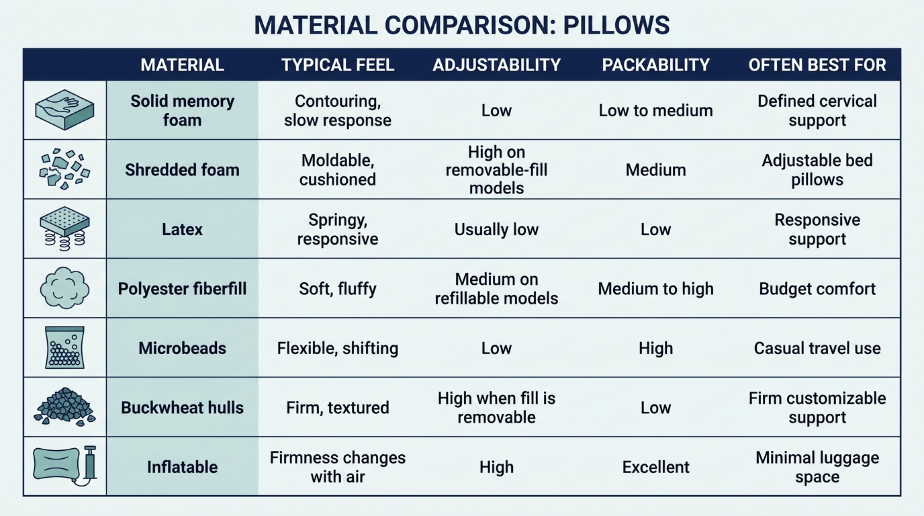
SaveThe main neck pillow materials available in 2026 include memory foam, latex, polyester fiber, down or feather blends, microbeads, buckwheat hulls, gel-based hybrids, and inflatable air chambers. Each material changes the balance between support, softness, cooling, weight, and packability.
No material wins every category. A recent systematic review indexed by PubMed also reinforces that pillow characteristics need to be considered together when evaluating pain, disability, and sleep outcomes.
| Material | Typical Feel | Adjustability | Packability | Often Best For |
|---|---|---|---|---|
| Solid memory foam | Contouring, slow response | Low | Low to medium | Defined cervical support |
| Shredded foam | Moldable, cushioned | High on removable-fill models | Medium | Adjustable bed pillows |
| Latex | Springy, responsive | Usually low | Low | Responsive support |
| Polyester fiberfill | Soft, fluffy | Medium on refillable models | Medium to high | Budget comfort |
| Microbeads | Flexible, shifting | Low | High | Casual travel use |
| Buckwheat hulls | Firm, textured | High when fill is removable | Low | Firm customizable support |
| Inflatable | Firmness changes with air | High | Excellent | Minimal luggage space |
Memory foam
Choose memory foam when you want contouring and a stable shape. Solid foam makes particular sense for molded cervical pillows, while shredded versions suit people who want to adjust loft.
Latex
Latex feels more elastic and responsive than slow-sinking memory foam. Ventilated latex cores can also allow substantial airflow through the pillow structure.
Polyester fiberfill
Polyester fiber is lightweight, familiar, and widely used. It can be comfortable, but softer fills may compress more noticeably with continued use.
Microbeads
Tiny synthetic beads shift as you move the pillow. They’re most familiar in small travel pillows where flexibility and low weight matter more than a precise molded contour.
Buckwheat hulls
Buckwheat pillows contain cleaned natural hulls that move independently. Removing or adding hulls can change loft, while the spaces between them allow air to move through the fill.
The tradeoff is obvious when you pick one up. Hull pillows can be heavy, firm, and noisier than foam or fiber.
Inflatable materials
Inflatable travel pillows use a sealed air bladder, often covered by a softer textile shell. Their main advantage is that you can deflate them into a tiny package.
Air volume also changes firmness. That makes them surprisingly adjustable, although they don’t reproduce the cushioned feel of foam.
Gel and hybrid materials
“Gel pillow” often means a hybrid rather than a pillow made entirely from gel. Manufacturers may add gel-infused foam, a cooling surface layer, or a flexible polymer grid around another supportive core.
When a product uses several materials, check which layer actually carries your head. The support core matters more than a thin cooling treatment when you’re judging neck position.
Which material should you choose?
Start with your sleeping or travel position, then choose the material that can maintain the height and feel you need. After that, compare temperature, washability, weight, and adjustability.
- Want a defined contour? Consider solid memory foam or molded latex.
- Want adjustable loft? Look at shredded foam, removable fiber, or buckwheat hulls.
- Sleep hot? Compare ventilated latex, open constructions, and breathable covers.
- Travel light? Inflatable designs save the most luggage space.
- Prefer a traditional pillow feel? Fiberfill or shredded blends may feel more familiar.
Don’t separate material from firmness either. My firm vs. soft neck pillow comparison explains how those two qualities work together.
If you’re ready to pick one, these are two useful material approaches I’d compare first:
🏆 Best Adjustable
Coop Sleep Goods Original Adjustable Pillow
★★★★☆ 4.5/5 material-fit rating
It uses a blend of cross-cut memory foam and microfiber, and the removable fill lets you change the loft. I like this approach when fixed-height foam feels risky because you can fine-tune how much material sits beneath your head.
❄️ Best Responsive Latex
Purple Harmony Pillow
★★★★☆ 4.4/5 material-fit rating
This hybrid combines a ventilated Talalay latex core with Purple’s flexible GelFlex Grid and comes in multiple heights. I’d look at it when you prefer faster rebound and a more open, responsive feel than traditional solid memory foam.
Frequently Asked Questions
What is the best material for a neck pillow?
There isn’t one best material for everyone. Memory foam suits people who like contouring, latex offers springier support, adjustable shredded fills help with loft changes, and inflatable pillows work well when packability matters. The correct height and shape are just as important as the fill.
Are cervical pillows made of memory foam?
Many cervical pillows use memory foam because it can hold a molded contour, but memory foam isn’t required. Cervical pillows may also use latex, polyester fiber, water-based systems, or other materials. “Cervical” describes the support design rather than the filling.
Is latex better than memory foam for a neck pillow?
Latex isn’t automatically better. It generally feels more responsive and springy, while memory foam provides slower contouring. Your preferred feel, required pillow height, sleeping position, and sensitivity to heat should guide the choice.
What are travel neck pillows filled with?
Travel neck pillows may contain solid memory foam, polyester fiber, microbeads, or inflatable air chambers. Structured wraparound designs can also include internal support pieces. Foam feels cushioned, while inflatable models usually offer the smallest packed size.
How do I know if a neck pillow material is right for me?
Lie or sit in your normal resting position and let the pillow fully compress. Your head should remain comfortably supported without obvious forward or sideways tilt. Then consider secondary factors such as warmth, texture, adjustability, weight, and cleaning requirements.
Final Takeaway:
Don’t choose a neck pillow from the material name alone. Match the pillow’s height and shape to your position first, then use material to fine-tune comfort, cooling, adjustability, and portability.

I’m a home decor enthusiast who loves discovering beautiful room ideas, creative DIY projects, and Pinterest-worthy decorating inspiration. At DecorMinty, I share simple tips, fresh trends, and practical ideas to help you create a home you’ll truly love—one room at a time.