How to Use an Osteo Bed Pillow for Better Sleep
Quick Answer
To use an Osteo bed pillow, place it flat on the mattress with the hollow centre under your head and the raised contour under your neck, keeping your shoulders on the mattress. Back sleepers use the lower side, side sleepers rotate the pillow 180 degrees to the higher side, and you can remove the 0.8-inch insert underneath to lower it further. Allow up to two weeks to adjust.
An Osteo bed pillow is a contoured cervical pillow, not a standard pillow. Its hollow centre cradles your head while the raised edge supports the curve of your neck. Used the right way round, it fills the gap between your head and the mattress and keeps your neck in line with your spine.
Set the height first, place it flat, lie down so your head drops into the hollow, then check that your head, neck, and spine form one straight line.
What an Osteo Bed Pillow Is
Osteo is a brand name for a cervical bed pillow. The model most people mean here is the Osteo Cervical Pillow, a memory-foam pillow with a hollow design and a cooling case. Its core is polyurethane memory foam, and the case is 100% polyester.
It comes in two sizes. The Standard is 21.6 by 14.3 inches, with heights of 3.5 and 4.4 inches. The Queen is 25.5 by 16.5 inches, with heights of 4.1 and 5.2 inches.
The manufacturer states that this product is not a medical product and cannot treat disease, and that pain relief varies from person to person. If you need it for rehabilitation, ask your doctor first.
Set It Up Before the First Night
- Air it for 48 hours. Air it flat for 48 hours before use, so it can fully expand and any natural odour can dissipate.
- Keep the case on. The cooling case is part of the pillow’s surface. Sleeping without it changes how the foam feels.
- Place it flat. Lay it flat on the mattress, long edge across the bed. Do not prop it against the headboard or stack it on another pillow.
- Find the two heights. Run your hand along the two long edges. One side is higher than the other.
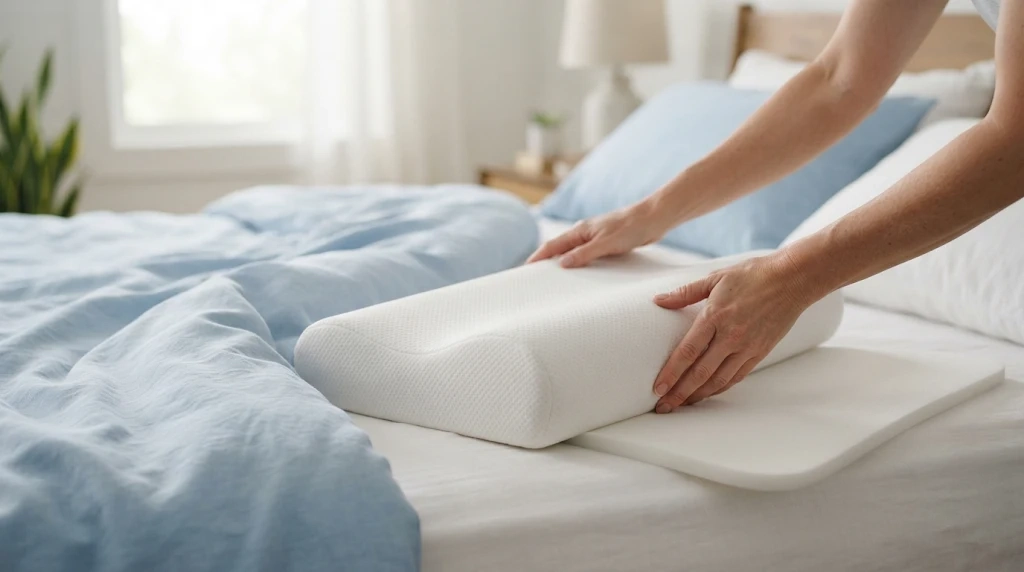
- Check the insert. Lift the pillow and look underneath for the removable 0.8-inch insert. With it in, the pillow sits at full height. With it out, the whole pillow sits lower.
How to Adjust the Height
 Save
Too high, and your chin drops toward your chest. Too low, and your head falls back. Change only one thing at a time, so you know what helped.
Rotate it 180 degrees. Turn the pillow around so the other long edge is nearest you. One edge gives the lower height, the other the higher height: 3.5 or 4.4 inches on the Standard, 4.1 or 5.2 inches on the Queen. You do not need a different pillow for back and side sleeping. You rotate the same one.
Remove the insert to go lower. If the lower side still feels too high, take out the 0.8-inch insert from underneath. That lowers both sides evenly. Keep the insert safe, in case you change mattress or want it back later.
On a firm mattress, your shoulder does not sink in, so you usually need the higher side. On a soft mattress, the lower side often fits better. The Cleveland Clinic notes that a proper pillow should keep your neck parallel to the mattress, rather than bent down or up.
How to Lie on It: Back Sleepers
- Lie down with the lower contour nearest your neck and your head centred in the hollow.
- Let the raised edge sit under the curve of your neck, not under the back of your head or your upper back.
- Keep your shoulders on the mattress, just below the edge of the pillow.
- Check your chin. It should sit level, not pressed toward your chest and not tipped back. Your ears should line up roughly with your shoulders.
If your chin is tucked, the pillow is too high. Rotate to the lower side, or remove the insert. If your head feels as if it is falling back, it is too low.
How to Lie on It: Side Sleepers
Side sleepers need more height, because the pillow has to bridge the distance from the mattress to the ear.
- Rotate the pillow 180 degrees so the higher contour is nearest your neck.
- Lie on your side with your shoulder on the mattress, snug against the edge of the pillow, not on top of it.
- Rest your neck firmly on the higher contour and let your head settle into the hollow.
- Check the line from your nose through the middle of your body. Your head should not tilt down toward the mattress or up toward the ceiling.
If your head is visibly higher or lower than your spine, adjust the height before you decide the pillow does not suit you. See our guide to the best sleeping position for neck pain.
What About Stomach Sleeping?
Stomach sleeping is the hardest position for any contoured pillow. Lying face down forces you to turn your head to one side for hours, which twists the neck. If you wake on your stomach, use the lowest setting: lower side, insert removed. It is designed for lying flat, not for reading propped up in bed.
How to Check the Fit in Two Minutes
 Save
Do this check on the second or third night.
- Ears and shoulders: on your back, your ears should line up with your shoulders. On your side, your nose, chin, and chest should form a straight line.
- Chin position: your chin should feel neutral, neither tucked nor lifted. A tucked chin usually means too much height.
- Shoulder position: your shoulders should rest on the mattress. If they are on the pillow, the pillow is too far up the bed.
- Neck contact: the contour should touch the curve of your neck without pressing hard into it. A gap under the neck means you are lying too far down the pillow.
- Morning feeling: mild stiffness in the first few nights can be part of adjusting. Sharp pain, numbness, or tingling in the arms or hands is a different signal.
Tip
Test a new height for two or three nights before you judge it. The first night on a contoured pillow often feels strange even when the alignment is correct.
The First Two Weeks: What to Expect
The manufacturer warns that you may feel some discomfort during the first two weeks while your body adjusts to the correct position. The first few nights can feel firmer than a standard pillow.
Do not switch back to your old pillow every other night. Use the Osteo every night for at least a week on one setting, unless pain gets worse or you develop numbness or tingling. Keep a note of which side you used and how your neck felt on waking. If you are still uncomfortable after two weeks, the height or shape may simply not match you. Our guide on how long to use a cervical neck pillow explains when a pillow has had a fair trial.
Common Mistakes With an Osteo Pillow
- Shoulders on the pillow. The pillow is for your head and neck only. Shoulders belong on the mattress.
- Using the high side on your back. The higher contour is for side sleeping. On your back it pushes the chin forward.
- Stacking it on another pillow. A second pillow underneath raises the head and flattens the hollow.
- Judging it after one night. The foam and your muscles both need a few nights.
- Changing two things at once. Rotating the pillow and removing the insert on the same night hides which change helped.
If your neck hurts more after switching, check the fit steps above first, then read our guide on why a neck pillow hurts your neck, which covers height, firmness, and position as the usual causes.
When to Stop and Get Advice
A pillow can support better alignment, but it cannot diagnose or treat a neck condition. Stop using the higher setting and get medical advice promptly if you notice numbness or tingling in your arms or hands, weakness, pain that spreads down the arm, pain after an injury or fall, or neck pain with fever or severe headache. Also seek advice before using it for rehabilitation, and if you have a diagnosed cervical condition, recent surgery, or a condition that affects the spine.
Warning
Do not use the Osteo pillow to treat a diagnosed neck injury, disc problem, or post-surgery recovery without medical advice. The manufacturer states it is not a medical product.
Care and When to Replace It
 Save
Keep the pillow flat during the day, air it regularly, and wash the case according to its label. Do not machine wash or soak the memory-foam core. For the case, follow our guide to how to wash and clean a neck pillow safely. If the hollow no longer cradles your head, it has likely reached the end of its useful life. See also our guide on how to sleep with a neck pillow.
Related Product
Osteo Cervical Pillow
The adjustable hollow-design bed pillow discussed in this guide, with two heights and a removable insert for back and side sleepers.
As an Amazon Associate, we earn from qualifying purchases.
Frequently Asked Questions
Which side of the Osteo pillow should I sleep on?
Use the lower side for back sleeping and the higher side for side sleeping. Rotate the pillow 180 degrees to switch sides. Your head should sit in the hollow centre and your neck should rest on the raised contour, with your shoulders on the mattress.
How do I make the Osteo pillow lower?
Remove the 0.8-inch insert from the bottom of the pillow. That lowers both sides evenly. If it is still too high, make sure you are on the lower side and that you are not stacking it on another pillow.
How long does it take to get used to an Osteo pillow?
Allow up to two weeks. The manufacturer warns of possible discomfort during the first two weeks while your body adjusts to the corrected position. Use one height setting consistently for at least a week before you judge it, unless pain worsens or you develop numbness or tingling.
Can I sleep on my stomach on an Osteo pillow?
You can, but it is not the position the pillow is designed for. Use the lowest setting, with the lower side up and the insert removed, to keep the neck as flat as possible. Side or back sleeping will usually give you better alignment.
Do I need to air the Osteo pillow before first use?
Yes. Air it flat for 48 hours before the first night so the memory foam can fully expand and any natural odour can dissipate. Keep the cooling case on while you sleep.
Is the Osteo pillow a medical device?
No. The manufacturer states that it is not a medical product and cannot treat disease, and that pain relief varies from person to person. If you need it for rehabilitation, ask your doctor for advice first.
Conclusion
Set the height, lie flat with your head in the hollow and your neck on the contour, and keep your shoulders on the mattress. Back sleepers start on the lower side, side sleepers rotate to the higher side, and the 0.8-inch insert is there if the lowest setting is still too high. Air it for 48 hours, give one setting a full week, and allow up to two weeks to adjust. If pain worsens, or you notice numbness or tingling, get medical advice rather than pushing through it.

I’m a home decor enthusiast who loves discovering beautiful room ideas, creative DIY projects, and Pinterest-worthy decorating inspiration. At DecorMinty, I share simple tips, fresh trends, and practical ideas to help you create a home you’ll truly love—one room at a time.