Best Artificial Plants for Bedroom: 10 Realistic Picks
Quick Answer
The best artificial plants for bedroom spaces include faux snake plant, ZZ plant, Phalaenopsis orchid, pothos, olive tree, Boston fern, monstera, eucalyptus, fiddle leaf fig, and bird of paradise because they add believable greenery without requiring sunlight, watering, or a plant-care routine.
Here’s the short version before you scroll further:
- Faux Snake Plant — slim, upright shape fits tight bedroom corners
- Faux ZZ Plant — glossy foliage suits clean modern spaces
- Faux Phalaenopsis Orchid — elegant flowers for dressers and nightstands
- Faux Pothos — trailing vines soften shelves and wardrobes
- Faux Olive Tree — airy height without visually crowding the room
- Faux Boston Fern — gives empty surfaces lush, feathery texture
- Faux Monstera — bold split leaves create tropical impact
- Faux Eucalyptus — muted foliage works with calm neutral bedrooms
- Faux Fiddle Leaf Fig — broad leaves make a strong floor-level statement
- Faux Bird of Paradise — dramatic height suits spacious bedroom corners
The best choice depends less on light and more on your available floor space, viewing distance, decorating style, and how often you’re willing to remove dust from the leaves.
Our Top Picks at a Glance
Easiest to Style — Faux Snake Plant
Best for Dark Corners — Faux ZZ Plant
Most Beautiful Bloom — Faux Phalaenopsis Orchid
Best for Small Spaces — Faux Pothos
If you like the look of greenery but don’t want to think about window direction or watering days, artificial plants make bedroom decorating much easier. If you’d rather grow something living, compare these ideas with our guide to bedroom plants for low-light spaces.


10 Best Artificial Plants for Bedroom Spaces
 Save
Save#1. Faux Snake Plant — “The Space Saver”
| Sunlight | None required |
| Watering | None, remove dust as needed |
| Pot Size | Product-dependent, use a cover pot that conceals the base |
| Care Level | Easy |
| Bloom Time | N/A, foliage replica |
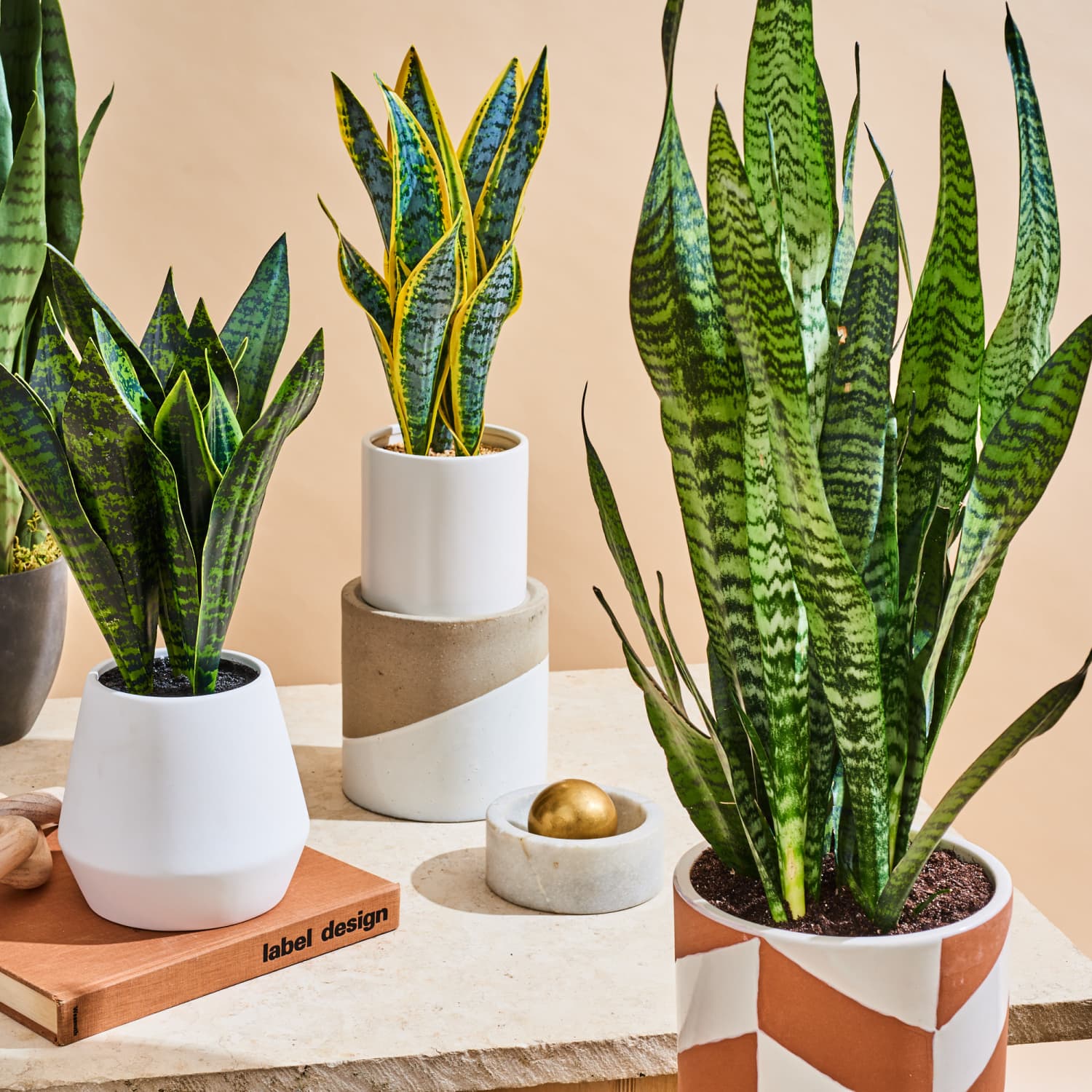
A faux snake plant copies the strong vertical form of Dracaena trifasciata. Its narrow silhouette gives you noticeable greenery without demanding much floor space.
Look for leaves with several shades of green rather than a flat printed pattern. Slightly irregular leaf angles usually appear more natural than perfectly symmetrical rows.
Place it beside a dresser, desk, or wardrobe and rotate the leaves until the arrangement looks loose. You can browse realistic artificial snake plants in several heights.
Pros
- Small footprint
- Strong architectural shape
- Works with many decor styles
Watch For
- Overly glossy leaves
- Visible plastic seams
- Undersized pots that look unstable
#2. Faux ZZ Plant — “The Polished One”
| Sunlight | None required |
| Watering | None, dust occasionally |
| Pot Size | Choose according to tabletop or floor scale |
| Care Level | Easy |
The live ZZ plant, Zamioculcas zamiifolia, is recognized by rows of smooth leaflets on gently arching stems. A good artificial version reproduces that simple shape especially well.
Because the real plant already has naturally glossy foliage, a subtle sheen looks believable here. Avoid leaves that reflect light like hard plastic.
Use a compact version on a desk or a taller model in an unused corner. A matte ceramic or stone-look planter helps soften the synthetic finish.
Pros
- Clean silhouette
- Believable in low-light areas
- Easy to fit into modern rooms
Watch For
- Excessive shine
- Perfectly identical stems
- Lightweight bases
#3. Faux Phalaenopsis Orchid — “The Dresser Upgrade”
| Sunlight | None required |
| Watering | None |
| Pot Size | Small tabletop container usually looks most proportional |
| Care Level | Easy |
| Bloom Time | Decorative flowers remain displayed year-round |
Phalaenopsis orchids are known for broad leaves and graceful flower spikes, which makes them easy to recognize even in artificial form. They add color without the visual weight of a floor plant.
The most realistic versions use petals with gentle color variation and stems that aren’t perfectly straight. Faux moss or bark around the base can also hide obvious plastic construction.
Keep the arrangement simple. One orchid on a dresser often looks more convincing than several small artificial flowering plants crowded together.
Pros
- Adds flowers without maintenance
- Compact footprint
- Works well at eye level
Watch For
- Fabric edges that fray
- Unnaturally bright petals
- Exposed plastic stems
#4. Faux Pothos — “The Shelf Softener”
| Sunlight | None required |
| Watering | None |
| Pot Size | Small hanging or shelf container |
| Care Level | Easy |
Artificial pothos imitates the trailing growth of Epipremnum aureum. Its cascading form is useful when you want greenery but have almost no spare floor space.
Choose vines with mixed leaf sizes and flexible stems. Bend several sections forward and sideways instead of letting every strand hang at exactly the same length.
A realistic faux pothos can soften a high wardrobe, floating shelf, or bookcase without creating another surface to water.
Pros
- Uses vertical space
- Flexible stems are easy to arrange
- Good for renters
Watch For
- Identical repeating leaves
- Thin plastic vines
- Too many strands in small rooms
 Save
Save#5. Faux Olive Tree — “The Airy Statement”
| Sunlight | None required |
| Watering | None |
| Pot Size | Floor planter sized to conceal and stabilize the base |
| Care Level | Easy |
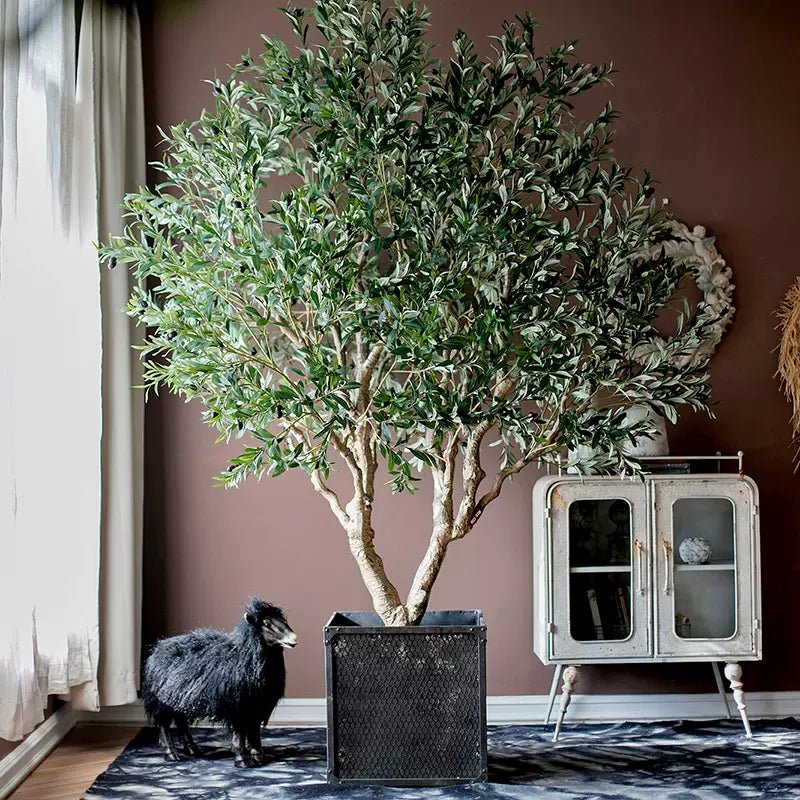
The olive tree, Olea europaea, has narrow leaves and an open branching habit. That airy structure makes the faux version especially useful when you want height without blocking furniture or windows.
Look for muted gray-green foliage and branches you can reshape. Sparse, irregular spacing is usually more convincing than a perfectly round artificial canopy.
For an empty floor corner, compare artificial olive trees by total height before choosing your planter.
Pros
- Creates height
- Light visual footprint
- Pairs well with neutral interiors
Watch For
- Very sparse budget models
- Visible trunk joins
- Top-heavy bases
#6. Faux Boston Fern — “The Texture Maker”
| Sunlight | None required |
| Watering | None |
| Pot Size | Medium basket or tabletop cover pot |
| Care Level | Easy |
Boston fern replicas use many fine fronds to create softness that upright plants can’t provide. They work especially well in bedrooms with woven baskets, wood furniture, and layered textiles.
Because there are many small leaflets, realistic color variation matters. Spread and bend the fronds so the plant looks fuller at the sides rather than forming a rigid dome.
The trade-off is dusting. Fine artificial foliage has more surfaces to clean, so a fern is best where you can lift and wipe it easily.
Pros
- Lush texture
- Softens hard furniture lines
- Looks natural in baskets
Watch For
- Collects visible dust
- Cheap fronds can look flat
- Needs occasional reshaping
#7. Faux Monstera — “The Tropical Accent”
| Sunlight | None required |
| Watering | None |
| Pot Size | Medium floor or raised planter |
| Care Level | Easy |
Monstera deliciosa is famous for large leaves that develop dramatic splits and openings. Those bold shapes remain recognizable even from across a bedroom.
Choose an artificial version with variation in leaf size and direction. A plant with every leaf facing forward tends to look like a display prop rather than natural foliage.
Monstera works best as one strong accent. Give the leaves breathing room instead of squeezing the plant between several pieces of furniture.
Pros
- Recognizable leaf shape
- Strong visual impact
- Works well from a distance
Watch For
- Oversized leaves in tiny rooms
- Obvious molded texture
- Perfectly repeated leaf patterns
#8. Faux Eucalyptus — “The Calm Minimalist”
| Sunlight | None required |
| Watering | None |
| Pot Size | Small pot or narrow vase |
| Care Level | Easy |
Eucalyptus species are associated with muted blue-green foliage and simple branching stems. Artificial eucalyptus brings that subdued color into a bedroom without requiring a large planter.
A few stems often look more natural than a dense plastic bush. Mix the heights and turn some leaves sideways so the arrangement doesn’t appear perfectly flat.
Use it in a ceramic vase on a dresser or shelf. It works particularly well when bedding and walls already use warm white, beige, gray, or muted green.
Pros
- Muted color palette
- Small-space friendly
- Easy to rearrange
Watch For
- Blue foliage that looks unnatural
- Identical stem lengths
- Overfilled arrangements
#9. Faux Fiddle Leaf Fig — “The Bold Corner Plant”
| Sunlight | None required |
| Watering | None |
| Pot Size | Stable floor planter |
| Care Level | Easy |
Ficus lyrata is known for large, fiddle-shaped leaves and an upright tree form. The artificial version gives you that oversized look without needing a bright window.
Broad leaves reveal poor materials quickly, so texture matters more here. Choose matte foliage with visible veins and a trunk that doesn’t look uniformly molded.
A decorative basket around the base adds weight and makes the tree look more intentional. Keep enough open space around the canopy so the leaves don’t crush against a wall.
Pros
- Large visual presence
- Fills empty vertical space
- Strong contemporary look
Watch For
- Cheap broad leaves show easily
- Needs more floor room
- May require branch reshaping
 Save
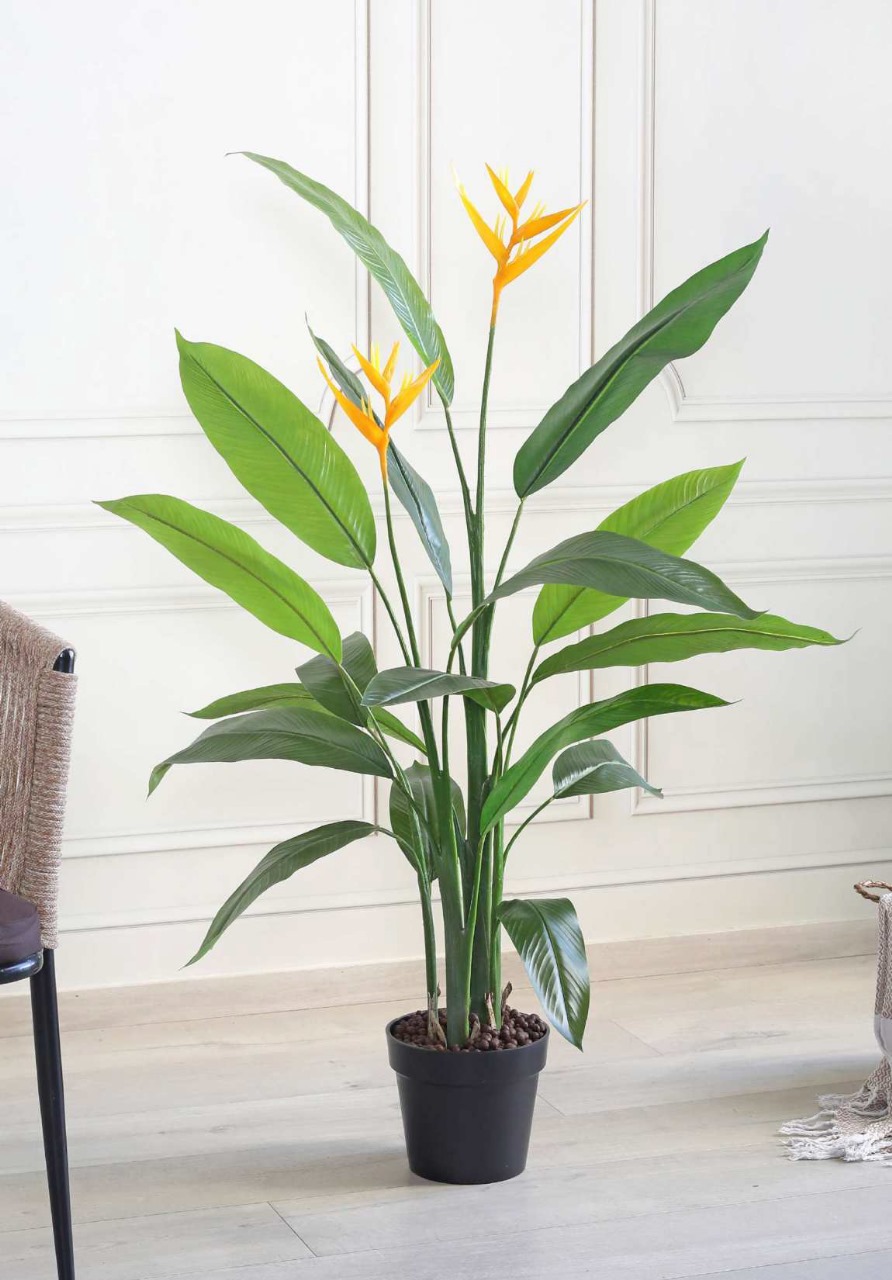
Save#10. Faux Bird of Paradise — “The Bedroom Statement”
| Sunlight | None required |
| Watering | None |
| Pot Size | Large stable floor planter |
| Care Level | Easy |
Bird of paradise plants in the genus Strelitzia are known for tall stems and broad tropical leaves. Their strong scale makes a faux version a natural choice for a large bedroom.
Separate and bend the leaves after unpacking. Wider spacing creates a much more believable silhouette than keeping every stem bundled tightly around the center.
Check ceiling height before ordering a tall artificial bird of paradise. Leaving open space above it makes the plant feel proportional.
Pros
- Excellent height
- Bold tropical silhouette
- Fills large empty corners
Watch For
- Can overwhelm small bedrooms
- Large leaves expose poor texture
- Needs a stable base
How to Choose the Right Plant for Your Space
The advantage of artificial greenery is that light doesn’t determine where you can put it. Scale, shape, and viewing distance matter much more.
- Measure before buying — A six-foot tree can look beautiful online but overwhelm a compact bedroom. Measure the floor area and ceiling height, then leave visual space around broad leaves.
- Match the shape to the furniture — Use narrow snake plants beside wardrobes and dressers. Save wider monstera, fiddle leaf fig, and bird of paradise forms for open corners.
- Think about viewing distance — A plant beside your pillow needs convincing leaf texture because you’ll see it up close. A taller tree across the room can rely more on silhouette and proportion.
- Choose believable materials — Matte leaves, subtle color changes, textured stems, and adjustable branches usually look more natural than uniform high-gloss plastic.
If low maintenance is your main goal but you’re still considering real greenery, see our guide to low-maintenance indoor bedroom plants. It makes the trade-offs between living and maintenance-free greenery easier to compare.
Basic Care Tips for Beginners
Artificial plants don’t need horticultural care, but a tiny amount of cleaning and reshaping keeps them looking much more convincing.
- Dust the leaves gently — The U.S. Environmental Protection Agency recommends damp dusting as a way to keep settled dust from being stirred back into indoor air. See the EPA guidance on indoor particulate matter.
- Reshape flexible stems — Artificial trees are often compressed for shipping. Spread branches at different angles and avoid perfect symmetry.
- Clean broad leaves individually — Monstera, fiddle leaf fig, snake plant, and bird of paradise leaves show dust more clearly than tiny foliage.
- Keep them away from open flames — Treat artificial foliage as decorative material. The U.S. Consumer Product Safety Commission advises keeping lit candles away from decorations and other items that can catch fire.
A soft microfiber duster is useful for artificial plants with broad leaves. For detailed ferns, a soft cloth or gentle handheld cleaning tool gives you more control.
Common Mistakes to Avoid
Most artificial plants look fake because of styling mistakes, not because they’re artificial.
Leaving branches exactly as they arrived in the box — Compressed branches create an unnaturally narrow silhouette. Spend several minutes bending stems outward at different heights.
Choosing a plant that’s too large for the bedroom — A giant bird of paradise or fiddle leaf fig can make a small room feel cramped. Slim snake plants and trailing pothos use space more efficiently.
Ignoring the nursery-style plastic pot — Even convincing foliage can look cheap when its small weighted base remains exposed. Place it inside a larger ceramic pot or woven basket.
Letting dust build up on the leaves — Dust dulls color and emphasizes plastic texture, especially on broad monstera and fiddle leaf fig leaves. Regular light cleaning keeps the finish more believable.
Filling every surface with artificial greenery — One substantial plant and one smaller accent usually feel calmer than many unrelated mini plants. Bedrooms benefit from visual breathing room.
Not sure whether artificial greenery is right for you? Our beginner bedroom plant guide offers real alternatives, while our bedroom air-purifying plant guide explains options for readers who specifically want living plants.
Make a Basic Faux Plant Look More Finished
A decorative planter or woven basket hides the small weighted container supplied with many artificial plants. Choose one that matches your bedroom’s materials rather than trying to make the original plastic pot work.
Frequently Asked Questions
Q: Are artificial plants good for bedrooms?
A: Yes. They’re useful when you want greenery without considering sunlight, watering, seasonal growth, or vacation care. Choose the right scale and clean dust from the foliage periodically.
Q: Which artificial plants look most realistic in a bedroom?
A: Snake plants, ZZ plants, olive trees, pothos, ferns, and monstera are strong choices because their recognizable shapes can be reproduced convincingly. Matte texture and varied leaf positioning matter most.
Q: Where should I put fake plants in a bedroom?
A: Put tall plants in empty floor corners, compact plants on dressers, and trailing greenery on shelves or wardrobes. Keep frequently used nightstands relatively uncluttered.
Q: How do you make artificial plants look less fake?
A: Reshape every branch, vary leaf directions, hide the original plastic container, and remove dust. Natural-looking planters and irregular spacing make a noticeable difference.
Q: What artificial plant is best for a small bedroom?
A: A slim faux snake plant works well on the floor, while pothos or eucalyptus is better when floor space is limited. Both give you greenery without a wide canopy.
Q: Do artificial bedroom plants need sunlight?
A: No. Artificial plants don’t photosynthesize, so sunlight isn’t needed for survival. You can use them in dark corners, windowless areas, or anywhere a living plant would receive unsuitable light.
Final Thoughts
The best artificial plants for bedroom spaces are the ones that fit your room before they try to impress you. Choose a snake plant or pothos when space is tight, an orchid for a polished tabletop accent, or an olive tree, fiddle leaf fig, or bird of paradise when you have an empty corner to fill.
Prioritize realistic texture, believable proportions, and a planter that suits the rest of your decor. A little reshaping and occasional dusting can keep even simple faux greenery looking intentional.
Which plant are you adding to your space first? Save this post to Pinterest so you can come back whenever you need fresh plant inspo!
“`

I’m a home decor enthusiast who loves discovering beautiful room ideas, creative DIY projects, and Pinterest-worthy decorating inspiration. At DecorMinty, I share simple tips, fresh trends, and practical ideas to help you create a home you’ll truly love—one room at a time.