How to Make Your Bed With a Pregnancy Pillow: Setup
Quick Answer
Lay the pregnancy pillow flat first, then lie on your side inside it. Rest your head on the top section, tuck the front part gently under your bump, place the lower part between your knees and ankles, and let the back part support your spine. A U shape stays in place when you turn; a C, J, or straight shape needs to be flipped with you.
Making your bed with a pregnancy pillow is about three support points: your head and neck, your bump, and your knees. When those three line up, your hips stay level, your lower back stops doing extra work, and side sleeping feels sustainable.
Before You Lie Down: Know Your Pillow Shape
Lay the pillow flat and find the head section first. On many U-shaped pillows, the closed curve goes at the head of the bed. On many C-shaped pillows, the top curve is the head rest and the bottom curve goes between the knees. A J shape usually has a straight top for your head and a hook at the bottom for your knees. A straight body pillow has no curve, so place it along the side you sleep on.
Check your model’s instructions before you assume one layout fits all. Some U pillows work with your usual head pillow on top of the curve, while others replace it. Head height matters most: if your neck bends up or drops down on the built-in section, no amount of tucking lower down will fix it.
How to Make Your Bed With a Pregnancy Pillow in 7 Steps
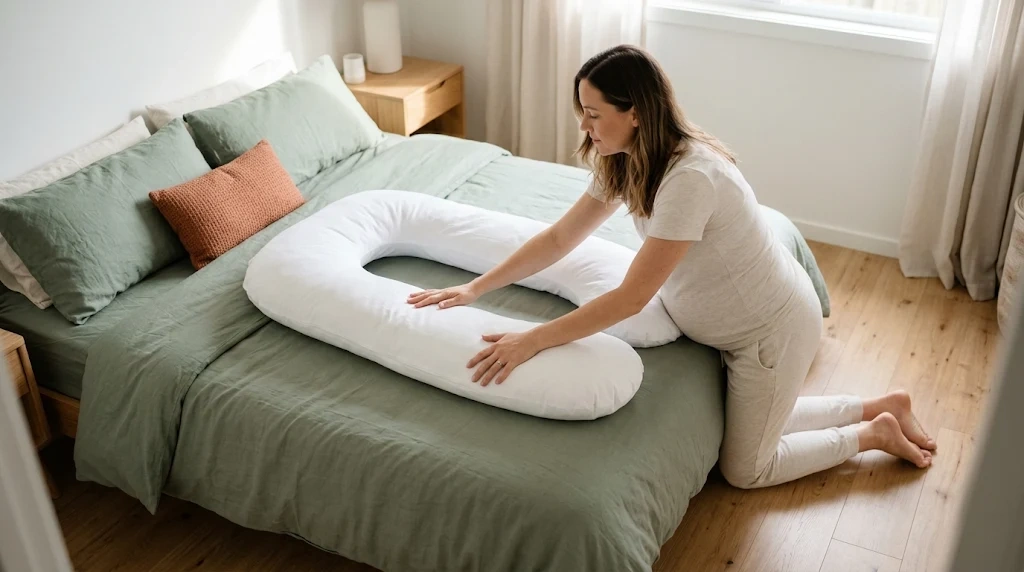
- Make the bed, then add the pillow last. Put the fitted sheet on, smooth the duvet, then lay the pregnancy pillow on top, flat and untwisted, so you can see its full shape.
- Place the head section first. Set the curve or top end where your head will rest. Your neck should stay level, not bent forward or tilted back.
- Lie on your side with knees slightly bent. Either side works. Let your top knee sit roughly level with your hip.
- Tuck the front section under your bump, not into it. It should lift the bump gently and take its weight off your lower back. A light touch is enough.
- Place the lower section between your knees and ankles. This keeps your hips stacked. If it only reaches your knees, your ankles can still twist.
- Bring the back section against your spine. Let it rest along your lower back so you have something to lean into. It should make rolling flat feel less natural than staying on your side.
- Test the setup. Check three things: your neck feels level, your bump feels lifted rather than pulled, and your top leg is not dragging forward. Change one thing at a time, starting with head height.
How to Set Up a U-Shaped Pregnancy Pillow
Lay a U pillow with the closed curve at the head of the bed and the open ends toward your feet. Lie in the middle, on your side, with one arm in front of you and one arm behind you. Hug the front arm, pull its lower half between your knees and ankles, rest your head on the curve, and let the back arm run along your spine.
The advantage is turning over: you roll inside the U, and the two arms swap jobs, without lifting the whole pillow. Watch head height first — if the curve is too thick, your neck bends up; if it is too flat, your head drops. Also leave the duvet loose over the pillow, so turning does not drag the covers with you.
How to Set Up a C-Shaped, J-Shaped, or Straight Pillow
A C-shaped pillow wraps around one side of your body. Open the C, lie inside the curve, and choose front or back support for that night. For front support, face into the C so the long side runs along your bump and the bottom curve sits between your knees. For back support, turn it the other way so the long side runs along your spine. Rest your head on the top curve in either position.
A J-shaped pillow is a shorter version: head on the straight top, long side along your front or back, hook between your knees. It takes less bed space than a C shape, which helps in a shared bed, but it supports one side at a time.
A straight body pillow is the simplest option. Lay it vertically down your side of the bed, lie on your side, and wrap your top arm and top leg over it. Hug the upper half so your shoulder does not roll forward, and let the lower section sit between your knees. It will not stop you rolling onto your back on its own, so add a small wedge behind your back if needed.
The trade-off with every one-sided shape is turning over. Bend your knees, hold the pillow close, and roll the whole lot together instead of twisting against it. It wakes you more than a U shape at first, and most people find it gets quicker after a few nights.
How to Set Up a Wedge Pillow and a Small-Space Setup
A wedge is the smallest, most targeted option. Slide one gently under your bump while you lie on your side, place another behind your back if you tend to roll flat, or use one between your knees if hip pain is your main problem. It solves one gap well and is easy to move, wash, and store.
Side Sleeping, Trimester Changes, and When to Start
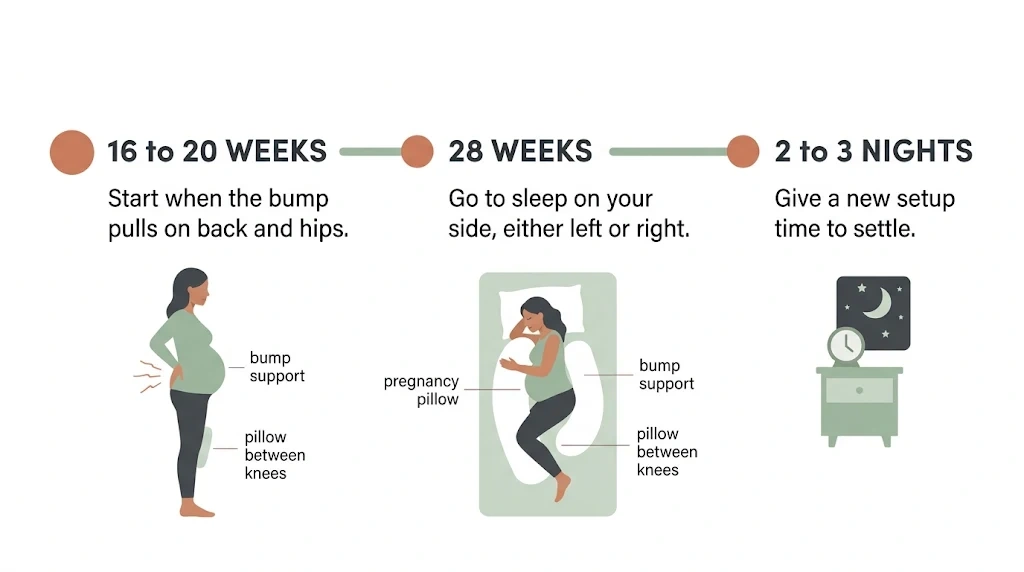
Side sleeping becomes the main goal later in pregnancy, and the pillow helps you stay there comfortably. The NHS guidance on tiredness and sleep in pregnancy says the safest position to go to sleep in is on your side, either left or right, and that after 28 weeks falling asleep on your back can double the risk of stillbirth. It also says not to worry if you wake on your back: turn over and go to sleep again on your side. The NHS suggests supporting your bump with pillows and putting a pillow between your knees.
When to start depends on comfort, not a fixed week. Many people start in the second trimester, often around 16 to 20 weeks, when the bump begins to pull on the back and hips. By 28 weeks, the side-sleeping habit is worth having in place, so practise the setup before then. Give a new setup two or three nights before you judge it.
Common Mistakes That Make the Setup Feel Wrong
First, the head is too high or too low — the most common cause of neck pain with a pregnancy pillow. Fix head height before you move anything else. Second, the pillow is pressed hard into the bump. Support should lift it gently, not squeeze it. Third, the knee section starts too low. If it keeps sliding down, move it up so it sits firmly between your knees.
Fourth, the bed is made too tightly around the pillow. A duvet tucked hard under a U or C pillow will pull when you turn. Leave the covers loose over the pillow. Fifth, the setup is judged after one night. Change one thing per night, and keep a note of what helped.
Making the Bed, Sheets, and Keeping the Pillow Clean

Put the cover on the pillow before you place it on the bed, zip it fully, and smooth out any twists. Then lay the pillow on the made bed and arrange the sheets and duvet around it, rather than trying to tuck sheets under a pillow that is already in place. A spare cover is worth having: you can wash one while the other is on the bed.
Wash the cover about once a week with your sheets, using a gentle detergent, and follow the care label for the insert. Many inserts are spot-clean only, while some can be machine washed on a gentle cycle. Do not assume either way. For washing guidance, see our guide to how to wash a bed pillow.
When to Change the Setup or Ask for Advice
Ask your midwife, doctor, or obstetric clinician if you have pain that does not ease with position changes, dizziness, breathlessness, bleeding, reduced fetal movement, or a high-risk pregnancy. A pillow is a comfort tool, not a medical device.
For related help, our guide to how to use a neck bed pillow covers head height and side-sleeper positioning, and our guide to the best neck pillow for sleeping on your side explains head and neck support on your side. If neck discomfort is part of the problem, see our guide to the best sleeping position for neck pain.
Related Product
Pregnancy Pillow
A U-shaped or C-shaped pregnancy pillow gives you bump, knee, and back support in one piece, so you can set up the bed once instead of stacking separate pillows.
As an Amazon Associate, we earn from qualifying purchases.
Frequently Asked Questions
Which way round does a pregnancy pillow go on the bed?
For a U shape, put the closed curve at the head of the bed and the open ends toward your feet, then lie in the middle on your side. For a C shape, put the top curve under your head and the bottom curve between your knees. Check your model’s instructions, because direction varies by brand.
Should I sleep on my left or right side with a pregnancy pillow?
Either side is fine according to NHS guidance from 28 weeks. Some sources favour the left side for circulation, but the key point is to go to sleep on your side rather than on your back. If you wake on your back, roll onto your side and settle again.
Do I still need my normal pillow with a pregnancy pillow?
It depends on the model. Some U and C pillows replace your head pillow, while others work better with your usual pillow on top of the built-in curve. If your neck feels too high or too low, try adding your normal pillow and see which height keeps your neck level.
How do I turn over in bed with a pregnancy pillow?
With a U shape, roll inside the pillow and let the two arms swap jobs, so you do not need to lift it. With a C, J, or straight pillow, bend your knees, hold the pillow close, and roll the whole lot together. Move the knee section first if it has slipped.
Can I use a pregnancy pillow in a shared or small bed?
Yes, but choose a smaller setup. A wedge under your bump, a slim support behind your back, and a knee pillow take far less space than a full U pillow. Keep every piece on your side of the mattress and leave the foot area clear.
When should I start using a pregnancy pillow?
Start when ordinary pillows stop working, often in the second trimester around 16 to 20 weeks. Have the side-sleeping setup in place by 28 weeks, when health services advise going to sleep on your side. Give a new setup two or three nights before you decide whether it works.
Conclusion
Making your bed with a pregnancy pillow comes down to a simple setup: head level, bump gently lifted, knees and ankles supported, and back supported enough to stay on your side. Lay the pillow flat first, lie on your side inside it, and test those three points before you settle. A U shape makes turning easier, a C, J, or straight shape takes less space, and a wedge solves one gap well. Give the setup two or three nights, change one thing at a time, and keep the covers loose. If pain or other symptoms do not ease with position changes, ask your midwife or doctor for personal advice.

I’m a home decor enthusiast who loves discovering beautiful room ideas, creative DIY projects, and Pinterest-worthy decorating inspiration. At DecorMinty, I share simple tips, fresh trends, and practical ideas to help you create a home you’ll truly love—one room at a time.