Can a Pillow Cause Neck Pain or Headaches? Signs, Causes, and Fixes
Quick Answer
Yes. A pillow can cause or worsen neck pain and some headaches when its height, shape, or firmness keeps your neck bent for hours. The best first step is checking whether your pillow supports neutral alignment, then choosing the right neck pillow for your usual sleeping position.
Signs your pillow may be contributing
- Morning neck pain: Your neck feels worse immediately after waking and loosens as you start moving.
- Base-of-skull pressure: Tight muscles where the neck meets the skull can accompany headache symptoms.
- One-sided stiffness: Your head may be tilting toward or away from the mattress while you sleep.
- Chin pushed forward: A pillow that is too high can keep your neck flexed through the night.
- Recent pillow change: Symptoms that begin after changing pillows deserve a closer look at height and firmness.
When not to blame the pillow
- Seek medical care for a sudden severe headache, significant weakness or numbness, fever with a stiff neck, vision or speech changes, or symptoms following a serious injury.
A pillow looks harmless, but you spend several hours with your head resting on it. If the fit is wrong, that small positioning problem can become hours of sustained neck strain.
I focus less on labels such as “orthopedic” and more on one question: Where does the pillow hold your head after you relax? That usually tells you more than the marketing on the package.
Pillow-related neck pain is discomfort that appears or worsens because the pillow fails to keep the head and cervical spine comfortably aligned during sleep. The cervical spine is the seven-vertebra section of your spine that forms your neck.


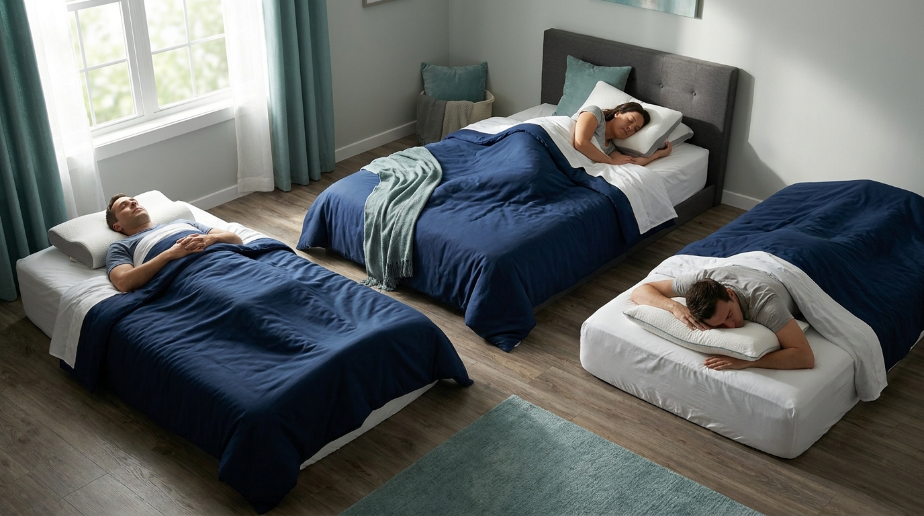
What is the healthiest sleeping position for your neck?
 Save
SaveFor many people, back and side sleeping are the easiest positions for maintaining comfortable neck alignment. Neither is automatically best for everyone.
Your pillow needs to complement the position rather than force your neck into a new angle. That distinction matters.
Back sleeping
When you sleep on your back, your pillow should support the natural curve behind your neck without pushing your head strongly forward. Your chin should not be forced toward your chest.
A lower or moderately contoured pillow often works better than a large, overstuffed pillow. Harvard Health also identifies back and side sleeping as generally easier on the neck when the pillow properly supports the neck’s natural curve.
See Harvard Health’s guidance on sleeping with neck pain for additional positioning advice.
Side sleeping
Side sleepers need enough pillow height to fill the space created by the shoulder. If that space stays empty, the head can drop toward the mattress.
Too much height creates the opposite problem. Your head gets pushed upward, producing another sideways bend.
- Too low: Your ear drops toward the mattress.
- Too high: Your head tilts away from the mattress.
- Closer to correct: Your nose, chin, and breastbone point forward without an obvious sideways head tilt.
- Shoulder position: Keep your shoulder mainly on the mattress instead of placing your whole shoulder on the pillow.
If you’re unsure which pillow design matches your position, this guide to the best neck pillow for your sleeping position explains the differences in more detail.
| Sleep position | Pillow starting point | Alignment check | Common mistake |
|---|---|---|---|
| Back | Low to medium, often with gentle neck contouring | Chin stays neutral rather than pushed toward chest | Using a thick pillow that bends the neck forward |
| Side | Medium to higher support based on shoulder width | Head remains level instead of dropping or lifting sideways | Choosing loft without considering mattress compression |
| Stomach | Low and soft, if a head pillow is used | Neck rotation and backward bending are minimized | Using a thick pillow while the head is turned sideways |
What sleeping position is best for neck pain?
Back or side sleeping usually provides the simplest path to neutral alignment when you’re dealing with neck discomfort. The better choice is whichever position lets your muscles relax without forcing your head sideways or forward.
The pillow still matters. A good position combined with the wrong pillow can remain uncomfortable.
Try the alignment test before replacing everything
Lie in your normal sleeping position and let your body relax. Don’t deliberately straighten your neck for the test.
Have someone look at your head position, or place your phone securely at mattress height and take a side-view photo.
- For side sleeping: Look for a relatively straight line through the center of your head and neck.
- For back sleeping: Make sure the pillow isn’t forcing your chin noticeably toward your chest.
- For either position: Notice whether your neck feels supported rather than stretched.
Cleveland Clinic also advises keeping the head and neck aligned with the rest of the body while sleeping. Its guidance generally favors back or side sleeping over stomach sleeping when neck discomfort is an issue.
You can review its neck pain guidance for more context.
Check pillow height before changing firmness
A pillow can feel beautifully soft yet still be too tall. It can also feel supportive while being too low.
That’s why I check height before assuming firmness is the problem. If you’re comparing the two, my guide to a firm vs. soft neck pillow explains how those factors work together.
- Head dips downward: Consider more loft or support.
- Head is pushed upward: Try less loft.
- Chin points toward chest: A back-sleeping pillow may be too thick.
- Pillow collapses overnight: You may need a more stable fill or firmer core.
What is the unhealthiest sleeping position?
For the neck specifically, stomach sleeping is often the hardest position to manage. Your face has to turn to one side so you can breathe, keeping the neck rotated for long periods.
A thick pillow can add backward bending to that rotation. That combination may leave some sleepers noticeably stiffer in the morning.
Why stomach sleeping can bother your neck
- Prolonged rotation: Your head remains turned away from a neutral forward-facing position.
- Excess pillow height: A thick pillow can lift the head while it is already rotated.
- Uneven muscle tension: One side of the neck may remain shortened while the opposite side stays stretched.
- Harder alignment: It is difficult to keep the neck aligned with the upper spine while lying face-down.
Mayo Clinic notes that awkward sleeping positions and using too many or too few pillows can contribute to neck pain. It also recommends keeping your head and neck aligned during sleep.
See the Mayo Clinic overview of neck pain for medical guidance.
This doesn’t mean every stomach sleeper must immediately change positions. If you sleep comfortably and consistently wake without symptoms, your current setup may be working for you.
Which side is not safe to sleep on?
For a generally healthy adult concerned mainly about neck alignment, neither the left nor right side is automatically unsafe. The bigger neck issue is whether your pillow holds your head level.
Your individual health situation can change that answer. Shoulder injuries, pregnancy, reflux, breathing disorders, recent surgery, and certain medical conditions may affect positioning recommendations.
Why one side can still feel worse
You may prefer one side simply because your mattress, shoulder anatomy, or pillow shape makes that side more comfortable. Habit also matters.
If one side consistently causes pain, don’t assume that side itself is dangerous. Check the mechanics first.
- Shoulder pressure: A painful shoulder can make you elevate or twist your neck unconsciously.
- Pillow compression: Some fills flatten more under repeated pressure on your preferred side.
- Mattress sink: Your shoulder may sink deeply, changing how much pillow height you need.
- Head position: Turning your face slightly downward toward the mattress can add neck rotation.
My practical check is simple: compare how your head sits on both sides. If one position visibly bends the neck more, fix the pillow setup before blaming the side itself.
What position should you never sleep in?
There isn’t one sleep position that every person must completely avoid. For people already experiencing pillow-related neck pain, though, prolonged stomach sleeping with a thick pillow is usually the position I would reassess first.
The problem is the combination of rotation and pillow height. Your neck can remain twisted while your head is also lifted away from the mattress.
Avoid these pillow-and-position combinations
- Stomach plus high loft: Often increases neck rotation and extension.
- Side plus flat pillow: Allows the head to fall toward the mattress.
- Side plus oversized pillow: Pushes the head away from the mattress.
- Back plus thick pillow: Can push the chin toward the chest.
- Shoulders fully on pillow: Changes the support angle and can leave the neck poorly supported.
Don’t force yourself into a supposedly perfect position that prevents you from sleeping. A sustainable setup should support both alignment and comfort.
If a cervical pillow itself seems uncomfortable, remember that specialized shapes aren’t automatically better. The detailed guide on choosing a neck pillow for neck pain can help you narrow the options.
How do you know if you sleep on your neck wrong?
 Save
SaveThe strongest clue is a repeated pattern: you wake with neck pain, stiffness, or a headache that was not present before bed. Symptoms may ease once you get up and start moving.
That pattern doesn’t prove the pillow is responsible. It does make your sleep setup worth checking.
Signs your pillow or sleeping posture needs attention
- Symptoms peak after waking: Your neck is consistently stiffest first thing in the morning.
- Pain follows a pillow change: Discomfort began after switching pillow height, material, or shape.
- Base-of-skull tension: Tightness develops where the upper neck meets the skull.
- One-sided pain: Your symptoms repeatedly match the direction you sleep or turn your head.
- Shoulder tightness: Neck discomfort appears alongside a raised or compressed shoulder.
- Visible head tilt: Photos show your head sitting noticeably above or below neutral alignment.
Can the wrong pillow cause headaches?
It can contribute to some headaches by creating sustained neck and upper-shoulder tension. Pain arising from structures in the neck can also be felt in the head.
However, headaches have many possible causes. Don’t assume a pillow explains a new, severe, frequent, or changing headache pattern.
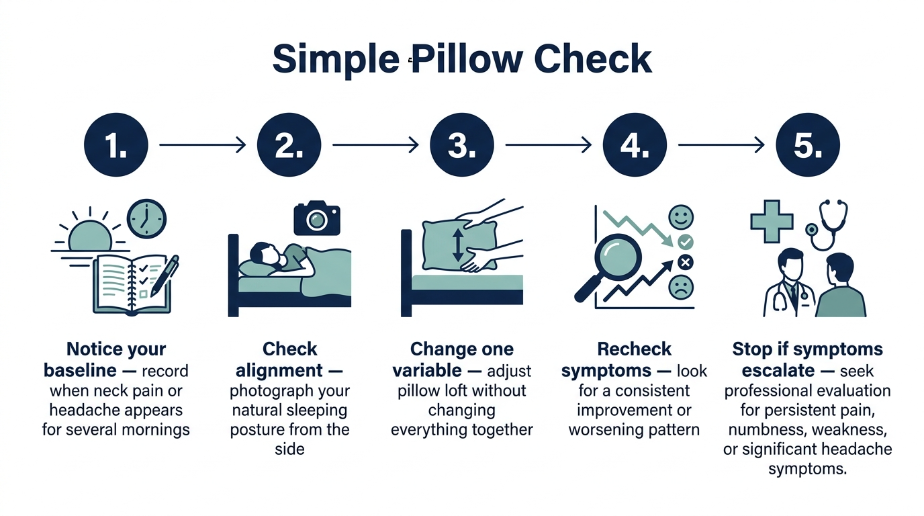
Try this simple pillow check
- Notice your baseline. Record when your neck pain or headache appears for several mornings.
- Check alignment. Photograph your sleeping posture from the side without deliberately correcting it.
- Change one variable. Adjust pillow loft rather than replacing the mattress, pillow, and sleeping position together.
- Recheck symptoms. Look for a consistent improvement or worsening pattern instead of judging one night.
- Stop if symptoms escalate. Persistent pain, numbness, weakness, or significant headache symptoms deserve professional evaluation.
MedlinePlus recommends a pillow that supports the neck as part of self-care for many cases of neck discomfort. Its neck pain self-care guidance also explains when medical follow-up may be appropriate.
A useful pillow should disappear from your awareness once you’re settled. If you’re constantly fighting the height, folding it, stacking another pillow, or waking to reposition it, the fit deserves another look.
If you’re ready to change your setup, these are two pillow styles I’d consider for different needs:
🏆 Best for adjustable loft
Coop Sleep Goods Original Adjustable Pillow
★★★★☆
Its adjustable fill lets you remove or add material to change the pillow’s height. I favor that adjustability when the main problem is figuring out how much loft your shoulder width and mattress require.
🛏️ Best for fixed contour
TEMPUR-Neck Pillow
★★★★☆
This molded cervical-style pillow uses a curved profile intended to support the neck rather than acting like a flat cushion. I’d consider this style when you prefer consistent contouring and don’t want loose fill shifting during the night.
Frequently Asked Questions
Can a pillow cause neck pain on one side?
Yes. A pillow that lets your head tilt sideways can place uneven strain on the neck, especially for side sleepers. Check whether your head drops toward the mattress or gets pushed upward, and consider shoulder width and mattress softness when adjusting pillow height.
Can sleeping on the wrong pillow cause headaches every morning?
A poorly fitted pillow may contribute to morning headaches when neck muscle tension is involved. However, recurring headaches have many possible causes. Frequent, worsening, unusual, or severe headaches should be discussed with a healthcare professional instead of being attributed automatically to your pillow.
How can I tell if my pillow is too high?
Back sleepers may notice the chin being pushed toward the chest. Side sleepers may see the head tilted away from the mattress. Morning neck stiffness, upper-shoulder tightness, or repeatedly pushing the pillow away can also suggest excessive height.
How can I tell if my pillow is too low?
A side sleeper’s head may droop toward the mattress, while a back sleeper may feel unsupported beneath the natural curve of the neck. If folding the pillow or putting a hand underneath it immediately feels better, insufficient loft may be part of the problem.
Should I replace my pillow if my neck hurts?
Not automatically. First check your sleeping position, pillow height, mattress compression, and whether the pillow has permanently flattened. If adjusting the setup doesn’t help, trying a different height or design makes more sense than repeatedly buying similar pillows.
Final takeaway:
A pillow can cause neck pain or contribute to headaches when it keeps your head out of comfortable alignment for hours. Focus first on height, sleeping position, and how your neck feels when you wake rather than assuming you need the most expensive orthopedic pillow.
Make one change at a time and watch for a consistent pattern. If pain persists, worsens, spreads into an arm, causes weakness or numbness, or comes with concerning headache symptoms, get medical advice rather than continuing to experiment with pillows.

I’m a home decor enthusiast who loves discovering beautiful room ideas, creative DIY projects, and Pinterest-worthy decorating inspiration. At DecorMinty, I share simple tips, fresh trends, and practical ideas to help you create a home you’ll truly love—one room at a time.