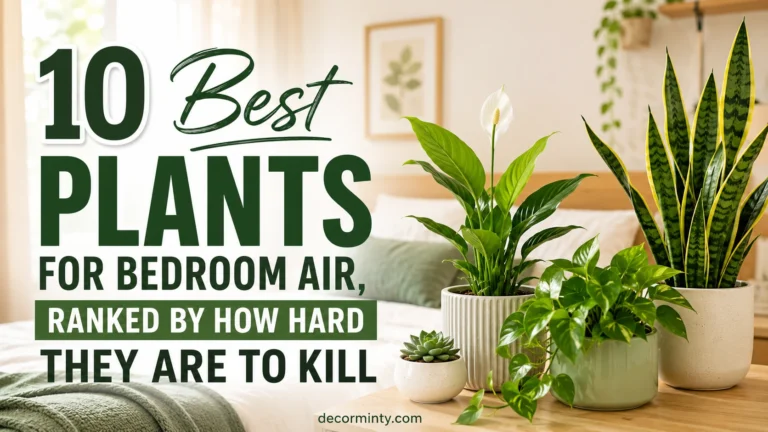
Best Plants for Bedroom Low Light: 12 Easy-Care Choices
Quick Answer
Snake Plant, ZZ Plant, Pothos, Peace Lily, Cast Iron Plant, Aglaonema, Parlor Palm, Dracaena, Syngonium, Philodendron, Monstera, and Dieffenbachia all thrive in bedroom low-light conditions, making them ideal for transforming shadowy corners into lush, breathing spaces without needing a sunny windowsill.
Here’s the short version before you scroll further:
- Snake Plant — Nearly indestructible, tolerates weeks without water, iconic sword-like leaves
- ZZ Plant — Glossy deep-green foliage, stores water underground, extremely forgiving
- Pothos — Trails beautifully, adapts to neglect, fastest grower on this list
- Peace Lily — Elegant white flowers, visibly droops when thirsty (no guessing)
- Cast Iron Plant — Named for its durability, pet-safe, grows at glacial pace
- Aglaonema — Vibrant patterned leaves, handles dimness beautifully, easy propagation
- Parlor Palm — Adds tropical height and softness, pet-friendly, slow-growing elegance
- Dracaena Corn Plant — Tall statement piece, variegated leaves, forgiving neglect specialist
- Syngonium — Arrow-shaped leaves, compact form, darker varieties handle shade best
- Philodendron — Heart-shaped leaves, trails or climbs, nearly as easy as Pothos
- Monstera — Bold dramatic leaves, survives shade (though slower than bright light)
- Dieffenbachia — Striking variegated foliage, bold statement, handles medium-low light
The takeaway: low-light bedrooms don’t mean sacrificing greenery. These twelve genuinely distinct plants prove that shadowy corners can become thriving pockets of life with the right choices.
Our Top Picks at a Glance
Hardest to Kill — Snake Plant
Best for Dramatic Flair — Dracaena Corn Plant
Most Beginner-Friendly — Pothos
Best for a Calm, Elegant Look — Peace Lily


Why Low-Light Bedrooms Deserve Living Plants
Your bedroom is one of the last places you’d think to add greenery—but it’s exactly where you need it most. A dark room doesn’t have to mean a bare room.
- Transforms neglected corners into focal points — A striking plant tucked into the shadowy corner that’s been empty for months suddenly becomes a reason to look there. You’re not fighting your room’s natural darkness; you’re working with it.
- Fits real bedroom life, not just Pinterest aesthetics — Bedrooms often lack the bright, sunny windows of living rooms. These plants accept that reality and thrive anyway, so you can have actual greenery instead of feeling guilty about a struggling plant.
- Adds peaceful depth without high maintenance — Low-light plants are almost universally low-maintenance. They forgive missed waterings, tolerate dust, and grow slowly enough that they won’t outgrow your space in a season.
- Brings quiet visual interest to a restful space — Even foliage-only plants—especially the patterned ones—add texture and movement to a bedroom without the intensity of a bright, needy flowering plant.
12 Best Low-Light Plants for Your Bedroom
#1. Snake Plant — “The Unforgettable Survivor”
| Sunlight | Low to bright indirect light; tolerates very low light |
| Watering | Every 2-4 weeks; let soil dry completely between waterings |
| Pot Size | 6-8 inches for mature plant; prefers to be slightly snug |
| Care Level | Easy |
| Soil pH | 6.0-7.0 (adaptable) |
| Bloom Time | N/A — grown for foliage |
The Snake Plant (Sansevieria trifasciata) is native to the understory of West African forests, where it evolved to survive with little light and infrequent rain. Its sword-like leaves store water internally, allowing it to go weeks without attention—perfect for a bedroom where you might forget watering day.
Plant it in well-draining, cactus-like soil (never regular potting mix, which holds too much moisture). The main threat to a Snake Plant is overwatering, not underwatering. Check the soil every 3-4 weeks and water only when completely dry to the touch an inch down.
Position it on a nightstand, dresser, or bedroom floor where it won’t block the view but catches whatever filtered light drifts through. It’s toxic to cats and dogs if chewed, so keep it out of reach of pets. For a live snake plant, look for mature specimens already established in 6-inch pots.
Pros
- Tolerates neglect and irregular watering like no other plant
- Extremely slow-growing—won’t overtake your space
- Can live for decades with minimal effort
Watch For
- Overwatering causes root rot and mushy leaves (the #1 killer)
- Toxic to cats and dogs—keep away from pet reach
- Growth in low light is extremely slow
 Save
Save#2. ZZ Plant — “The Glossy Minimalist”
| Sunlight | Low to medium indirect light; tolerates fluorescent-only rooms |
| Watering | Every 2-3 weeks; water only when soil is completely dry |
| Pot Size | 8-10 inches; doesn’t need frequent repotting |
| Care Level | Easy |
| Soil pH | 6.0-7.0 |
| Bloom Time | Rare indoors; tiny greenish-white flowers at base |
Zamioculcas zamiifolia (ZZ Plant) evolved in the seasonally dry forests of Kenya and South Africa. Underground rhizomes store water for weeks, making it the perfect choice for bedrooms where you might not water for extended periods. Its waxy, glossy leaflets never need misting—they thrive in average home humidity.
The ZZ tolerates low light (100-500 lux, even in corners far from windows) but grows noticeably faster in medium light. Allow the top 2-3 inches of soil to dry completely before watering; yellowing stems signal overwatering. For a well-draining pot with drainage holes, try ceramic pots with drainage to prevent root rot.
This plant is toxic to pets if chewed, though ingestion causes only mild to moderate oral irritation. Place on a high shelf or in a spot pets can’t easily access. It’s one of the slowest-growing plants here—ideal if you want a plant that stays put.
Pros
- Strikingly elegant deep-green leaves with minimal effort required
- Survives weeks of neglect thanks to underground water storage
- Naturally resistant to most common houseplant pests
Watch For
- Overwatering is the primary cause of death; rhizome rot sets in quickly
- Toxic to cats and dogs if ingested; keep out of reach
- Extremely slow growth means you won’t see rapid change
#3. Pothos — “The Confident Climber”
| Sunlight | Low to bright indirect; Jade Pothos (solid green) tolerates low light best |
| Watering | Every 1-2 weeks; let top 1 inch dry between waterings |
| Pot Size | 4-6 inches initially; scale up only when root-bound |
| Care Level | Easy |
| Soil pH | 6.0-7.0 |
| Bloom Time | N/A — grown for foliage |
Epipremnum aureum (Pothos, or Devil’s Ivy) is native to tropical rainforests and grows as a vining groundcover in low light under forest canopies. Its heart-shaped leaves stay smaller in shadowy corners but the plant itself is nearly unstoppable—it forgives sporadic watering, low humidity, and irregular light.
Choose Jade Pothos (solid green) over variegated varieties if your bedroom is truly dark; variegated leaves lose their pattern and revert to green in insufficient light. Water when the top inch feels dry to the touch. The plant roots so readily that many people propagate it by sticking cuttings directly into soil or placing them in water indefinitely.
Let it trail from a high shelf, climb a moss pole, or hang from a bedroom ceiling corner. Pothos is toxic to cats and dogs, so keep it elevated or in a space pets can’t access. Check out moss poles for pothos training if you want to encourage vertical growth.
Pros
- Fastest-growing plant on this list; noticeably fills space within weeks
- Forgiving of both underwatering and occasional neglect
- Propagates effortlessly in water or soil for sharing
Watch For
- Variegated varieties fade to plain green in low light
- Can become leggy and bare if you don’t prune; occasional trimming keeps it full
- Toxic to cats and dogs if chewed or ingested
#4. Peace Lily — “The Communicative Beauty”
| Sunlight | Low to medium indirect light; blooms less frequently in dim light |
| Watering | Weekly in low light (every 7-12 days); watch for visible droop |
| Pot Size | Prefers to be slightly root-bound; 6-8 inches is ideal |
| Care Level | Easy |
| Soil pH | 6.0-6.5 |
| Bloom Time | Spring and summer in bright light; occasional blooms year-round in ideal conditions |
Spathiphyllum wallisii thrives on the forest floor of tropical South America, where dappled light filters through tree canopies. Its elegant white spathes (modified leaves that look like flowers) bloom sporadically even in low-light bedrooms. The plant communicates thirst dramatically by drooping, then perking up within hours after watering—perfect for beginners unsure of watering schedules.
Keep soil consistently moist but not soggy. In low-light bedrooms, water every 7-12 days depending on humidity and temperature. Mist leaves occasionally or place on a pebble tray to increase humidity; the plant appreciates moisture in the air. For live peace lily plants, select ones already in bloom for immediate bedroom elegance.
Peace Lily is toxic to pets and humans if ingested, causing mouth swelling and throat irritation. Position it on a high shelf or in a corner pets can’t easily reach. The plant tolerates average room humidity, though it thrives with slightly elevated moisture.
Pros
- Produces graceful white blooms even in low light (though less frequently)
- Visibly droops when thirsty—removes all guesswork from watering
- Lush green foliage adds elegance without needing bright light
Watch For
- Blooming depends on sufficient light; very dim rooms produce only foliage
- Toxic to cats, dogs, and humans if chewed; keep away from reach
- Brown leaf tips indicate low humidity or mineral buildup in water
#5. Cast Iron Plant — “The Stalwart Victorian”
| Sunlight | Low to moderate indirect light; actually benefits from shade |
| Watering | Every 10-14 days; allow top half of soil to dry completely |
| Pot Size | 8-10 inches; grows very slowly, repot rarely |
| Care Level | Very Easy |
| Soil pH | 6.0-7.0 |
| Bloom Time | Rare indoors; small purplish flowers at base when mature |
Aspidistra elatior earned its name during the Victorian era when coal-fired homes filled with toxic fumes—yet Cast Iron Plants thrived. Native to the dark forest understory of Japan and Taiwan, it stores water in underground rhizomes and grows so slowly it practically doesn’t consume soil moisture. It’s one of the only common houseplants safe around cats and dogs.
Water sparingly: every 10-14 days at most, and only when the top half of soil feels bone dry. The biggest mistake is overwatering, which causes stem rot faster than anything else. This plant actually prefers low light; direct sun can scorch the leaves. Wipe the large, glossy leaves with a damp cloth every few months to keep them dust-free and able to photosynthesize efficiently.
For a bedroom where pets have full access, this is the ideal non-toxic choice. Growth is glacial—you might see 6-12 new leaves per year—but that means the plant won’t outgrow the space and requires near-zero intervention. Place it on the floor in a corner or on a sturdy pedestal for height.
Pros
- Completely safe for cats, dogs, and children if chewed
- Thrives on benign neglect; truly difficult to kill
- Glossy, dramatic foliage commands attention despite slow growth
Watch For
- Growth is glacially slow—if you want rapid change, this isn’t the plant
- Overwatering is the primary threat; erring on the dry side is correct
- Dust accumulates on those large paddle leaves and dulls appearance
#6. Aglaonema — “The Patterned Gem”
| Sunlight | Low to medium indirect; green varieties handle shade best |
| Watering | Every 7-10 days; keep soil lightly moist, not soggy |
| Pot Size | 4-6 inches; prefers to be slightly root-bound |
| Care Level | Easy |
| Soil pH | 6.0-6.5 |
| Bloom Time | N/A — grown primarily for vibrant foliage |
Aglaonema (Chinese Evergreen) is native to tropical forests of Southeast Asia and New Guinea. With over 20 species and hundreds of cultivars, there’s a color option for any bedroom aesthetic: solid deep green, silver-striped, pale pink, coral, or burgundy. The solid-green varieties handle genuinely low light better than the colorful ones, which fade to plain green without sufficient brightness.
Water when the top inch of soil dries out—typically every 7-10 days. These plants like consistent moisture but hate waterlogged soil. Aglaonema is mildly toxic to pets and humans, so position it where animals can’t chew leaves and wash hands after handling. Propagation is effortless: take stem cuttings, place them in water, and roots appear within 1-2 weeks.
This plant thrives in the bedroom with its compact, bushy growth habit and stunning foliage. Pick a variety with patterning that matches your aesthetic, and know that the slower growth keeps it manageable indefinitely. Green varieties are the safest bet for truly dim bedrooms; use live aglaonema plants in various colors.
Pros
- Incredible diversity of leaf colors and patterns; highly customizable
- Solid green varieties handle shade beautifully without fading
- Propagates so easily you’ll have multiple plants within weeks
Watch For
- Colorful varieties lose their pattern and revert to green in low light
- Mildly toxic to cats, dogs, and humans if ingested; keep away from mouths
- Can become leggy if pruned infrequently; occasional pinching maintains bushiness
#7. Parlor Palm — “The Tropical Diplomat”
| Sunlight | Low to medium indirect light; one of few palms that genuinely tolerates shade |
| Watering | Weekly or every 7-10 days; keep soil evenly lightly moist |
| Pot Size | 8-10 inches; prefers consistent container, dislikes frequent repotting |
| Care Level | Easy to Moderate |
| Soil pH | 6.0-7.0 |
| Bloom Time | Rare indoors; tiny flowers at base when mature |
Chamaedorea elegans (Parlor Palm) has been a houseplant since the Victorian era, prized for its ability to thrive in the low-light interiors of grand homes heated by coal fires. Native to Mexican and Guatemalan rainforests, it grows as an understory palm beneath taller trees. Unlike most palms, it genuinely tolerates—even prefers—lower light conditions and adapts well to average household humidity.
Keep soil evenly and lightly moist, never bone dry or waterlogged. Water when the top 1-2 centimeters feel dry, roughly every 7-10 days depending on your bedroom’s conditions. The narrow watering window (never too wet, never too dry) is the Parlor Palm’s only real quirk. It’s completely safe around cats and dogs and can live 20-40 years with proper care. Growth is slow, making it ideal for a permanent bedroom fixture.
Position it on the bedroom floor or a sturdy stand to let its soft, feathery fronds add tropical elegance without needing a bright window. Rotate it occasionally so all sides receive equal light. For a live parlor palm, young specimens are easier to place than mature ones.
Pros
- One of the few palms that genuinely tolerates low light and shade
- Completely non-toxic to cats, dogs, and humans
- Soft, graceful fronds add visual interest and tropical feeling
Watch For
- Needs evenly moist soil; both overwatering and underwatering cause problems
- Root rot sets in quickly if drainage is poor or soil stays soggy
- Very slow growth means patience is required to see size increase
#8. Dracaena Corn Plant — “The Stately Statement”
| Sunlight | Low to bright indirect light; growth rate depends heavily on light |
| Watering | Every 7-10 days; allow top 1 inch of soil to dry between waterings |
| Pot Size | 10-12 inches for mature plant; grows slowly and stays contained |
| Care Level | Easy |
| Soil pH | 6.0-7.0 |
| Bloom Time | Rare indoors; fragrant whitish-pink flowers bloom occasionally on mature specimens |
Dracaena fragrans (Corn Plant) is named for its large, sword-shaped leaves that resemble corn foliage. Native to tropical Africa, it grows on the forest floor where it evolved to tolerate low, filtered light. Its thick, woody canes store energy for extended drought—overwatering is far more dangerous than underwatering. Variegated varieties need brighter light to maintain their yellow-stripe pattern; solid-green cultivars like ‘Janet Craig’ handle genuine darkness better.
Water when the top 1 inch of soil feels dry, roughly every 7-10 days. Allow some drying between waterings; the plant is slightly succulent-like in its drought tolerance. Corn Plants are mildly toxic to cats and dogs if chewed, so place them away from pet access. The plant’s slow growth and architectural form make it ideal for a bedroom corner where it can make a statement for years without becoming unwieldy.
These plants are famous for their air-purifying abilities and long-term durability. A single Corn Plant can live 10-15+ years in the same pot with minimal intervention. For a tall mature corn plant specimen, purchase one already 3+ feet tall for immediate impact.
Pros
- Tall, dramatic form provides instant visual impact without taking floor space
- Extremely forgiving of neglect and irregular watering
- Can live 10-15+ years as a permanent bedroom fixture
Watch For
- Overwatering causes stem rot and mushy, blackening leaves
- Mildly toxic to cats and dogs; keep away from chewing reach
- Very slow growth means you won’t see major size changes
#9. Syngonium — “The Arrow-Shaped Charmer”
| Sunlight | Low to bright indirect; solid-green varieties handle low light; pink/variegated need more |
| Watering | Weekly (7-14 days depending on conditions); keep soil lightly moist |
| Pot Size | 4-6 inches initially; repot when root-bound |
| Care Level | Easy |
| Soil pH | 6.0-7.0 |
| Bloom Time | N/A — grown for attractive arrow-shaped foliage |
Syngonium podophyllum (Arrowhead Plant) is native to tropical rainforests of Central and South America, where it grows as an understory vine beneath taller canopies. The foliage naturally shifts from arrow-shaped juvenile leaves to deeply lobed mature leaves as the plant ages. Green and silver varieties tolerate genuine low light; pink, red, and white variegated cultivars need brighter conditions to maintain their coloring or they revert to solid green.
Water when the top 1 inch of soil dries out, roughly every 7-14 days depending on humidity. The plant prefers moisture but dislikes waterlogging, so the “moist wrung-out sponge” analogy works well. Syngoniums are mildly toxic to cats and dogs if chewed, causing drooling and mouth irritation. Keep it on a high shelf or in a corner pets can’t easily access. Propagate effortlessly by cutting stems below a node and placing them in water; roots emerge within 1-2 weeks.
This plant can trail or climb depending on the variety and whether you provide support. Let it cascade from a shelf or train it up a moss pole. For true low-light bedrooms, choose solid green varieties like solid green syngonium plants.
Pros
- Solid-green varieties handle shade beautifully without losing their color
- Compact, bushy form stays manageable on shelves or bedside tables
- Propagates so readily from cuttings that one plant multiplies effortlessly
Watch For
- Variegated varieties fade to plain green in low light; invest in solid-green types for dim bedrooms
- Mildly toxic to cats and dogs; keep away from chewing reach
- Can become leggy if grown in low light; occasional pruning maintains bushiness
#10. Philodendron — “The Reliable Companion”
| Sunlight | Low to bright indirect light; adapts to various conditions |
| Watering | Every 7-10 days; keep soil lightly moist but well-draining |
| Pot Size | 4-6 inches; scale up only when roots emerge from drainage |
| Care Level | Easy |
| Soil pH | 6.0-7.0 |
| Bloom Time | N/A — grown for foliage |
Philodendron hederaceum (Heart-leaf Philodendron) closely resembles Pothos but has slightly thinner stems and softer leaf texture. It’s equally adaptable and nearly as forgiving, though it prefers slightly more consistent moisture than Pothos. Native to tropical Central and South America, it grows as a vining groundcover in low light beneath tree canopies.
Water when the top 1 inch of soil feels dry, roughly every 7-10 days. Philodendrons prefer soil to stay lightly moist but not waterlogged. Overwatering causes more problems than underwatering. Train it up a moss pole, let it trail from a shelf, or keep it compact by pruning. Propagation is identical to Pothos: cuttings root readily in water or moist soil within 1-2 weeks.
Philodendron is toxic to cats and dogs if chewed, causing oral irritation. Position it high or out of reach. This plant is slightly slower-growing than Pothos in low light, making it a good middle ground between Pothos and more sedentary plants. Get heart-leaf philodendron plants for bedroom trailing displays.
Pros
- Tolerates low light and forgiving of neglect, like Pothos but with softer feel
- Heart-shaped leaves add gentle aesthetic to bedroom spaces
- Grows quickly enough to fill empty space; trails beautifully over time
Watch For
- Prefers slightly more consistent moisture than Pothos; don’t let it dry out completely
- Toxic to cats and dogs if chewed; keep away from pet access
- Can become sparse and leggy if not pruned; occasional trimming maintains fullness
#11. Monstera Deliciosa — “The Bold Tropical”
| Sunlight | Medium to bright indirect light; survives low light but growth slows significantly |
| Watering | Every 7-10 days; allow top 2 inches of soil to dry between waterings |
| Pot Size | 10-12 inches; repot annually or when root-bound |
| Care Level | Easy to Moderate |
| Soil pH | 6.0-7.0 |
| Bloom Time | N/A — grown for dramatic fenestrated (split) foliage |
Monstera deliciosa (Swiss Cheese Plant) is native to tropical Central America and typically grows as a vining epiphyte, climbing trees in the understory. While it prefers bright, indirect light for robust growth and fenestration development, it survives—and can eventually thrive—in medium to low-light bedrooms. Growth is slower without sufficient brightness, and the famous “holes” (fenestrations) develop more slowly or not at all in dim conditions.
Water when the top 2 inches of soil feel dry, typically every 7-10 days. Allow drainage to be excellent; the plant hates sitting in water. Monstera is toxic to cats and dogs if chewed, causing oral irritation. Position it where pets can’t access it. The dramatic split leaves eventually command attention in any bedroom, even if growth is slower than in brighter locations.
This is the plant for bedroom corners that receive some filtered light but aren’t fully dark. Pair it with moss pole support to encourage climbing growth. For a large, ready-made statement, buy established specimens 2-3 feet tall.
Pros
- Iconic dramatic foliage makes a powerful visual statement instantly
- Can survive in low-light conditions even if growth is slower
- Grows large enough to anchor an entire bedroom corner
Watch For
- Fenestrations (famous holes) develop poorly or not at all in truly low light
- Toxic to cats and dogs if chewed; keep away from pet access
- Needs more frequent watering and repotting than truly low-light plants
#12. Dieffenbachia — “The Bold Patterned Statement”
| Sunlight | Medium to bright indirect light; can tolerate lower medium light |
| Watering | Weekly (every 7-10 days); keep soil consistently moist but well-draining |
| Pot Size | 6-8 inches for tabletop varieties; larger for floor specimens |
| Care Level | Moderate |
| Soil pH | 6.0-6.5 |
| Bloom Time | N/A — grown for striking variegated foliage |
Dieffenbachia (Dumb Cane) is named for its toxic sap, which causes temporary speechlessness if ingested—hence the common name. Native to tropical Central America, it thrives as an understory plant beneath forest canopies. With bold white, cream, or pale yellow variegation on deep green leaves, Dieffenbachia makes a striking visual statement. Variegation fades in low light, so it’s best for bedrooms with medium indirect light rather than genuinely dim corners.
Keep soil consistently lightly moist; unlike succulents or Dracaenas, Dieffenbachia doesn’t appreciate extended drying. Water weekly or when the top 1 inch of soil feels dry. Rotate the plant occasionally to maintain even growth. Dieffenbachia is toxic to cats, dogs, and humans—all parts of the plant (leaves, stems, roots) contain oxalate crystals. Wear gloves when handling and place it well out of reach of curious animals and children.
The plant becomes leggy over time as lower leaves naturally die off. Prune the top and propagate the cutting (it roots in water readily), or allow it to grow tall as a floor statement. For dramatic impact, get mature dieffenbachia specimens already 2-3 feet tall with established foliage.
Pros
- Strikingly bold variegated foliage commands attention in any bedroom
- Can handle medium-low indirect light better than true low-light plants
- Propagates easily from cuttings for sharing or creating new plants
Watch For
- Variegation fades and disappears in truly low light; won’t suit very dark bedrooms
- Highly toxic to cats, dogs, and humans; keep completely away from all access
- Becomes leggy over time; pruning required to maintain attractive shape
Mistakes That Tank Low-Light Plants (And How to Avoid Them)
Knowing what plants tolerate low light is half the battle. Here’s what actually kills them.
Overwatering on a fixed schedule instead of checking the soil first — Low-light plants use water much more slowly than bright-light plants. Checking soil moisture before watering prevents the #1 killer of indoor plants: root rot. Use your finger, not a calendar.
Placing a plant directly under an air conditioning vent or heat source — Temperature swings and dry drafts stress low-light plants even more than bright-light ones. Find a stable corner away from vents, radiators, and heating ducts.
Using regular indoor potting soil instead of well-draining mix — Heavy, moisture-retaining soil is a death sentence for plants in low light where evaporation is slow. Mix in perlite or coco coir to improve drainage, especially for succulents or Dracaenas.
Repotting too frequently or into pots that are too large — Low-light plants grow slowly. A pot larger than the root ball means excess soil holds water too long, leading to rot before the plant can use it. Only repot when roots genuinely crowd the current container.
Expecting variegated varieties to keep their color in shade — Pink, white, or yellow variegated foliage reverts to solid green in low light because the variegated parts produce less chlorophyll. For truly dim bedrooms, choose solid-green varieties of Syngonium, Pothos, or Aglaonema.
Frequently Asked Questions
Q: Can I actually grow plants in a bedroom with zero windows?
A: Yes, but with artificial light. Low-light plants survive on tiny amounts of natural light, but they still need *some* light. A basic LED grow light running 8-12 hours daily will support most plants on this list indefinitely. Cast Iron Plant and ZZ Plant are the most forgiving options even with minimal artificial lighting.
Q: How often should I fertilize low-light plants?
A: Much less than bright-light plants. Most low-light plants on this list need fertilizer only once monthly (or every other month) during spring and summer growing season. In winter, skip fertilizer entirely. Overfertilizing damages leaves and causes salt buildup, especially when water turnover is slow.
Q: Why are the leaves turning yellow?
A: Most commonly from overwatering or poor drainage. Low-light plants use water slowly, so wet soil sits and promotes root rot before leaves show yellow. Check the soil’s dryness, ensure drainage holes exist, and adjust watering frequency downward. Fluoride in tap water also causes tip burn; let water sit overnight before using.
Q: Should I mist the leaves of low-light plants?
A: Misting helps only if your bedroom is very dry (below 30% humidity). Most low-light plants adapt to average household humidity (30-50%). If leaves look crispy, mist weekly or place the pot on a pebble tray with water beneath (don’t let the pot sit in water). Dust accumulation matters more than humidity for foliage plants.
Q: Can I move a low-light plant to a brighter spot later?
A: Yes, but acclimate it gradually. An abrupt move from shade to bright light stresses the plant and can scorch leaves. Introduce it to a brighter spot over 2-3 weeks by moving it closer incrementally. The plant will eventually adjust and may even grow faster with increased light.
Q: Which low-light plants are safe if I have pets or young children?
A: Only two on this list are completely non-toxic: Cast Iron Plant and Parlor Palm. All others contain calcium oxalate crystals that cause mouth irritation and gastrointestinal upset if chewed. Position toxic plants high on shelves or in corners pets and kids can’t reach, no matter how low-maintenance they seem.
Final Thoughts
Your bedroom doesn’t have to be plant-free just because it lacks a sunny window. These twelve genuinely distinct low-light plants prove that shadowy corners can become thriving, green sanctuaries with the right choices. Start with one of the easiest (Snake Plant, Pothos, or ZZ Plant) to build confidence, then expand into more dramatic specimens like Monstera or Dracaena as your comfort grows. Every plant on this list will reward patience with low maintenance and years of quiet, beautiful growth.
Which low-light bedroom plant are you adding to your space first? Save this post to Pinterest so you can come back whenever you need fresh plant inspo!

I’m a home decor enthusiast who loves discovering beautiful room ideas, creative DIY projects, and Pinterest-worthy decorating inspiration. At DecorMinty, I share simple tips, fresh trends, and practical ideas to help you create a home you’ll truly love—one room at a time.