10 Best Indoor Plants for Bedroom (Easy to Keep Alive)
Quick Answer
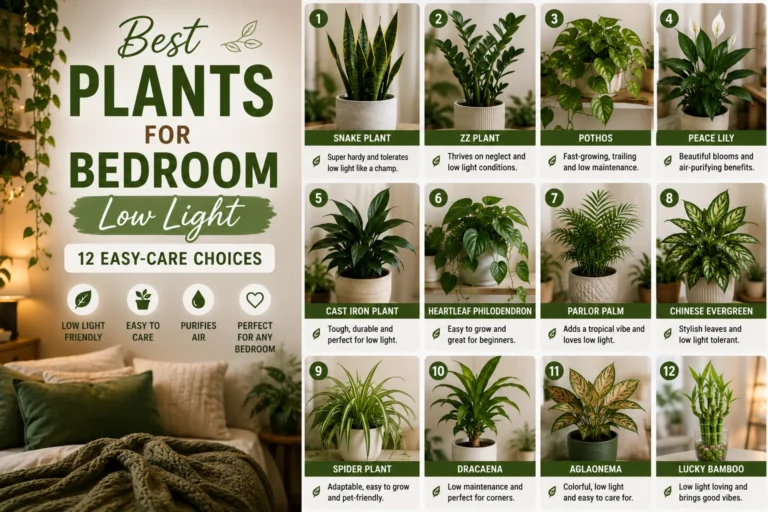
The best indoor plants for a bedroom are the snake plant, peace lily, pothos, spider plant, ZZ plant, Chinese evergreen, heartleaf philodendron, dracaena, Boston fern, and areca palm, and they made this list because each one handles the low, uneven light most bedrooms get, forgives an inconsistent watering schedule, and offers a genuinely different look, size, or care level so there’s a fit for almost any sleeping space.
Here’s the short version before you scroll further:
- Snake Plant — thrives in near-darkness and can go weeks without water
- Peace Lily — the only flowering plant on this list, and it droops dramatically when thirsty
- Pothos — grows fast, roots in a cup of water, nearly impossible to kill
- Spider Plant — one of the few here that’s genuinely pet-safe
- ZZ Plant — stores its own water reserves and can be forgotten for a month
- Chinese Evergreen — the most colorful foliage of any low-light plant here
- Heartleaf Philodendron — a trailing vine that looks great on a high shelf
- Dracaena — the tallest floor statement piece on this list
- Boston Fern — lush and full, but the neediest plant here when it comes to humidity
- Areca Palm — a big, pet-safe statement plant for bright bedrooms
The deciding factor usually isn’t which plant looks the prettiest on Pinterest. It’s whether you have pets in the house, how dark your room actually is, and whether you’ll remember to water on a schedule — match the plant to those things first, and the rest falls into place.
Our Top Picks at a Glance
Easiest to Care For — ZZ Plant
Best for Low Light — Snake Plant
Most Beautiful Bloom — Peace Lily
Best for Beginners — Pothos


The 10 Best Bedroom Plants, Ranked by What They Actually Do Well
#1. Snake Plant (Sansevieria trifasciata) — “The Nearly Indestructible One”
| Sunlight | Low to bright indirect light; tolerates dim corners far from any window |
| Watering | Every 2-3 weeks; water only once the soil is fully dry a few inches down |
| Pot Size | Snug pot, only 1-2 inches wider than the root ball |
| Care Level | Easy |
| Bloom Time | N/A — grown for foliage |
The snake plant, a member of the Asparagaceae family also sold as mother-in-law’s tongue, is native to West Africa’s dry, rocky scrubland. That desert origin is exactly why it shrugs off the low light and irregular watering that most bedrooms deliver. It was one of the top performers in NASA’s original 1989 Clean Air Study on VOC removal in sealed chambers.
Here’s the thing that makes it uniquely suited to a bedroom. As a CAM plant, it releases oxygen and takes in carbon dioxide overnight instead of during the day, the opposite rhythm of most houseplants.
Let the soil dry out completely between waterings, since root rot is the only real way to kill this plant. Keep it away from pets: the ASPCA lists snake plant as toxic to cats and dogs due to saponin compounds that can cause vomiting and nausea if chewed.
Pros
- Survives weeks of neglect without visible stress
- Sculptural upright leaves need zero styling effort
- Genuinely thrives in the darkest bedroom corner
Watch For
- Toxic to cats and dogs if chewed
- Overwatering is the single most common way people kill it
- Slow grower, so don’t expect quick size payoff
#2. Peace Lily (Spathiphyllum) — “The Bloomer”
| Sunlight | Tolerates low light but blooms more with bright, indirect light |
| Watering | Weekly, when the top inch of soil feels dry; the leaves droop visibly when thirsty |
| Pot Size | A container roughly twice the size of the root ball, 6-12 inches in diameter |
| Care Level | Easy to Moderate |
| Soil pH | Slightly acidic, around 5-6 |
| Bloom Time | Starts in early summer and can continue on and off year-round in good light |
Native to the tropical rainforest floors of South America, the peace lily grows under a dense tree canopy in nature. That’s why it’s one of the few genuinely flowering plants that still tolerates a dim bedroom, producing those elegant white spathes even when light is far from ideal.
What sets it apart is how clearly it communicates. When a peace lily needs water, its leaves droop dramatically within a day or two, then perk back up completely within hours of a good soak.
Wipe the leaves occasionally to keep them dust-free and photosynthesizing well, and consider a self-watering planter if you tend to forget. Keep this one away from pets, since the ASPCA lists peace lily as toxic to cats and dogs due to calcium oxalate crystals that irritate the mouth and throat.
Pros
- Only plant on this list that flowers reliably indoors
- Tells you exactly when it needs water
- Handles the low light of a north-facing bedroom
Watch For
- Toxic to cats and dogs if ingested
- Brown leaf tips if direct sun or dry air hits it
- Will skip blooming entirely if light is too dim
#3. Pothos (Epipremnum aureum) — “The Effortless Grower”
| Sunlight | Medium to bright indirect light; tolerates lower light with slower growth |
| Watering | Weekly-ish, once the top 1-2 inches of soil are dry to the touch |
| Pot Size | 1-2 inches wider than the current root ball; it likes being slightly snug |
| Care Level | Easy |
| Soil pH | Slightly acidic, 6.1 to 6.5 |
| Bloom Time | N/A — grown for foliage |
Also called devil’s ivy for its ability to survive almost anything, pothos belongs to the Araceae family and hails from the Solomon Islands. Its heart-shaped, often variegated leaves trail for feet if you let them, which is why it’s such a natural fit for a headboard shelf or a hanging planter.
The most useful thing about pothos is how easily it propagates. Snip a cutting below a leaf node, drop it in a glass of water, and you’ll usually see roots within a month.
Water only when the top of the soil is dry, since this plant’s biggest risk is root rot from overwatering, not underwatering. It’s toxic to cats and dogs, so hang it out of reach if you have curious pets, and consider it as a beginner-friendly first plant before working up to trickier varieties.
Pros
- Propagates almost by accident from a single cutting
- Fast-growing, so mistakes grow out quickly
- Trails beautifully off shelves or hanging baskets
Watch For
- Toxic to cats and dogs if chewed
- Can look leggy in very low light without pruning
- Vines need occasional trimming to stay tidy
#4. Spider Plant (Chlorophytum comosum) — “The Pet-Safe Classic”
| Sunlight | Bright, indirect light; tolerates medium light but grows fuller with more |
| Watering | Weekly; check with a finger to the second knuckle and water if it comes out dry |
| Pot Size | About an inch wider in diameter than the current pot when repotting |
| Care Level | Easy |
| Soil pH | 6.0 to 6.5 |
| Bloom Time | Small white star-shaped flowers can appear in summer, though it’s grown mainly for foliage |
Chlorophytum comosum, part of the Asparagaceae family, comes from the coastal grasslands of Central and Southern Africa. Its arching, ribbon-like leaves and dangling baby “spiderettes” have made it a fixture in homes since the Victorian era.
What makes it stand out from most of this list is its safety record. The ASPCA classifies spider plant as only mildly toxic to cats and dogs, with the worst-case outcome being mild stomach upset rather than a real emergency.
Propagate the dangling plantlets by potting them directly in soil once they’re a couple of inches wide, and rotate the pot occasionally so light reaches all sides evenly. It was also part of NASA’s original air-quality testing, though the effect in a real bedroom is modest compared to the sealed lab conditions it was tested in.
Pros
- Only mildly toxic to pets, unlike most bedroom staples
- Produces endless free babies to propagate or gift
- Forgiving of missed waterings once established
Watch For
- Brown leaf tips from tap water salts and minerals
- Wants more light than the darkest bedroom corners offer
- Needs repotting every 1-2 years as it grows quickly
#5. ZZ Plant (Zamioculcas zamiifolia) — “The Forgetful Owner’s Best Friend”
| Sunlight | Low to bright indirect light; one of the few plants that truly tolerates dim rooms |
| Watering | Every 2-4 weeks in summer, every 4-6 weeks in winter, once soil is fully dry |
| Pot Size | Only 1-2 inches wider than the current pot; it prefers being snug |
| Care Level | Easy |
| Bloom Time | N/A — grown for foliage |
Native to eastern Africa’s dry grasslands, the ZZ plant belongs to the Araceae family and stores water in thick underground rhizomes. That storage system is what lets it sit untouched for a month without complaint, a trait few other houseplants can match.
Its glossy, dark green leaflets grow in a symmetrical fern-like pattern, and the plant enters a near-dormant state in winter or low light, effectively pausing growth until conditions improve. Overwatering, not neglect, is what kills this plant.
Check the soil by feeling it or lifting the pot to gauge weight before watering again. It contains calcium oxalate crystals and is considered mildly toxic if ingested by pets or children, so keep it out of reach even though it’s a relatively low-risk plant.
Pros
- Can be watered as rarely as once a month
- Glossy leaves stay clean-looking with almost no effort
- Handles the darkest bedroom on this whole list
Watch For
- Mildly toxic if chewed by pets or kids
- Very slow grower, so don’t expect quick change
- Rhizomes rot fast if the pot lacks drainage
#6. Chinese Evergreen (Aglaonema) — “The Colorful Low-Light Star”
| Sunlight | Low to medium indirect light; solid green varieties tolerate the dimmest spots |
| Watering | Every 7-10 days, when the top 1-2 inches of soil feel dry |
| Pot Size | 1-2 inches wider than the current pot; it likes being slightly root-bound |
| Care Level | Easy |
| Bloom Time | N/A — grown for foliage |
Aglaonema is native to the tropical and subtropical understory of Southeast Asia and New Guinea, which explains its comfort with shaded conditions. Unlike the mostly solid-green plants on this list, Chinese evergreen comes in cultivars streaked with silver, pink, or deep red, giving low-light bedrooms a genuine pop of color.
The general rule is simple: darker green varieties tolerate lower light, while the more colorful variegated types need a bit more brightness to hold their pattern. It’s a slow, forgiving grower that rarely needs much intervention.
Wear gloves when pruning, since the sap can irritate skin, and keep it away from pets. The Clemson Cooperative Extension notes its leaves are toxic to dogs and cats due to calcium oxalate crystals.
Pros
- Most colorful foliage among true low-light plants
- Handles dry indoor air and drought stress well
- Rarely bothered by pests indoors
Watch For
- Toxic to pets and mildly irritating to human skin via sap
- Sensitive to temperatures below 50°F
- Variegated types fade without enough light
#7. Heartleaf Philodendron (Philodendron hederaceum) — “The Trailing Vine”
| Sunlight | Medium indirect light; genuinely tolerates low light better than most vines |
| Watering | Every 1-2 weeks, once the top inch of soil is dry |
| Pot Size | 1-2 inches wider than the current pot |
| Care Level | Easy |
| Bloom Time | N/A — grown for foliage |
Native to the Caribbean and Central America, the heartleaf philodendron grows as an epiphyte in the wild, climbing tree trunks rather than rooting in open soil. Its small, glossy, heart-shaped leaves emerge bronze before turning a deep green, and the vine can trail several feet given time.
According to Iowa State University Extension’s home horticulture guidance, heartleaf philodendron can tolerate very low light levels better than most other philodendron varieties, which is what earns it a spot on a bedroom list. It’s often confused with pothos, but the leaves are thinner and more pointed.
Pinch back the vine occasionally after a leaf node to keep it bushy instead of long and sparse. It’s toxic to both people and pets if ingested, so a hanging planter or high shelf keeps curious hands and paws away.
Pros
- Handles lower light better than most trailing vines
- Easy to propagate from stem cuttings in water
- Thrives under fluorescent light if your room lacks windows
Watch For
- Toxic to people and pets if chewed
- Gets leggy without occasional pinching
- Brown leaf tips signal air that’s too dry
#8. Dracaena (Dracaena fragrans) — “The Architectural Statement”
| Sunlight | Medium to bright indirect light; several varieties tolerate lower light |
| Watering | Roughly every 1-2 weeks, once about 75% of the soil has dried out |
| Pot Size | 1-2 inches wider than the root ball |
| Care Level | Easy |
| Soil pH | Slightly acidic, 6.0 to 6.5 |
| Bloom Time | Fragrant flowers are rare indoors; grown mainly for foliage |
Dracaena belongs to a large genus of over 100 species in the Asparagaceae family, and popular bedroom varieties like ‘Janet Craig’ or the striped ‘Lemon Lime’ can grow into a genuine floor-height statement piece. The New York Botanical Garden notes that the best light is a few hours a day filtered through a curtain rather than direct sun.
As the lowest leaves naturally age and drop, older dracaena plants develop a slender, palm-like trunk that adds real architectural interest to an otherwise plain corner. Growth is slow, so a plant you buy today will still look similar a year from now.
Use distilled or rain water when possible, since dracaena is sensitive to the fluoride and salts in tap water, which show up as brown leaf tips. It’s toxic to both cats and dogs if chewed, typically causing mouth and stomach irritation.
Pros
- Grows into a genuine floor-standing statement piece
- Slow growth means very little ongoing maintenance
- Wide range of leaf patterns and colors to choose from
Watch For
- Toxic to cats and dogs if ingested
- Sensitive to tap water fluoride and chlorine
- Needs floor space, so it’s not ideal for tiny rooms
#9. Boston Fern (Nephrolepis exaltata) — “The Humidity Lover”
| Sunlight | Bright, indirect light; no direct midday or afternoon sun |
| Watering | Every few days to weekly; keep soil evenly moist, never soggy or bone-dry |
| Pot Size | Shallow pot no more than 1 inch wider than the root ball on any side |
| Care Level | Moderate |
| Bloom Time | N/A — grown for foliage; produces spores on frond undersides, not flowers |
Native to tropical and subtropical regions around the world, the Boston fern was a beloved parlor plant in Victorian homes and remains prized for its soft, arching fronds that fill out into a full fountain shape. Unlike most of this list, it’s genuinely non-toxic to cats and dogs, making it one of the safest choices for a pet-filled bedroom.
The catch is humidity. This fern’s fronds crisp up and brown at the tips fast in the dry air of a typical heated or air-conditioned bedroom, so it does best somewhere close to a bathroom that gets steamy.
Double-potting in damp sphagnum moss, or running a small humidifier nearby, makes a noticeable difference. It’s still worth considering an indoor humidifier if your bedroom air runs dry in winter.
Pros
- Genuinely non-toxic to cats and dogs
- Lush, full texture unlike anything else on this list
- Looks stunning as a hanging plant over a dresser
Watch For
- Needs consistently high humidity to avoid crispy fronds
- Least forgiving of missed waterings on this list
- Sheds a few leaflets naturally, which can look messy
#10. Areca Palm (Dypsis lutescens) — “The Big, Pet-Safe Statement”
| Sunlight | Bright, indirect light; can tolerate a little direct morning sun |
| Watering | Weekly; water once the top of the soil has partly dried out |
| Care Level | Moderate |
| Bloom Time | N/A — grown for foliage |
Also known as the butterfly palm or golden cane palm, Dypsis lutescens is native to Madagascar and grows in dense, multi-stemmed clusters of arching, feathery fronds. It’s large enough to anchor a corner and instantly reads as tropical, which is part of why it appeared on the original NASA Clean Air Study list alongside snake plant and pothos.
Unlike most of the plants on this list, areca palm is genuinely non-toxic to cats and dogs according to the ASPCA, making it one of two safe statement options here for pet owners along with Boston fern. It does need real humidity and warmth to stay lush, generally between 60-75°F.
Avoid trimming brown frond tips too aggressively, since cutting into living tissue can cause the whole frond to die back. Feed lightly during the growing season and keep humidity up with occasional misting for the fullest look.
Pros
- Non-toxic to cats and dogs
- Large, lush silhouette fills a bare corner fast
- One of NASA’s original tested air-quality performers
Watch For
- Needs brighter light than the low-light plants on this list
- Prone to spider mites in dry indoor air
- Takes up real floor space as it matures
How to Choose the Right Plant for Your Bedroom
Every bedroom on this list’s plants can survive is different, and the honest starting point is your light, not your favorite look. Walk through these factors before you fall for a plant on Pinterest.
- Measure your actual light, not your assumed light. A bedroom with one small north-facing window is a genuinely different growing environment than one with a big east-facing window. Snake plant, ZZ plant, and Chinese evergreen tolerate the dimmest rooms; pothos, spider plant, and areca palm want more brightness.
- Factor in pets before anything else. Most of the plants on this list, including snake plant, pothos, and peace lily, are toxic to cats and dogs if chewed. Spider plant, Boston fern, and areca palm are the pet-safer options here.
- Match the plant to your actual habits, not your ideal ones. If you regularly forget to water for weeks, a ZZ plant or snake plant will forgive you. A Boston fern, by contrast, punishes neglect fast.
Common Mistakes to Avoid
These mistakes account for most of the dead or struggling bedroom plants beginners deal with.
Watering on a fixed calendar instead of checking the soil first. A ZZ plant watered every week on a rigid schedule will rot from the roots up long before it ever shows a wilted leaf on the surface.
Choosing a pot with no drainage hole for looks. A peace lily or dracaena left sitting in trapped water at the bottom of a decorative pot will develop root rot within weeks, even if you’re watering correctly otherwise.
Sizing up the pot too aggressively when repotting. Jumping a snake plant or ZZ plant from a 6-inch pot straight into a 12-inch one leaves excess soil that stays wet far longer than the roots can use, inviting rot.
Placing a low-light plant like Chinese evergreen in a direct afternoon sunbeam. Plants adapted to a shaded forest floor scorch and bleach in direct sun instead of thriving in it.
Ignoring humidity for a Boston fern. A fern set on a dry shelf far from any water source or humidifier will crisp up at the tips within a couple of weeks, no matter how carefully you water it.
Signs Your Plant Needs Attention
Most bedroom plants tell you something is wrong well before it’s fatal. Here’s what to watch for.
- Yellowing lower leaves. Almost always a sign of overwatering rather than underwatering, especially on snake plant, ZZ plant, or pothos. Let the soil dry out fully before watering again.
- Dramatic drooping that bounces back after watering. This is the peace lily’s signature thirst signal, and it’s actually a useful, low-stress way to learn a watering rhythm.
- Brown, crispy leaf tips. Usually points to low humidity or mineral buildup from tap water, a common issue for Boston fern, dracaena, and spider plant in particular.
- Slow or stalled growth with pale, small new leaves. A sign the plant wants more light, most often seen on Chinese evergreen or dracaena pushed too far into a dark corner.
Make Overwatering Nearly Impossible
A simple soil moisture meter takes the guesswork out of the number one mistake on this list. Instead of watering on a calendar and hoping for the best, you get an actual reading before you ever pick up the watering can.
Frequently Asked Questions
Q: What is the best plant for a bedroom with no windows?
A: Snake plant, ZZ plant, and Chinese evergreen are the most tolerant of very dim conditions on this list, though even these plants do best with at least some indirect daylight rather than none at all. In a truly windowless room, a small grow light can help.
Q: Do plants really release oxygen at night and help you sleep?
A: Snake plant is a CAM plant, meaning it releases oxygen overnight instead of during the day, unlike most houseplants. The actual amount is small, and research links houseplants more to reduced stress and better relaxation than to a measurable oxygen boost.
Q: Which bedroom plants are safe for cats and dogs?
A: Of the plants covered here, spider plant, Boston fern, and areca palm are the safest choices, with spider plant only mildly toxic and the other two considered non-toxic by the ASPCA. Snake plant, pothos, peace lily, ZZ plant, Chinese evergreen, philodendron, and dracaena are all toxic to pets to some degree.
Q: How many plants should you keep in a bedroom?
A: There’s no strict rule, but two or three plants is a common, manageable starting point for most bedrooms. Focus on variety in size and care level rather than quantity, so you’re not managing several high-maintenance plants at once.
Q: Can houseplants actually purify the air in a bedroom?
A: NASA’s 1989 Clean Air Study found real VOC removal in sealed test chambers, but later research, including a widely cited Drexel University follow-up, found the effect in a normally ventilated room is much smaller than the original study suggested. Plants are still genuinely good for mood, humidity, and aesthetics, even if the air-purifying effect is modest in practice.
Q: What’s the easiest bedroom plant for someone who’s killed plants before?
A: ZZ plant and snake plant are the two most forgiving options here, both tolerating low light and infrequent watering without much fuss. Overwatering is the main risk with both, so when in doubt, wait another few days before reaching for the watering can.
Final Thoughts
The right bedroom plant isn’t the one with the most Pinterest saves. It’s the one that actually matches your light, your pets, and how honestly you’ll water it week to week.
Start with just one or two from this list, get comfortable with their rhythm, and build from there.
Which plant are you adding to your space first? Save this post to Pinterest so you can come back whenever you need fresh plant inspo!

I’m a home decor enthusiast who loves discovering beautiful room ideas, creative DIY projects, and Pinterest-worthy decorating inspiration. At DecorMinty, I share simple tips, fresh trends, and practical ideas to help you create a home you’ll truly love—one room at a time.