How to Decorate a Bed With a Bolster Pillow the Right Way — Size, Placement & 5 Easy Looks
Quick Answer
Place one bolster horizontally across the front of your propped sleeping pillows, centred and slightly shorter than the bed width. Choose a length that matches your bed size, a cover that picks up one colour or texture already in the bedding, and keep the rest of the arrangement simple. The bolster should finish the bed, not compete with it.
A bolster pillow is the easiest way to make a bed look finished without adding a pile of small cushions. Its long, round shape creates one clean line across the front of the bed, which pulls the sleeping pillows, shams and duvet together.
That simplicity is also why it is easy to get wrong. A bolster that is too long, too thick, too bright or placed in the wrong layer can make the bed look crowded or unbalanced. The fix is rarely a different bolster. It is usually a better size, a calmer cover and a clearer place in the arrangement.
What a Bolster Pillow Actually Does on a Bed
A bolster is a long, cylindrical pillow. Unlike a square throw pillow, it does not sit in a corner or lean at an angle. It runs across the bed and acts as a front edge for the whole pillow stack.
That shape gives it three jobs. First, it hides the uneven bottom edges of the pillows behind it. Second, it adds height and depth at the front, so a flat bed gains a finished silhouette. Third, it gives the eye one place to rest, which makes the rest of the bedding feel calmer.
A bolster is not the same as a lumbar pillow or a neck roll, although the terms are often mixed up. A lumbar pillow is usually a shorter, flat rectangle. A neck roll is much shorter and narrower, made mainly for neck support. A bolster is longer, rounder and more visible, which is why it works as a decorative anchor. Houzz explains the difference between bolsters and neck rolls and notes that bolsters are typically close to the width of the bed, while neck rolls are much shorter.
A bolster can also be useful when you sit up in bed to read or watch television. It supports the lower back and keeps the pillows behind it from slipping. That does not make it a sleeping pillow. Most people remove it at night and place it on a bench, chair or the foot of the bed.
Think of it this way: sleeping pillows are for sleep, shams are for height and structure, and the bolster is the finishing line. When each layer has one job, the bed looks intentional rather than piled up.
Choose the Right Size Before You Style Anything

Size matters more than colour. A bolster that is too short leaves gaps at the sides and looks lost. One that is too long hangs over the edge and makes the bed look wider than it is. The most reliable rule is to leave a small margin on each side.
For most beds, a bolster that is 2 to 6 inches shorter than the mattress width looks balanced. A slim bolster, around 6 to 7 inches in diameter, suits a modern or minimal bedroom. A fuller bolster, around 8 to 9 inches in diameter, suits a taller headboard, thick bedding or a more traditional room.
Common guidance from bedding makers follows a similar pattern. A twin bed often works with a bolster around 24 inches long. A queen bed often works with one around 36 inches long. A king bed often works with one around 48 inches long, or two shorter bolsters placed side by side. These are starting points, not fixed rules, and the width of your pillows matters too.
| Bed size | One bolster | Two bolsters |
|---|---|---|
| Twin | About 24 in long | Usually not needed |
| Full / Double | About 24–36 in long | Two 18–24 in bolsters |
| Queen | About 36 in long | Two 18 in bolsters |
| King | About 48 in long | Two 24 in bolsters |
Measure the mattress width before you buy, then check the bolster length against that number. If you already own a bolster, measure it too. A difference of a few inches is hard to judge by eye once the bed is made, but it is easy to see in a photo.
Diameter matters for comfort as well as looks. A very thick bolster can push the pillows behind it backwards and make the bed feel shallow. A very thin bolster can disappear behind a tall Euro sham. Hold it in front of your arranged pillows before you commit to a cover or a second bolster. If you need a refresher on standard sizes, our guide to how big a bed pillow is explains the common pillow dimensions, and our guide to how long a bed pillow is covers length in more detail.
Tip
If you are between two sizes, choose the shorter one. A slightly shorter bolster looks deliberate. A bolster that overhangs the mattress looks like a mistake.
Pick a Cover That Works With Your Bedding, Not Against It
The cover decides whether the bolster blends in or stands out. Both can work, but only one should happen at a time. If the bedding is already patterned, the bolster should usually be solid. If the bedding is plain, the bolster can carry the pattern.
Start with the colours already on the bed. Pick one colour from the duvet, throw, headboard or rug and repeat it in the bolster, in a slightly different shade or texture. That repeat is what makes the bed look planned. An exact match is not needed. In fact, a slightly different texture often looks more natural than a perfect match.
Texture is as important as colour. Washed linen suits a relaxed, breathable bed. Velvet adds weight and suits a colder room or a darker headboard. Cotton canvas suits a crisp, tailored bed. Bouclé or knitted covers add softness but can look heavy on a small bed, so use them when the rest of the bedding is simple.
Pattern needs more care. Stripes work well on a bolster because the cylinder shows the pattern clearly from every angle. A bold stripe or a strong geometric print can be the focal point. A floral or busy print can look restless when it wraps around a round pillow, so keep the scale small or place the pattern only on the bolster and nowhere else.
End details also change the look. A plain bolster with a zip looks clean and modern. A bolster with tassels, pleated ends or a buttoned cap looks more traditional. Choose the detail that matches the headboard and the throw at the foot of the bed. If those are simple, keep the bolster simple too.
A removable cover makes the choice less risky. You can change the cover with the season, wash it more easily and try a bolder colour without replacing the whole pillow. This helps in a guest room, where the same bed needs to feel fresh for different visitors.
How to Decorate a Bed With a Bolster Pillow, Step by Step
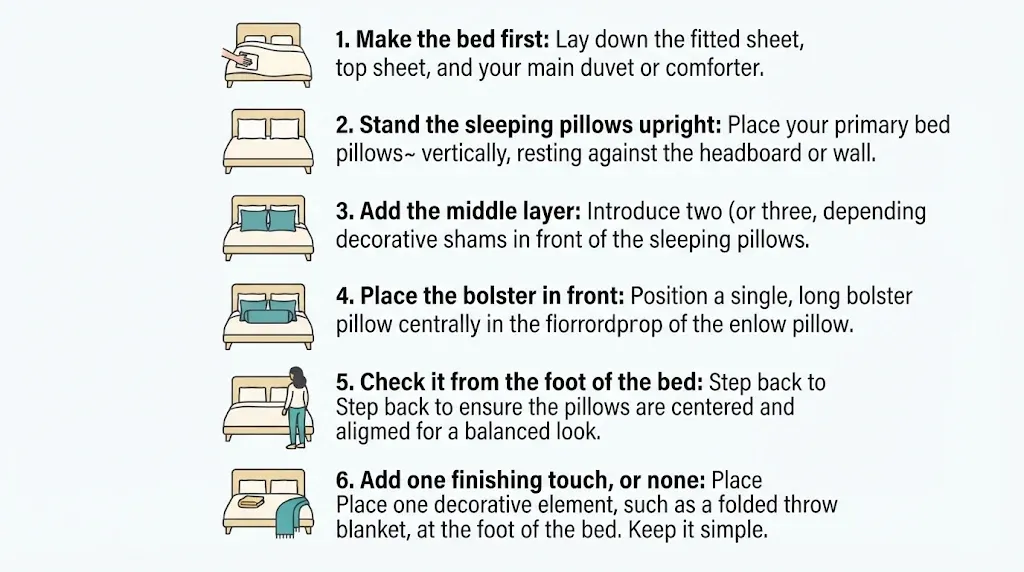
Work from back to front. That order keeps each layer visible and stops the bolster from hiding the pillows it is meant to finish.
- Make the bed first. Smooth the fitted sheet, lay the flat sheet or duvet evenly and fold the top back by about a third. A neat base makes the pillows sit straight. If the duvet is lumpy, the bolster will sit unevenly too.
- Stand the sleeping pillows upright. Place two standard or king pillows against the headboard, one on each side. If your bed is wide, use Euro shams behind them for height. These are the back layer, so they should be taller than everything in front.
- Add the middle layer. Place standard shams or square throw pillows in front of the sleeping pillows. Use two for a queen bed and two or three for a king bed. Leave a small gap between them so the bed does not look like a solid wall.
- Place the bolster in front. Lay it horizontally, centred, with equal space on both sides. It should rest against the middle layer, not on top of it. The top of the bolster should sit below the top of the pillows behind it.
- Check it from the foot of the bed. Step back and look straight at the bed. The bolster should form one straight line. If it slopes, fluff the pillows behind it or move the bolster slightly forward. A crooked bolster is noticeable from across the room.
- Add one finishing touch, or none. A folded throw at the foot of the bed is usually enough. If you add a small square pillow in front of the bolster, keep it small and centred. More than that starts to hide the bolster.
At night, move the bolster to a bench, a chair or across the foot of the bed. That keeps the insert firm and the cover clean. In the morning, it takes less than a minute to put it back in place, which is the main reason a bolster works better than a stack of six small pillows for everyday use.
5 Arrangements That Work for Different Beds
One layout does not suit every bed. The right arrangement depends on the bed width, the headboard height and how much time you want to spend making the bed each day.
1. The simple queen bed
Place two sleeping pillows upright, two Euro shams in front of them and one bolster across the front. This is the cleanest everyday arrangement for a queen bed. It uses only three layers and leaves the bed easy to remake.
2. The layered king bed
Place three Euro shams at the back, two or three standard shams in the middle and one long bolster in front. The extra width needs the extra height at the back, or the bolster will look too dominant. Two shorter bolsters side by side also work well here, especially if two people share the bed.
3. The minimal bed
Place two sleeping pillows flat or slightly propped and one bolster in front, with no other throw pillows. This suits a low headboard, a plain duvet and a modern bedroom. Choose a bolster in a solid colour with a clear texture, such as linen or velvet, so it still adds interest.
4. The twin bed and daybed
Place one sleeping pillow against the headboard, one square pillow in front of it and a short bolster across the front. On a daybed, place the bolster along the back edge instead, with two square pillows in front of it. That turns the daybed into a sofa during the day without extra cushions.
5. The hotel-style bed
Place sleeping pillows behind Euro shams, add two square pillows in the middle and finish with a bolster in a contrasting fabric. A white or cream bed with a dark or patterned bolster is a reliable version of this look. Keep the duvet folded neatly and add a throw at the foot for the final layer.
Key Insight
A bolster replaces several small pillows, it does not join them. If you keep all the old throw pillows and add a bolster on top, the bed will look crowded. Remove at least two small pillows when you add one.
Common Mistakes That Make a Bolster Look Wrong
Most bolster problems come from the same few choices. They are easy to fix once you can name them.
- Too many pillows. A bolster plus three layers of throw pillows leaves no space for the bed itself. Keep the total to two or three layers, including the bolster.
- Wrong scale. A thin bolster on a king bed disappears. A thick bolster on a twin bed overwhelms it. Match diameter and length to the bed width and headboard height.
- Competing patterns. A patterned duvet, patterned shams and a patterned bolster fight for attention. Let one piece carry the pattern and keep the others calm.
- Hiding the bolster. Placing square pillows in front of the bolster defeats its purpose. The bolster should be the front layer, or at most have one small pillow centred in front of it.
- Off-centre placement. A bolster shifted to one side makes the whole bed look uneven, even if the pillows behind it are straight. Centre it, then check from the foot of the bed.
- Ignoring the room. A bright, heavy bolster can clash with a pale, quiet bedroom. The bolster should fit the room, not just the bed. If the curtains, rug and headboard are muted, keep the bolster muted too.
If the bed still looks wrong after fixing these points, take the bolster away for a day and look at the bed without it. That makes it easier to see whether the problem is the bolster, the pillows behind it or the bedding underneath.
How to Keep It Looking Good Day to Day

A bolster keeps its shape when the insert is firm and the cover fits well. Fluff it by rolling it gently between your hands, then smooth the cover from the centre outwards. If the insert has gone flat in the middle, a firmer insert will hold the shape better than adding more filling to a soft one.
Wash the cover according to its label. Most cotton and linen covers can be washed on a gentle cycle, while velvet and embellished covers often need more care. Air the bolster regularly and keep it out of direct sunlight, which can fade the fabric unevenly. For full washing advice, see our guide to how to wash a bed pillow.
Change the cover when the season changes if you want a simple refresh. A light linen cover suits warmer months. A heavier velvet or woven cover suits colder months. One cover change can make the whole bed feel different without changing the bedding.
When you are not using the bolster for support, treat it as part of the bedding, not as a spare pillow. Store it on the bed during the day and move it aside at night. A bolster left on the floor or folded in a cupboard will lose its shape faster and will be less likely to be used.
If you use a bolster as a neck roll for reading or sitting up, the same placement rules still apply. A shorter, firmer roll placed behind the neck is different from a long decorative bolster across the bed. Our guide to how to use a neck bed pillow explains how to position a neck pillow for support without straining the neck.
Related Product
Bolster Pillow for Bed
A firm bolster in the right length for your bed gives you the finished front layer described above, without a stack of extra throw pillows.
As an Amazon Associate, we earn from qualifying purchases.
Frequently Asked Questions
Where should a bolster pillow go on a bed?
Place it horizontally across the front of the pillow arrangement, centred in front of the shams or sleeping pillows. That is the most common and most balanced position. You can also place it at the foot of the bed for support, or along the back of a daybed, but the front position is the best starting point.
What size bolster pillow should I get for a queen bed?
For a queen bed, a bolster around 36 inches long usually works well. It leaves a small margin on each side of a 60-inch-wide mattress. Choose a diameter of about 7 to 9 inches, depending on how tall your headboard and pillows are.
Should a bolster pillow match the bedding?
It should coordinate, not match exactly. Pick up one colour or texture already in the bedding and repeat it in a slightly different shade. If the bedding is patterned, choose a solid bolster. If the bedding is plain, the bolster can carry a stripe or a subtle pattern.
Can you sleep with a bolster pillow?
Some people do, especially side sleepers who use it between the knees or as a body pillow. Most people remove a decorative bolster at night, however, because it is firmer and longer than a sleeping pillow. If you want to sleep with one, choose a softer fill and a length that fits the way you sleep.
How many pillows should be on a bed with a bolster?
Two or three layers are usually enough, including the bolster. For a queen bed, that often means two sleeping pillows, two Euro or standard shams and one bolster. Adding more small pillows on top of that can hide the bolster and make the bed look crowded.
What is the difference between a bolster and a lumbar pillow?
A bolster is long, round and cylindrical, and it usually runs across much of the bed width. A lumbar pillow is shorter and flatter, with a rectangular shape. Both can sit in front of other pillows, but a bolster makes a stronger visual line, while a lumbar pillow is more discreet.
Conclusion
Decorating a bed with a bolster pillow comes down to three decisions: the right length, a cover that belongs with the bedding, and a clear place at the front of the arrangement. Get those right and one bolster can replace a stack of small pillows and give the bed a finished, calm look.
Start with the simple layout, step back and check it from the foot of the bed, then adjust the size or the cover if something looks off. A bed that is easy to remake in the morning is a bed you will keep styled, and that is the real test of a good arrangement.

I’m a home decor enthusiast who loves discovering beautiful room ideas, creative DIY projects, and Pinterest-worthy decorating inspiration. At DecorMinty, I share simple tips, fresh trends, and practical ideas to help you create a home you’ll truly love—one room at a time.