How to Sleep With a Neck Pillow in Bed: Back & Side Guide
Quick Answer
To sleep with a neck pillow in bed, place the thicker part under your neck and the lower, flatter part under the back of your head, with your shoulders just off the pillow. On your back, use the lower side; on your side, use the higher side so your head stays level with your spine. Give it a few nights to adjust, and change the pillow if you wake up with new or worse neck pain.
A neck pillow only helps in bed when it holds your head and neck in the same line as the rest of your spine. Most people get it wrong in two ways: they push the pillow too far under their shoulders, or they choose a height that tilts the head up or lets it drop down. Both feel comfortable for a few minutes, then cause stiffness by morning.
What Sleeping With a Neck Pillow in Bed Actually Means
A bed neck pillow is usually a contour or cervical pillow, not the U-shaped pillow used for travel. It has a dip for the back of the head and a raised edge that fills the curve under the neck. Some models have two heights, so you can turn the pillow round for back or side sleeping.
The goal is neutral alignment. When you lie down, your ear should sit roughly above your shoulder and your chin should not be pressed toward your chest. If you can draw a straight line from the top of your head through your neck to the middle of your back, the pillow is doing its job.
That line changes with position. Back sleeping needs less height; side sleeping needs more, because the shoulder holds the head further from the mattress. A pillow that is right for one position can be wrong for the other. If pain is severe, sudden, or comes with numbness or tingling in the arms, get medical advice rather than trying a different pillow first.
Set the Pillow Up Before You Lie Down
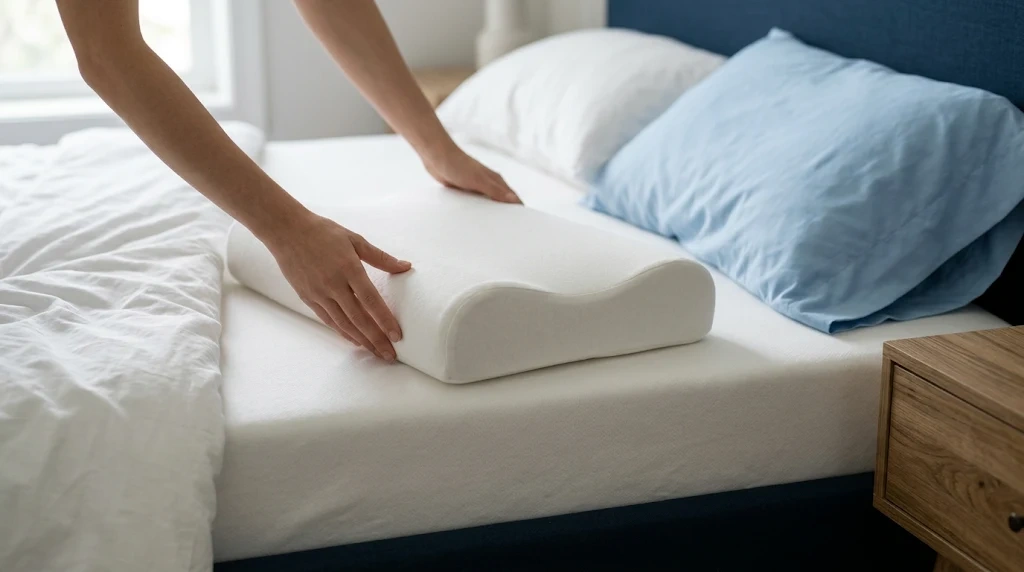
Place the pillow flat on the mattress, contour side up, with the raised edge closest to your shoulders. Use the lower edge if you start on your back, and the higher edge if you start on your side. Do not push it against the headboard, because most people settle a little lower once they lie down.
Do not stack a neck pillow on a normal pillow. The extra height bends the neck forward. A firmer mattress needs a thicker pillow; a soft mattress needs a thinner one.
- Place the contour side up, raised edge toward your shoulders.
- Choose the lower edge for back sleeping and the higher edge for side sleeping.
- Lie down slowly and let the back of your head settle into the central dip.
- Slide the pillow until the raised edge meets the curve under your neck, with no gap.
- Check that your chin is level, not tucked to your chest or tipped back.
- Move your shoulders just off the pillow, so it supports only head and neck.
If there is a gap between your neck and the pillow, the orientation is wrong or the height does not suit you. Turn the pillow round, try the other edge, or move it a little at a time until the curve fills in. A small move often makes a large difference.
How to Sleep on Your Back With a Neck Pillow
Back sleeping is the easiest position to get right. Lie on your back, centre your head in the dip, and let the raised edge support the curve of your neck. Your face should point straight up.
Keep your shoulders on the mattress, not on the pillow. When they climb onto the pillow, the neck bends forward and the head ends up too high. A small pillow under your knees can help by taking pressure off the lower back.
Check with a hand test. Slide a flat hand between your neck and the pillow. It should meet gentle resistance. If it passes through freely, there is a gap. Back sleepers who wake up with pressure under the chin are usually too high. The Cleveland Clinic notes that a proper pillow should keep your neck parallel to the mattress.
How to Sleep on Your Side With a Neck Pillow
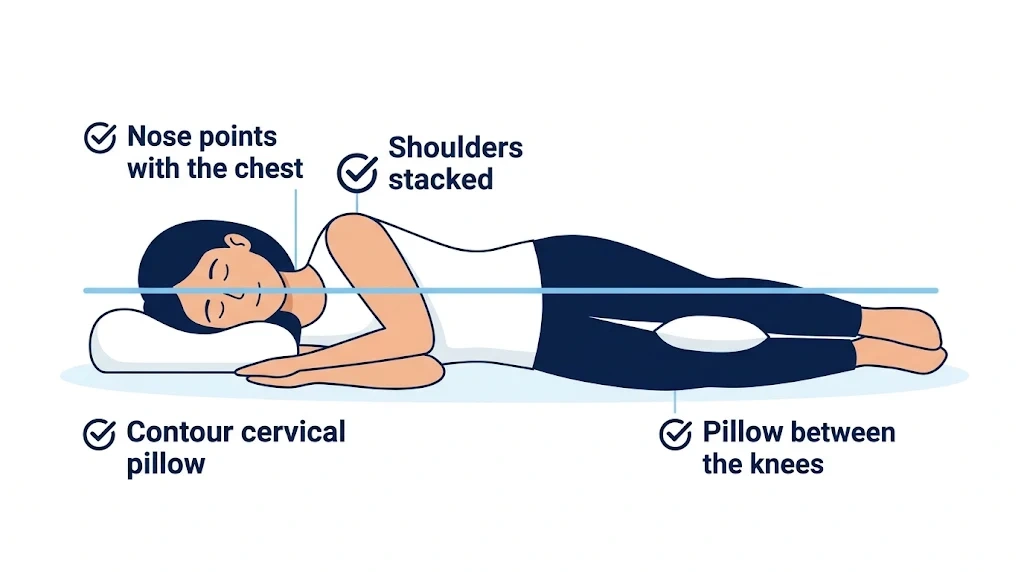
Side sleeping needs more height. Lie on your side and use the higher edge under your neck. The pillow must fill the space between your ear and the outside of your shoulder, so your head stays level.
Your nose should point in the same direction as the centre of your chest. If it points up, the pillow is too low. If it points down, the pillow is too high.
Keep both shoulders stacked. A pillow between your knees stops the top leg pulling the hips forward and twisting the spine, which often shows up as morning neck stiffness. Rest your bottom arm in front of your chest, or hug a second pillow. Broad-shouldered sleepers usually need a firmer, higher pillow. Our guide to the best sleeping position for neck pain explains how back and side positions change that gap.
What to Do If You Sleep on Your Stomach, or Turn Over at Night
Stomach sleeping is the hardest position for a neck pillow. Lying face down forces the neck to turn to one side for hours, and no contour can keep the spine neutral in that twist. If you wake up on your stomach, use a very thin pillow or no pillow under your head at all.
Most people change position several times a night. When you roll from your back to your side, slide the pillow so the higher edge is under your neck, and check that your head is level again. When you roll back, use the lower edge.
A U-shaped travel pillow is different. It is made to stop the head falling sideways in a chair, not to support the neck flat on a mattress. It can work for short naps propped up in bed, but for a full night lying flat, a contour pillow is usually better. Our guide on how to use and wear a neck pillow correctly covers the travel shape and where it fits.
Tip
If you change position a lot, choose a pillow you can turn without fully waking up. A symmetrical contour, or a pillow with a clear high side and low side you can feel in the dark, is easier to adjust at 3 a.m.
The First Few Nights, and Common Mistakes
A new neck pillow often feels strange for the first few nights. Mild soreness for three to five nights is common, and it usually settles within one to two weeks. Start gradually: use it for the first part of the night, then switch back to your old pillow if you wake up uncomfortable.
Keep a short morning note: where the pain is, and whether you slept on your back, side or stomach. After a week, the pattern is usually clear. Stop and change something if pain is sharp, new, or worse after two or three nights, or if you develop numbness or tingling. Our guide to how long to use a cervical neck pillow explains the usual adjustment period.
The most common mistake is putting the pillow the wrong way round. The raised edge belongs under the neck, and the dip belongs under the head. Reversing them pushes the chin up. The second mistake is letting the shoulders onto the pillow. The third is using a pillow that is too high because it feels soft at first.
Warning
Do not stack a neck pillow on a normal pillow, and do not use a travel U-shaped pillow flat in bed for a full night. Both raise the head too far and bend the neck forward.
How to Check in the Morning Whether It Worked

The morning check is more useful than how the pillow felt when you fell asleep. Did you stay asleep, did you wake up with less stiffness, and did the pillow stay in place? Less stiffness in the first half hour is a good sign.
Check where the pillow ended up. If it is still under your head and neck, the size and shape are probably close. If it has moved away, the height or firmness needs a change. Give a new pillow at least a week before you judge it, unless it causes sharp or new pain.
If you still wake up stiff after a week, try a different loft, and use the guide to why a neck pillow hurts your neck to work through the causes. The Sleep Foundation guide to pillows for neck pain also stresses matching loft to your sleep position. See also how to sleep with a neck pillow.
Related Product
Cervical Contour Neck Pillow for Bed
A contour pillow with a dip for the head and a raised edge for the neck makes it easier to hold the back and side positions in this guide.
As an Amazon Associate, we earn from qualifying purchases.
Frequently Asked Questions
Can you sleep with a neck pillow every night?
Yes, if it holds your head level and you wake up without new pain. Many people use one nightly for back and side sleeping. If you wake up stiff most mornings, the height or shape may not suit you, and it is worth trying a different loft.
Is it better to sleep with a neck pillow on your back or your side?
Both can work. Back sleeping is easier to set up because it needs less height. Side sleeping can work just as well if the pillow is high and firm enough to fill the gap between your ear and shoulder. Stomach sleeping is the least suitable position.
How long does it take to get used to a neck pillow?
Mild discomfort for three to five nights is common, and most people adapt within one to two weeks. Start with part of the night if the pillow feels very different, then increase the time gradually. Sharp pain or numbness is not normal adjustment.
Should your shoulders be on a neck pillow?
No. Your shoulders should stay on the mattress, just off the pillow, while the pillow supports only your head and neck. If your shoulders climb onto the pillow, your head rises too high and your neck bends forward.
Can a neck pillow make neck pain worse?
Yes, if it is the wrong height, the wrong way round, or worn out. A pillow that is too high bends the neck forward, a reversed contour pushes the chin up, and a flat pillow leaves a gap under the neck. Check orientation and height first, then try a different loft.
Can you use a travel U-shaped neck pillow in bed?
You can use one for a short nap propped up in bed, but it is not a good choice for a full night lying flat. The thick arms can lift the head too high or push it forward. A contour cervical pillow is usually better for sleeping through the night in bed.
Conclusion
Sleeping with a neck pillow in bed comes down to one check: is your head level with your spine, and does it stay that way when you turn over? Use the lower edge on your back, the higher edge on your side, keep your shoulders off the pillow, and give the new shape a week to settle. If mornings get easier and the pillow stays in place, you have the right height. If pain is sharp, new, or worse after a few nights, change the loft or the shape, and get medical advice if the symptoms continue.

I’m a home decor enthusiast who loves discovering beautiful room ideas, creative DIY projects, and Pinterest-worthy decorating inspiration. At DecorMinty, I share simple tips, fresh trends, and practical ideas to help you create a home you’ll truly love—one room at a time.