How to Make a Bed Pillow Fort: Step-by-Step Guide at Home
Quick Answer
To make a bed pillow fort, use the bed as the back wall, line the open sides with firm pillows and sofa cushions, drape a light sheet over chairs or the headboard for the roof, and weigh the edges down with books. Leave a gap for air and an entrance, then add soft bedding inside.
A bed pillow fort turns an ordinary bed into a small hideaway in about 15 minutes. The trick is not piling up more pillows. It is using firm pillows for walls, keeping the roof light, and leaving enough support so the fort does not slide down when someone leans on it.
What You Need to Build a Bed Pillow Fort
Gather everything before you start. For walls, firm pillows and sofa cushions work best. Bed pillows fold and slide when stacked high, while sofa cushions hold their shape. Use soft bed pillows for the floor and for leaning against inside.
For the roof, choose a light flat sheet rather than a heavy comforter. A sheet spans a gap without pulling the walls inward. You will need one large sheet for the roof and one extra sheet for a door flap.
- 6 to 10 pillows and cushions: firm cushions for walls, soft pillows for inside.
- 2 large flat sheets: one for the roof, one for a side wall or entrance.
- 1 light blanket or quilt: for the floor of the fort.
- 2 to 4 chairs or a headboard: to hold the roof up.
- Clips and weights: binder clips, clothespins, and a few heavy books.
- Optional extras: battery lights and books.
Pillow size shapes how the walls behave. A king pillow can cover more of a side wall at once, while a standard pillow is easier to stack in a small gap. See our guide to standard bed pillow sizes for the common lengths and widths.
How to Make a Bed Pillow Fort Step by Step

Build in this order: clear the space, make the floor, build the walls, add the roof, then furnish the inside.
- Clear the bed and floor beside it. Remove loose and breakable items. Leave space on one side for an entrance. If the bed is against a wall, use that wall as one side.
- Make a soft floor first. Lay a quilt or thick blanket on the bed where people will sit, and add a rug or sleeping bag if the fort extends onto the floor.
- Use the bed as the back wall. Push the bed against the wall or headboard if you can. Stack firm cushions along the edge facing the room, standing sofa cushions on their narrow sides.
- Build the side walls. Line the short ends of the bed with firm pillows, standing them upright and overlapping the corners slightly. Two pillows high is usually enough.
- Add chairs for roof support. Place a chair at each open corner, with the chair back facing outward. Use a tall headboard at the head end instead of a chair if you have one.
- Drape the roof sheet. Spread a large flat sheet over the chairs and headboard. Pull it taut enough to remove deep sags, but not so tight that it pulls the chairs inward.
- Secure the roof. Clip the sheet to the chair backs and place a heavy book on each corner where it rests on a chair seat. If a corner slips, fold it over once before clipping it.
- Make an entrance. Leave a gap in one side wall instead of sealing every side. Hang a second sheet over that gap as a curtain, clipped at the top and loose at the bottom.
- Furnish the inside. Add soft pillows, a light blanket, and a small light. Add books or a game after the structure has stayed up for a few minutes.
- Test it before settling in. Sit inside and lean gently against each wall. If a wall wobbles, add a firm cushion behind it. If the roof sags, tighten one side and add another clip.
Tip
Build the roof sheet slightly loose at first, then tighten it one corner at a time.
Three Easy Bed Pillow Fort Designs to Try
These three versions use the same materials in different arrangements.
| Design | Best for | What you need |
|---|---|---|
| Classic on-bed fort | Reading or sleeping on the bed | Bed, headboard, 2 chairs, 1 sheet |
| Tunnel fort | Small rooms and younger kids | Bed edge, 2 chairs, 1 sheet |
| Bunk-bed fort | A tall, room-like hideaway | Bunk bed, 2 sheets, clips |
The classic on-bed fort is the easiest place to start. It keeps everything on the mattress. Use the headboard as back support and drape the sheet to two chairs at the foot corners.
A tunnel fort works well when the room is small. Put two chairs a short distance from the side of the bed, facing the bed, and drape a sheet from the bed edge over the chair backs. The space between becomes a low tunnel to sit in.
A bunk-bed fort uses the top bunk as a ready-made roof frame. Tuck a sheet under the top mattress, let it hang down on the open sides, and clip the bottom edge to the lower bed frame. The lower bunk becomes the floor.
How to Make the Roof Stay Up Without Collapsing
A collapsing roof usually has one of three causes: the roof is too heavy, the span is too wide, or the supports are too far apart. Fix the cause instead of adding more pillows on top.
Use a flat sheet, not a comforter, for the roof. A heavy blanket pulls down in the middle and drags the side walls inward.
Shorten the span when the roof sags. Move the chairs closer together, or add a third chair in the middle of a long side. Anchor the sheet at four points, not just two, and fold the edge over a chair back before clipping it so the clip grips two layers.
How to Make It Cozy Inside
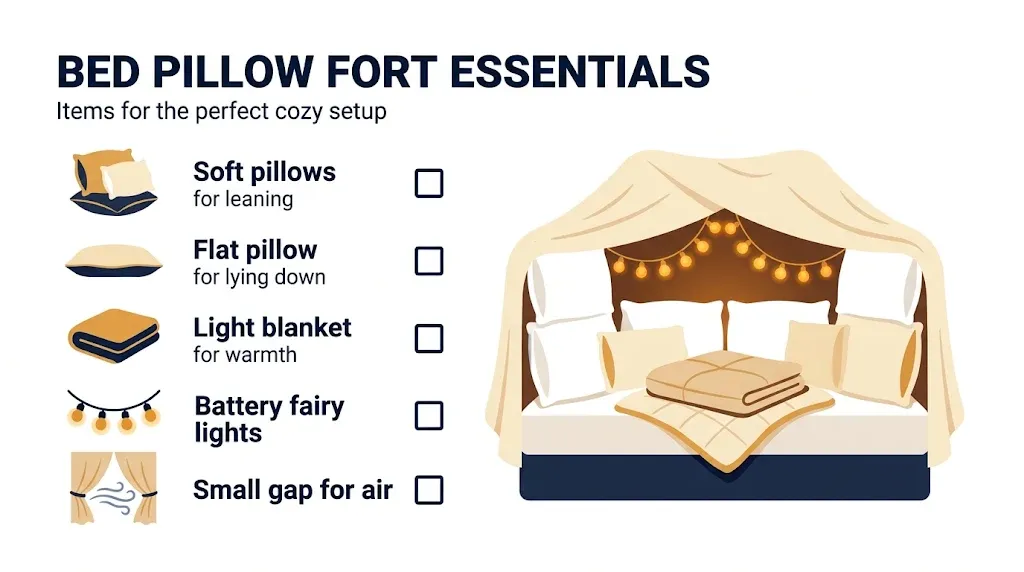
Comfort comes from layers, not from filling every corner. Place two or three soft pillows against the back wall for leaning, keep one flat pillow for lying down, and add a light blanket for warmth.
Light matters too. Battery fairy lights or a small flashlight pointed at a wall gives a soft glow without heat. Leave a small gap under the entrance curtain for air, because a fully sealed fort gets warm and stuffy quickly. See our guide to bed pillow sizes.
Common Mistakes That Make a Pillow Fort Fall Down
Most failed forts repeat the same few mistakes:
- Using only soft pillows for walls. Put firm cushions on the outside of the wall and soft pillows on the inside.
- Building walls too high. Walls more than two pillows high need a chair or furniture behind them.
- Using a heavy roof. A thick comforter pulls the walls inward. Use a light sheet instead.
- Skipping clips and weights. Clip every corner and weigh down the edges that rest on a chair.
- Sealing every side. Leave a clear gap for an entrance and cover it with a loose curtain.
- Building on a slippery surface. Chairs on a smooth floor slide outward. Place chair legs on a rug or against the bed frame.
If the fort falls once, look at what moved first. A wall that slid outward needs a heavier base. A roof that sank needs a shorter span or a lighter sheet.
How to Keep a Pillow Fort Safe
Keep the entrance clear so anyone inside can get out quickly. Do not stack heavy objects above head height, and do not let anyone climb on the roof or chair backs.
Never use candles, matches, or any open flame inside a fort. Bedding and sheets catch fire easily. The U.S. Consumer Product Safety Commission advises keeping candles, lighters, and matches away from mattresses and bedding. Use battery lights only.
Watch for heat and stuffiness when children are inside. Leave a ventilation gap and take the fort down if anyone feels hot or short of breath. For very young children, build a low fort they can crawl out of easily and keep an adult nearby.
Warning
Never use candles or other open flames inside a pillow fort. Use battery-operated lights only, keep the entrance clear, and take the fort down if it feels hot or stuffy inside.
What to Do Inside a Bed Pillow Fort

A fort works best when it has a purpose. For reading, place a leaning pillow at the back and books within reach. For a movie, put a tablet on a tray at the foot of the bed. For a sleepover, spread the floor bedding flat, add one pillow per person, and leave the entrance curtain half open for air.
For play, keep the floor clear enough for a board game or cards. A small tray makes a flat surface for pieces. When you are done, take the fort down in reverse: inside items first, then the roof, then the walls. Afterward, the pillows and sheets may need a wash. See our guide on how to wash a bed pillow and our guide on how to clean a bed pillow for spot cleaning and smells.
Related Product
Battery-Operated Fairy Lights
Battery fairy lights add a soft glow inside a pillow fort without heat or an open flame, which makes them a safer choice than candles.
As an Amazon Associate, we earn from qualifying purchases.
Frequently Asked Questions
How many pillows do you need to make a pillow fort?
You need about 6 to 10 pillows and cushions for a small bed fort. Use 4 to 6 firm cushions for the walls and 2 to 4 soft pillows for leaning and lying on inside.
How do you make a pillow fort on a bed without chairs?
Use the headboard and the wall as supports, and stand firm cushions along the bed edges for walls. Drape a light sheet from the headboard to the foot of the bed, clip it to the headboard, and weigh the foot end down with books.
How do you keep a pillow fort from falling down?
Use firm cushions for the outer walls, keep walls no more than two pillows high, and use a light sheet for the roof. Clip the sheet at four points, weigh down the corners, and shorten the roof span if the middle sags.
What is the best blanket or sheet for a pillow fort roof?
A large, light flat sheet is best for the roof. It will not pull the walls inward, it is easy to clip, and it lets a little light through. Avoid heavy comforters.
Can adults make a pillow fort on a bed?
Yes. Adults can use the same method, with a wider base and sturdier supports. Use a queen or king bed when possible, place chairs closer together for a shorter roof span, and leave more headroom inside so you can sit up comfortably.
How long can you leave a pillow fort up?
You can leave a bed pillow fort up for a day or a sleepover, but take it down after use. Sheets slip, walls settle, and bedding needs air. Taking it down lets you wash the pillows and sheets.
Conclusion
A good bed pillow fort does not need many supplies. Start with the bed as your base, build low walls from firm cushions, use a light sheet for the roof, and secure it at four points. Leave a clear entrance and a gap for air, add soft pillows and a battery light inside, and test it before you settle in.

I’m a home decor enthusiast who loves discovering beautiful room ideas, creative DIY projects, and Pinterest-worthy decorating inspiration. At DecorMinty, I share simple tips, fresh trends, and practical ideas to help you create a home you’ll truly love—one room at a time.